

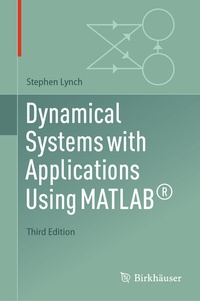
Dynamical Systems with Applications Using MATLAB®
Description

This textbook, now in its third edition, provides a broad and accessible introduction to both continuous and discrete dynamical systems, the theory of which is motivated by examples from a wide range of disciplines. It emphasizes applications and simulation utilizing MATLAB®, Simulink®, the Image Processing Toolbox®, the Symbolic Math Toolbox®, and the Deep Learning Toolbox®.
The text begins with a tutorial introduction to MATLAB that assumes no prior programming knowledge. Discrete systems are covered in the first part, after which the second part explores the study of continuous systems using delay, ordinary, and partial differential equations. The third part considers chaos control and synchronization, binary oscillator computing, Simulink, and the Deep Learning Toolbox. A final chapter provides examination- and coursework-type MATLAB questions for use by instructors and students.
For the Third Edition , all the material has been thoroughly updated in line with the most recent version of MATLAB, R2025a. New chapters have been added on artificial neural networks, delay differential equations, numerical methods for ordinary and partial differential equations, and the Deep Learning Toolbox. MATLAB program files, Simulink model files, and other materials are available to download from the author's website and through GitHub.
The hands-on approach of Dynamical Systems with Applications using MATLAB® has minimal prerequisites, only requiring familiarity with ordinary differential equations. It will appeal to advanced undergraduate and graduate students, applied mathematicians, engineers, and researchers in a broad range of disciplines such as population dynamics, biology, chemistry, computing, economics, nonlinear optics, neural networks, and physics.
Praise for the Second Edition :
"This book [is] a valuable reference to the existing literature on dynamical systems, especially for the remarkable collection of examples and applications selected from very different areas, as well as for its treatment with MATLAB of these problems." -- Fernando Casas, zbMATH
"[The] vast compilation of applications makes this text a great resource for applied mathematicians, engineers, physicists, and researchers. Instructors will be pleased to find an aims and objectives section at the beginning of each chapter where the author outlines its content and provides student learning objectives." -- Stanley R. Huddy, MAA Reviews
More details
Other editions
Additional editions
Person
Stephen Lynch is a Professor of Digital Skills at Loughborough University, a Fellow of the Institute of Mathematics and Its Applications (FIMA), and a Senior Fellow of the Higher Education Academy (SFHEA). According to the scholarly analytics platform Scholar GPS, he is ranked #18 in the world for Dynamical Systems. In 2022, he was awarded a National Teaching Fellowship (NTF), the highest teaching honour in the UK. He is the co-inventor of binary oscillator computing and the author of ten books.
Content
A Tutorial Introduction to MATLAB.- Linear Discrete Dynamical Systems.- Nonlinear Discrete Dynamical Systems.- Complex Iterative Maps.- Electromagnetic Waves and Optical Resonators.- Fractals and Multifractals.- Neural Networks and Neurodynamics.- Image and Signal Processing.- Differential Equations.- Numerical Methods for Ordinary and Partial Differential Equations.
