

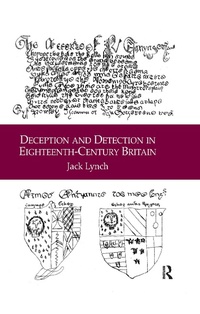
Deception and Detection in Eighteenth-Century Britain
Published on 5. December 2016
232 pages
978-1-351-94604-9 (ISBN)
Description

In the first extended treatment of the debates surrounding public deception in eighteenth-century Britain, Jack Lynch contends that forgery, fakery, and fraud make explicit the usually unspoken grounds on which Britons made sense of their world. Confrontations with inauthenticity, in other words, bring tacitly understood conceptions of reality to the surface. Drawing on a wide range of contemporary print and manuscript sources"not only books and pamphlets, but ballads, comic prints, legal proceedings, letters, and diaries"Lynch focuses on the debates they provoked, rather than the forgers themselves. He offers a comprehensive treatment of the criticism surrounding fraud in most of the noteworthy controversies of the long eighteenth century. To this end, his study is structured around topics related to the arguments over deception in Britain, whether they concerned George Psalmanazar's Formosan hoax at the beginning of the eighteenth century or William Henry Ireland's Shakespearean imposture at the end. Beginning with the question of what constitutes deception and ending with an illuminating chapter on what was at stake in these debates for eighteenth-century British thinkers, Lynch's accessibly written study takes the reader through the means"whether simple, sophisticated, or tortuously argued"by which partisans on both sides struggled to define which of the apparent contradictions were sufficient to disqualify a claim to authenticity. Fakery, Lynch persuasively argues, transports us to the heart of eighteenth-century notions of the value of evidence, of the mechanisms of perception and memory, of the relationship between art and life, of historicism, and of human motivation.
Reviews / Votes
'Jack Lynch's new book is a masterful and remorseless unraveling of the tangled web of "fakery studies". As much a review of current trends, and runaway fixations, in literary scholarship, this is a landmark contribution to eighteenth-century literary and cultural history: the intelligent scepticism of Lynch's study has important implications for all those interested in the status of literary truth, authoriality, the nature of oral transmission, and the validity of evidence.' Philip Smallwood, Birmingham City University, UK 'With admirable clarity, Lynch examines implications and aspects of fraud and credulity"from Ossian to Chatterton, Mary Toft to William Henry Ireland. He does so not so as to determine whether or not fraud occurred, but rather to historicize the questions, illuminating contemporaries' understanding of literary truth, evidence, and genre.' Allen Reddick, University of Zurich, Switzerland 'Lynch displays exceptional patience in teasing out the implications of his analysis on his textual material, and, as in the most thought-provoking works in fake studies, he takes his time over reassessing the social and cultural assumptions of a period, and indeed in repositioning the language of authenticity.' Times Literary Supplement '...a worthwhile treatment of its subject...Recommended.' Choice 'Lynch's book is of major importance because of the very specific and original angle he opts for. He rightly claims that 'this book is different', as he addresses, not the fakers themselves, but the critics who argued over the fakes... This approach results in a fascinating and convincingy argued account of some major changes in our ways of thinking about authorial authenticity, the nature of evidence, and the connection between reputation and literary values. Well-written and entirely jargon-free...' Sharp News 'Deception and Detection is engaging, consistently convincing, and ought to enliven conversations about the development of historiMore details
Language
English
Place of publication
London
United Kingdom
Publishing group
Taylor & Francis Ltd
Target group
College/higher education
File size
3,64 MB
ISBN-13
978-1-351-94604-9 (9781351946049)
Copyright in bibliographic data and cover images is held by Nielsen Book Services Limited or by the publishers or by their respective licensors: all rights reserved.
Schweitzer Classification
Other editions
Additional editions
Book
11/2016
1st Edition
Routledge
€85.50
Shipment within 10-20 days
Book
03/2008
1st Edition
Routledge
€231.60
Shipment within 10-20 days
Person
Jack Lynch is Associate Professor of English at Rutgers-Newark, The State University New Jersey, USA.
Content
Contents: Preface; Introduction; Recognizing a fake when you see one; Conviction on the first view; The utmost evidence; Truth is uniform; All manner of experience and observation; The mention of posterior facts; False recollections; Motivated malignity; Different kinds of value; Bibliography; Index.
