

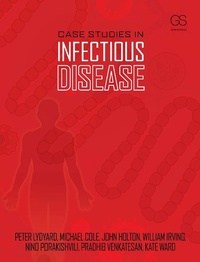
Case Studies in Infectious Disease
Published on 25. April 2021
609 pages
978-1-135-15314-4 (ISBN)
Description

Case Studies in Infectious Disease presents forty case studies featuring the most important human infectious diseases worldwide. Written for students of microbiology and medicine this book describes the natural history of infection from point of entry of the pathogen through pathogenesis, followed by clinical presentation, diagnosis and treatment.
Five core sets of questions are posed in each case. What is the nature of the infectious agent, how does it gain access to the body, what cells are infected, and how does the organism spread? What are the host defense mechanisms against the agent and how is the disease caused? What are the typical manifestations of the infection and the complications that can occur? How is the infection diagnosed and what is the differential diagnosis? How is the infection managed, and what preventative measures can be taken to avoid infection?
This standardized approach provides the reader with a logical basis for understanding these diverse and medically important organisms, fully integrating microbiology and immunology throughout.
Five core sets of questions are posed in each case. What is the nature of the infectious agent, how does it gain access to the body, what cells are infected, and how does the organism spread? What are the host defense mechanisms against the agent and how is the disease caused? What are the typical manifestations of the infection and the complications that can occur? How is the infection diagnosed and what is the differential diagnosis? How is the infection managed, and what preventative measures can be taken to avoid infection?
This standardized approach provides the reader with a logical basis for understanding these diverse and medically important organisms, fully integrating microbiology and immunology throughout.
Reviews / Votes
"Scientifically, the chapter is accurate...the figures have been well chosen and they will help the reader to grasp the main points more readily. It was a pleasure reviewing this material..."Dr Juerg Utzinger, Swiss Tropical Institute, Switzerland
(referring to Case 32. Schistosoma)
"I like the use of questions to deliver teaching to students. They can easily identify with what is being discussed and how it fits in with the overall chapter. It can also quickly direct learning to the appropriate part of the text and aid revision."
Dr Gordon Ramage, Glasgow Caledonian University, UK
(referring to Case 1. Aspergillus fumigatus)
"...this is an extremely well-written book that would be a useful primer for microbiology - and medical students in understanding the natural history, diagnosis and treatment of many of the world's most important human infectious diseases. It may also be of benefit to the research scientist, clinical laboratory scientist and practising infectious disease physicians."
Andrew Taylor-Robinson, Faculty of Biological Sciences, University of Leeds, British Society of Immunology Newsletter
More details
Language
English
Place of publication
London
United Kingdom
Publishing group
Taylor & Francis Ltd
Target group
College/higher education
File size
18,14 MB
ISBN-13
978-1-135-15314-4 (9781135153144)
Copyright in bibliographic data and cover images is held by Nielsen Book Services Limited or by the publishers or by their respective licensors: all rights reserved.
Schweitzer Classification
Other editions
Additional editions
Peter Lydyard | Michael Cole | John Holton
Case Studies in Infectious Disease
Book
03/2009
1st Edition
CRC Press
€73.22
Article exhausted; check for reprint
Persons
Peter M. Lydyard, Michael F. Cole, John Holton, William L. Irving, Nino Porakishvili, Pradhib Venkatesan and Katherine N. Ward
Content
Case 1. Aspergillus fumigatus
Case 2. Borellia burgdorferi
Case 3. Campylobacter jejuni
Case 4. Chlamydia trachomatis
Case 5. Clostridium difficile
Case 6. Coxiella burnetti
Case 7. Coxsackie B virus
Case 8. Echinococcus spp.
Case 9. Epstein-Barr virus
Case 10. Escherichia coli
Case 11. Giardia lamblia
Case 12. Helicobacter pylori
Case 13. Hepatitis B virus
Case 14. Herpes simplex type 1 (HSV 1)
Case 15. Herpes simplex type 2 (HSV 2)
Case 16. Histoplasma capsulatum
Case 17. Human immunodeficiency virus (HIV)
Case 18. Influenza virus
Case 19. Leishmania
Case 20. Leptospira
Case 21. Listeria monocytogenes
Case 22. Mycobacterium leprae
Case 23. Mycobacterium tuburculosis
Case 24. Neisseria gonorrhoea
Case 25. Neisseria meningitides
Case 26. Norovirus
Case 27. Parvovirus
Case 28. Plasmodium
Case 29. Respiratory syncytial virus (RSV)
Case 30. Rickettsia spp.
Case 31. Salmonella typhi
Case 32. Schistosoma
Case 33. Staphlococcus aureus
Case 34. Streptococcus mitis
Case 35. Streptococcus pneumoniae
Case 36. Streptococcus pyogenes
Case 37. Toxoplasma
Case 38. Trypanosoma
Case 39. Varicella Zoster virus
Case 40. Wuchereria
Case 2. Borellia burgdorferi
Case 3. Campylobacter jejuni
Case 4. Chlamydia trachomatis
Case 5. Clostridium difficile
Case 6. Coxiella burnetti
Case 7. Coxsackie B virus
Case 8. Echinococcus spp.
Case 9. Epstein-Barr virus
Case 10. Escherichia coli
Case 11. Giardia lamblia
Case 12. Helicobacter pylori
Case 13. Hepatitis B virus
Case 14. Herpes simplex type 1 (HSV 1)
Case 15. Herpes simplex type 2 (HSV 2)
Case 16. Histoplasma capsulatum
Case 17. Human immunodeficiency virus (HIV)
Case 18. Influenza virus
Case 19. Leishmania
Case 20. Leptospira
Case 21. Listeria monocytogenes
Case 22. Mycobacterium leprae
Case 23. Mycobacterium tuburculosis
Case 24. Neisseria gonorrhoea
Case 25. Neisseria meningitides
Case 26. Norovirus
Case 27. Parvovirus
Case 28. Plasmodium
Case 29. Respiratory syncytial virus (RSV)
Case 30. Rickettsia spp.
Case 31. Salmonella typhi
Case 32. Schistosoma
Case 33. Staphlococcus aureus
Case 34. Streptococcus mitis
Case 35. Streptococcus pneumoniae
Case 36. Streptococcus pyogenes
Case 37. Toxoplasma
Case 38. Trypanosoma
Case 39. Varicella Zoster virus
Case 40. Wuchereria
