

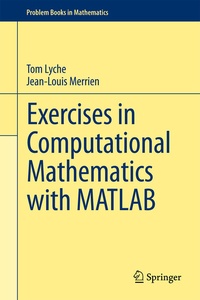
Exercises in Computational Mathematics with MATLAB
Description

Designed to provide tools for independent study, this book contains student-tested mathematical exercises joined with MATLAB programming exercises.
Most chapters open with a review followed by theoretical and programming exercises, with detailed solutions provided for all problems including programs. Many of the MATLAB exercises are presented as Russian dolls: each question improves and completes the previous program and results are provided to validate the intermediate programs.
The book offers useful MATLAB commands, advice on tables, vectors, matrices and basic commands for plotting. It contains material on eigenvalues and eigenvectors and important norms of vectors and matrices including perturbation theory; iterative methods for solving nonlinear and linear equations; polynomial and piecewise polynomial interpolation; Bézier curves; approximations of functions and integrals and more. The last two chapters considers ordinary differential equations including two point boundary value problems, and deal with finite difference methods for some partial differential equations.
The format is designed to assist students working alone, with concise Review paragraphs, Math Hint footnotes on the mathematical aspects of a problem and MATLAB Hint footnotes with tips on programming.
Reviews / Votes
From the book reviews:
"This is a very interesting and useful book for any advanced undergraduate and beginning graduate student on mathematics, statistics, computational physics, chemistry, and engineering, with a focus on numerical analysis and computational science. The main scope of this book is to provide students with the opportunity to apply numerical analysis and the well-known MATLAB to solve problems in their own specialties." (T. E. Simos, Computing Reviews, January, 2015)
"This is an interesting new kind of book in the area of numerical analysis. . It is widely accepted that solving exercises is essential to achieve a deeper understanding of a mathematical topic. Under this point of view the present book can be seen as an adequate vehicle to really get into the field of numerical analysis. . the book can also serve as a rich source of exercises for university courses." (Rolf Dieter Grigorieff, zbMATH, Vol. 1304, 2015)More details
Other editions
Additional editions
Persons
Both authors have a long experience, at university and engineering school, in teaching numerical methods and numerical analysis. The authors started research collaboration a few years ago. They realized that they had complementary approaches to mathematical research and teaching. They think that combining these approaches gives an interesting perspective for an original book.
Tom Lyche has received the Dagstuhl foundation's John Gregory Memorial Award for "Outstanding contributions to geometric modeling" and is a member of Norwegian Academy of Science and Letters. He has published more than 85 papers in leading international journals and refereed proceedings, edited 14 books and is on the editorial board of 4 international journals.
Jean-Louis Merrien is active as a researcher on subdivision and has published the book "Analyse Numerique avec Matlab", Dunod, Paris 2007.
Content
1 An Introduction to MATLAB commands.- 2 Matrices and Linear Systems.- 3 Matrices, Eigenvalues and Eigenvectors.- 4 Matrices, Norms and Conditioning.- 5 Iterative Methods.- 6 Polynomial Interpolation.- 7 Bézier Curves and Bernstein Polynomials.- 8 Piecewise Polynomials, Interpolation and Applications.- 9 Approximation of Integrals.- 10 Linear Least Squares Methods.- 11 Continuous and Discrete Approximations.- 12 Ordinary Differential Equations, One Step Methods.- 13 Finite Differences for differential and partial differential equations.- References.- Index of Names.- Subject Index.- MATLAB Index.
