

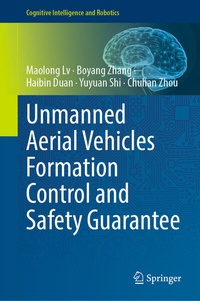
Unmanned Aerial Vehicles Formation Control and Safety Guarantee
Description

This book focuses on the practical challenges in the process of UAV cooperative control from three aspects: the first to satisfy the task requirement of convergence time for multi-UAV system, the second to fit the actual capability of transmission, computation and communication for multi-UAV system, the third to ensure safety in the presence of strong disturbances and DoS attack for multi-UAV system. In addition, this book presents the cooperative control design from inner-loop velocity and attitude tracking to outer-loop position motions of multiple UAVs. It offers readers with deep understanding and insights on reliability, adaptability and safety of multi-UAV system and the corresponding control designs.
The advanced cooperative control methods presented in this book can provide guidelines for engineers to improve the reliability, adaptability and safety of aerospace engineering systems and some other related fields. This book is suitable for scientists and researchers, aerospace engineers, control engineers, lecturers and teachers, postgraduates, undergraduates in the system and control community, especially those engaged in the field of UAV cooperation and multi-agent systems.
More details
Other editions
Additional editions
Persons
Assoc. Prof. Maolong Lv received the Ph.D. degree in control science and engineering from the Delft Center for Systems and Control, Delft University of Technology, Delft, The Netherlands, in 2021. He is currently with Air Force Engineering University, Xi'an, China. His research interests include adaptive learning control, distributed control, reinforcement learning, and intelligent decision making with applications in multiagent systems, hypersonic vehicles, and unmanned autonomous systems. He received Descartes Excellence Fellowship from the French Government in 2018, which allowed him a research visit from 2018 to 2019 at the University of Grenoble working on adaptive networked systems with emphasis on traffic with human-driven and autonomous vehicles. He was awarded the Young Talent Support Project for Military Science and Technology, the Young Talent Fund of the Association for Science and Technology in Shaanxi, and the Postdoctoral International Exchange Program in 2022.
Content
Preface.- Part 1 Fundamentals and Theoretical Foundations.- Chapter 1 Introduction to Cooperative UAV Control.- Chapter 2 UAV Dynamics Fundamentals.- Part 2 Advanced Control Systems for UAVs.- Chapter 3 Fixed-Time Fault-Tolerant Control.- Chapter 4 Fixed-Time Control Against Saturation.- Chapter 5 Specified-Time Fault-Tolerant Tracking Control.- Part 3 Event-triggered and Communication-Efficient Control.- Chapter 6 Event-Triggered Fault-Tolerant Control.- Chapter 7 Event-Triggered Control with Dynamic Communication.- Chapter 8 Control with Asynchronously Switching Topologies.- Part 4 Safety and Security in UAV Operations.- Chapter 9 Optimal Formation Tracking Control.- Chapter 10 Secure Control under Asynchronous DoS.- Part 5 Conclusions.- Chapter 11 Conclusions and Challenges.
