

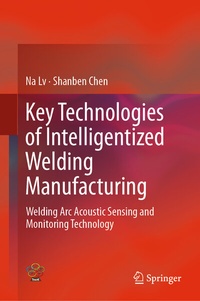
Key Technologies of Intelligentized Welding Manufacturing
Description

More details
Other editions
Additional editions
Persons
Dr. Na Lv
received her Ph.D. degree in Materials Processing Engineering from School of Materials Science and Engineering, Shanghai Jiao Tong University, in 2014. She currently worked as an assistant research fellow in School of Electronic information and electrical engineering, Shanghai Jiao Tong University. Her research interests focus on Intelligent welding, multi-information processing, welding process modeling, machine learning, intelligent tea picking robot, and image recognition. She has published several papers in international conferences and reputed journals in her research area.
Dr. Shanben Chen received his BS degree in industrial automation from Dalian Railway Institute (Dalian Jiao Tong University) in 1982, and received his MS and PhD in control theory and application from Harbin Institute of Technology, China, in 1987 and 1991, respectively. He worked as a postdoctoral fellow at the National Key Laboratory of Advanced Welding Production of China in Harbin Institute of Technology (HIT) from 1993 to 1995, and as a professor from 1995 to 2000.
From 2000 to present, he has served as the Special Professor, Cheung Kong Scholar Program of the Ministry of Education of China & Li Ka Shing Foundation, Hong Kong, and engaged at Shanghai Jiao Tong University, China, where he is also director of the Intelligentized Robotic Welding Technology Laboratory. Prof. Chen has also been a visiting professor at the University of Western Sydney (UWS) in connection with the ARC Linkage collaboration since 2009.
Currently, Prof. Chen is a senior member of the IEEE; a member of the American Welding Society; Chair of the Robotics & Automation Committee of the Chinese Welding Society (CWS); Deputy Secretary-General of the Chinese Welding Society; and a standing member of the Board of Directors, CWS.Content
Multi-source information of arc welding dynamic process.- Acoustic mechanism and arc sound source modeling for GTAW welding.- Feature extraction and analysis of arc sound signal with dynamic welding process.- Channel generation mechanism and modeling for arc sound signal during GTAW.- Prediction model establishment based on arc sound feature array.- Relationship modeling between weld pool collapse and welding penetration based on analyzing arc sound features.- Real-time control of welding penetration via arc sound signal for GTAW welding.- Microphone array technology in welding dynamic process monitoring.- Multi-source Information Fusion between Welding Arc Sound and other Welding dynamic processes.- Summary and Conclusions.
