

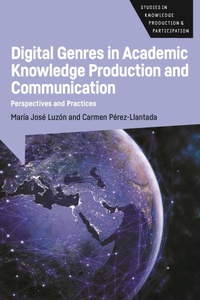
Digital Genres in Academic Knowledge Production and Communication
Perspectives and Practices
Published on 7. March 2022
208 pages
978-1-78892-473-3 (ISBN)
Description

This book presents an overview of the wide variety of digital genres used by researchers to produce and communicate knowledge, perform new identities and evaluate research outputs. It explores the role of digital genres in the repertoires of genres used by local communities of researchers to communicate both locally and globally, both with experts and the interested public, and sheds light on the purposes for which researchers engage in digital communication and on the semiotic resources they deploy to achieve these purposes. The authors discuss the affordances of digital genres but also the challenges that they pose to researchers who engage in digital communication. The book explores what researchers can do with these genres, what meanings they can make, who they interact with, what identities they can construct and what new relations they establish, and, finally, what language(s) they deploy in carrying out all these practices.
Reviews / Votes
Bringing together multiple genre traditions, this timely book offers critical insights into how online platforms influence how science is communicated to a range of audiences, affords multimodal expressions, and can be more engaging through multilingual genre-ing activities. Expansive, generative, and smart, this is an important contribution to genre studies. Science communicators, too, will benefit from the detailed and thoughtful analyses in this essential book. * Ashley Rose Mehlenbacher, University of Waterloo, Canada * Finally a definitive guide to academic genres online! Covering an impressive range of digital practices, this insightful and inspiring book masterfully demonstrates the connection between the affordances of digital media and the exigences of scientific communication. * Christoph A. Hafner, City University of Hong Kong, Hong Kong * This highly readable and constantly stimulating book makes a landmark contribution to our understanding of the profound changes taking place in scholarly communication practices in the digital era. The excellent balance between critical syntheses of current research and original case-studies of specific digital genres makes it essential reading for all scholars and students of digital genres and academic communication. * Elizabeth Rowley-Jolivet, University of Orleans, France * One of Luzon and PerezLlantada's most valuable contributions to the conversation on digital research genres is their systematic integration of the global, multilingual perspective in every dimension of their ambitious analysis [...] I suspect their work will inspire researchers of academic writing and scholarly genres for years to come. Likewise, teachers and practitioners of academic writing will find Luzon and Perez-Llantada's work useful for attending to a wider range of scholarly genres and communication practices and for better understanding our research ecosystem as a whole. * Gwendolynne Reid, Oxford College of Emory University, USA, ESP Today, Vol. 11(2) (2023) *More details
Series
Language
English
Place of publication
Bristol
United Kingdom
Target group
College/higher education
Product notice
Reflowable
Dimensions
Height: 234 mm
Width: 156 mm
ISBN-13
978-1-78892-473-3 (9781788924733)
Copyright in bibliographic data and cover images is held by Nielsen Book Services Limited or by the publishers or by their respective licensors: all rights reserved.
Schweitzer Classification
Other editions
Additional editions
Maria Jose Luzon | Carmen Perez-Llantada
Digital Genres in Academic Knowledge Production and Communication
Perspectives and Practices
Book
03/2022
Multilingual Matters
€158.20
Shipment within 3-4 weeks
Persons
Maria Jose Luzon is Senior Lecturer at the University of Zaragoza, Spain. Her research interests include genre analysis, digital genres, academic discourse, and English for Academic Purposes.
Carmen Perez-Llantada is Professor of English Linguistics at the University of Zaragoza, Spain. Her research interests include genre analysis, English for Academic Purposes, academic writing, and rhetoric and composition.
Carmen Perez-Llantada is Professor of English Linguistics at the University of Zaragoza, Spain. Her research interests include genre analysis, English for Academic Purposes, academic writing, and rhetoric and composition.
Content
List of Figures
List of Tables
Acknowledgments
Chapter 1. Introduction: Why Focus on Digital Genres?
Chapter 2. Genre as a Framework for the Analysis of Digital Communication
Chapter 3. Knowledge Communication in the Digital Era
Chapter 4. Performing Multiple Identities and Enhancing Academic Visibility
Chapter 5. Sharing Research in Progress with Peers: Online Laboratory Notebooks
Chapter 6. Interacting in Academic Social Networking Sites
Chapter 7. Disseminating Knowledge to Diversified Audiences
Chapter 8. Engaging The Public in Research
Chapter 9. 'Showing' Research through Audiovisual Genres
Chapter 10. Assessing Research and Participating in Research Discussions Online
Chapter 11. Final Considerations and Future Directions
References
List of Tables
Acknowledgments
Chapter 1. Introduction: Why Focus on Digital Genres?
Chapter 2. Genre as a Framework for the Analysis of Digital Communication
Chapter 3. Knowledge Communication in the Digital Era
Chapter 4. Performing Multiple Identities and Enhancing Academic Visibility
Chapter 5. Sharing Research in Progress with Peers: Online Laboratory Notebooks
Chapter 6. Interacting in Academic Social Networking Sites
Chapter 7. Disseminating Knowledge to Diversified Audiences
Chapter 8. Engaging The Public in Research
Chapter 9. 'Showing' Research through Audiovisual Genres
Chapter 10. Assessing Research and Participating in Research Discussions Online
Chapter 11. Final Considerations and Future Directions
References
