

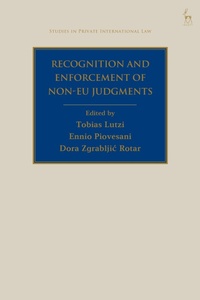
Recognition and Enforcement of Non-EU Judgments
1st Edition
Published on 19. February 2026
448 pages
978-1-5099-7939-4 (ISBN)
Description

This book examines the EU Member States' national rules on recognition and enforcement of Non-EU judgments.
Through its country report methodology, it explores the rules of 21 Member States in a structured manner. The emerging points of convergence - and divergence - form the basis of a detailed comparative report, which provides a unique overview of the current legal framework of recognition and enforcement of non-EU judgments across the European Union. This allows for (at least) three intriguing points of comparison: between the laws of the individual Member States; between the laws of the Member States and the legal framework applicable to EU judgments under the Brussels Ia Regulation; and between the laws of the Member States and the 2019 HCCH Judgments Convention.
This ambitious and unique work will be an indispensable reference for scholars, policymakers, and practitioners in the field of international commercial law.
Through its country report methodology, it explores the rules of 21 Member States in a structured manner. The emerging points of convergence - and divergence - form the basis of a detailed comparative report, which provides a unique overview of the current legal framework of recognition and enforcement of non-EU judgments across the European Union. This allows for (at least) three intriguing points of comparison: between the laws of the individual Member States; between the laws of the Member States and the legal framework applicable to EU judgments under the Brussels Ia Regulation; and between the laws of the Member States and the 2019 HCCH Judgments Convention.
This ambitious and unique work will be an indispensable reference for scholars, policymakers, and practitioners in the field of international commercial law.
More details
Series
Edition
1. Auflage
Language
English
Place of publication
London
United Kingdom
Publishing group
Bloomsbury Publishing PLC
Target group
Professional and scholarly
ISBN-13
978-1-5099-7939-4 (9781509979394)
Copyright in bibliographic data and cover images is held by Nielsen Book Services Limited or by the publishers or by their respective licensors: all rights reserved.
Schweitzer Classification
Other editions
Additional editions
Tobias Lutzi | Ennio Piovesani | Dora Zgrabljic Rotar
Recognition and Enforcement of Non-EU Judgments
Book
approx. 02/2026
Hart Publishing
€163.30
Not yet published
Persons
Tobias Lutzi is Junior Professor for Private Law at the University of Augsburg, Germany.
Ennio Piovesani is a lawyer specialising in International Law registered with the Pistoia Bar Association, Italy.
Dora Zgrabljic Rotar is Associate Professor at the Chair of Private International Law at the University of Zagreb, Croatia.
Ennio Piovesani is a lawyer specialising in International Law registered with the Pistoia Bar Association, Italy.
Dora Zgrabljic Rotar is Associate Professor at the Chair of Private International Law at the University of Zagreb, Croatia.
Content
Foreword by Ronald A Brand
Series Editor's Preface
Preface
List of Contributors
1. Questionnaire
2. Comparative Report: Recognition and Enforcement of Non-EU Judgments in EU Member States, Tobias Lutzi (University of Augsburg, Germany), Ennio Piovesani (Pistoia Bar Association, Italy) and Dora Zgrabljic Rotar (University of Zagreb, Croatia)
3. National Reports
Austria, Paul Lorenz Eichmüller (University of Vienna, Austria)
Belgium, Cedric Vanleenhove (University of Liège, Belgium)
Bulgaria, Ilia Lassin and Dafina Sarbinova (Sofia University, Bulgaria)
Croatia, Tena HoSko and Dora Zgrabljic Rotar (University of Zagreb, Croatia)
Cyprus, Nicolas Kyriakides and Konstantinos Rokas (University of Nicosia, Cyprus)
Czech Republic, Patrik Provazník and Radovan Malachta (Masaryk University, Czechia)
Finland, Onerva-Aulikki Suhonen (University of Eastern Finland Law School)
France, Claudia Cavicchioli (Linklaters)
Germany, Karin Arnold (University of Tübingen, Germany) and Leon Theimer (Humboldt University of Berlin, Germany)
Greece, Eva Litina (Hellenic Consumers' Ombudsman, Greece)
Hungary, Ferenc Szilágyi (Pázmány Péter Catholic University, Hungary)
Ireland, Yagmur Hortoglu Grant (Maynooth University, Ireland)
Italy, Marco Pasqua (Università Cattolica del Sacro Cuore, Italy)
Latvia, Aleksandrs Fillers (Riga Graduate School of Law, Latvia) and Ivan Allegranti (University of Camerino, Italy)
Lithuania, Katarzyna Bogdziewicz and Giedrius Oziunas (Mykolas Romeris University, Lithuania)
Malta, Ioannis Revolidis (University of Malta)
Netherlands, Tess Bens (University of Vienna, Austria) and Birgit van Houtert (Maastricht University, the Netherlands)
Poland, Anna Wysocka-Bar (Jagiellonian University, Poland)
Romania, Ramona Cirlig (RC International Disputes, Romania) and Daniel-Florin Petrache (University of Bucharest, Romania)
Spain, Blas Piñar Guzmán (Belagua Abogados, Spain) and Anna María Ruiz Martín (Open University of Catalonia, Spain)
Sweden, Erik Sinander (University of Stockholm, Sweden)
Index
Series Editor's Preface
Preface
List of Contributors
1. Questionnaire
2. Comparative Report: Recognition and Enforcement of Non-EU Judgments in EU Member States, Tobias Lutzi (University of Augsburg, Germany), Ennio Piovesani (Pistoia Bar Association, Italy) and Dora Zgrabljic Rotar (University of Zagreb, Croatia)
3. National Reports
Austria, Paul Lorenz Eichmüller (University of Vienna, Austria)
Belgium, Cedric Vanleenhove (University of Liège, Belgium)
Bulgaria, Ilia Lassin and Dafina Sarbinova (Sofia University, Bulgaria)
Croatia, Tena HoSko and Dora Zgrabljic Rotar (University of Zagreb, Croatia)
Cyprus, Nicolas Kyriakides and Konstantinos Rokas (University of Nicosia, Cyprus)
Czech Republic, Patrik Provazník and Radovan Malachta (Masaryk University, Czechia)
Finland, Onerva-Aulikki Suhonen (University of Eastern Finland Law School)
France, Claudia Cavicchioli (Linklaters)
Germany, Karin Arnold (University of Tübingen, Germany) and Leon Theimer (Humboldt University of Berlin, Germany)
Greece, Eva Litina (Hellenic Consumers' Ombudsman, Greece)
Hungary, Ferenc Szilágyi (Pázmány Péter Catholic University, Hungary)
Ireland, Yagmur Hortoglu Grant (Maynooth University, Ireland)
Italy, Marco Pasqua (Università Cattolica del Sacro Cuore, Italy)
Latvia, Aleksandrs Fillers (Riga Graduate School of Law, Latvia) and Ivan Allegranti (University of Camerino, Italy)
Lithuania, Katarzyna Bogdziewicz and Giedrius Oziunas (Mykolas Romeris University, Lithuania)
Malta, Ioannis Revolidis (University of Malta)
Netherlands, Tess Bens (University of Vienna, Austria) and Birgit van Houtert (Maastricht University, the Netherlands)
Poland, Anna Wysocka-Bar (Jagiellonian University, Poland)
Romania, Ramona Cirlig (RC International Disputes, Romania) and Daniel-Florin Petrache (University of Bucharest, Romania)
Spain, Blas Piñar Guzmán (Belagua Abogados, Spain) and Anna María Ruiz Martín (Open University of Catalonia, Spain)
Sweden, Erik Sinander (University of Stockholm, Sweden)
Index
