

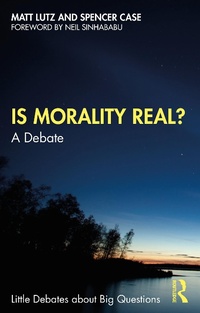
Is Morality Real?
A Debate
1st Edition
Published on 7. September 2023
260 pages
978-1-000-92421-3 (ISBN)
Description

In this book, Spencer Case and Matt Lutz debate whether objective moral facts exist. We often say that actions like murder and institutions like slavery are morally wrong. And sometimes people strenuously disagree about the moral status of actions, as with abortion. But what, if anything, makes statements about morality true? Should we be realists about morality, or anti-realists?
After the authors jointly outline the major contemporary positions in the moral realism debate, each author argues for his own preferred views and responds to the other's constructive arguments and criticisms. Case contends that there are moral truths that don't depend on human beliefs or attitudes. Lutz maintains that there are no moral truths, and even if there were, we wouldn't be in a position to know about them. Along the way, they explore topics like the nature of common sense, the meaning of moral language, and why the realism/anti-realism debate matters. The authors develop their own arguments and responses, but assume no prior knowledge of metaethics. The result is a highly accessible exchange, providing new students with an opinionated gateway to this important area of moral philosophy. But the authors' originality gives food for thought to seasoned philosophers as well.
Key Features
Gives a comprehensive overview of all the main positions on moral realism, without assuming any prior knowledge on the subject
Features both traditional and original arguments for each position
Offers highly accessible language without sacrificing intellectual rigor
Draws upon, and builds on, recent literature on the realism/anti-realism debate
Uses only a limited number of technical terms and defines all of them in the glossary
After the authors jointly outline the major contemporary positions in the moral realism debate, each author argues for his own preferred views and responds to the other's constructive arguments and criticisms. Case contends that there are moral truths that don't depend on human beliefs or attitudes. Lutz maintains that there are no moral truths, and even if there were, we wouldn't be in a position to know about them. Along the way, they explore topics like the nature of common sense, the meaning of moral language, and why the realism/anti-realism debate matters. The authors develop their own arguments and responses, but assume no prior knowledge of metaethics. The result is a highly accessible exchange, providing new students with an opinionated gateway to this important area of moral philosophy. But the authors' originality gives food for thought to seasoned philosophers as well.
Key Features
Gives a comprehensive overview of all the main positions on moral realism, without assuming any prior knowledge on the subject
Features both traditional and original arguments for each position
Offers highly accessible language without sacrificing intellectual rigor
Draws upon, and builds on, recent literature on the realism/anti-realism debate
Uses only a limited number of technical terms and defines all of them in the glossary
More details
Series
Edition
1. Auflage
Language
English
Place of publication
London
United Kingdom
Publishing group
Taylor & Francis Ltd
Target group
College/higher education
ISBN-13
978-1-000-92421-3 (9781000924213)
Copyright in bibliographic data and cover images is held by Nielsen Book Services Limited or by the publishers or by their respective licensors: all rights reserved.
Schweitzer Classification
Other editions
Additional editions
Book
09/2023
1st Edition
Routledge
€46.00
Shipment within 10-20 days
Book
09/2023
1st Edition
Routledge
€205.40
Shipment within 10-20 days
Persons
Matt Lutz is Associate Professor of Philosophy at Wuhan University, where he has worked since receiving his PhD in philosophy from the University of Southern California in 2015. He works on metaethics and epistemology, with a particular focus on moral epistemology and moral skepticism.
Spencer Case received his PhD in philosophy from the University of Colorado Boulder in 2018, and teaches online classes there. He is also a freelance writer and podcaster.
Spencer Case received his PhD in philosophy from the University of Colorado Boulder in 2018, and teaches online classes there. He is also a freelance writer and podcaster.
Content
1. Fact or opinion? 2. Anti-realism 3. Realism 4.The Moorean Argument 5. A Foothold for Realists 6. The Case for Error Theory 7. The Case for Skepticism 8. The Life of an Anti-Realist 9. Humeanism 10. Moral Explanations 11. Mooreanism and the a priori 12. Entanglement revisited
