

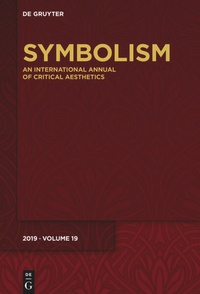
Symbolism 2019
Description

Special Focus editor: Natasha Lushetich
Series editors: Rüdiger Ahrens, Florian Kläger, Klaus Stierstorfer
Symbolism is cohesive. It gathers heterogeneity over time, across fields of human endeavor and systems of communication. Non-sequiturs, paradox and tautology, appear dissipative. Yet they are highly productive in reticular and fractal ways. Suffice it to look at the philosophical tautology of Parmenides's kind, which suggests that being "is"; at the practice of the koan , which collapses dualistic thinking by way of incompatible propositions, such as "the Eastern hill keeps running on the water"; at logical paradoxes in which the operative logic is sabotaged by its own means, as in Hempel's paradox; at absurdist dramatic texts in which protagonists record empty time in order to mark the emptiness of the time they are recording, as in Beckett's Krapp's Last Tape ; or at paradoxical games like Maciunas's Prepared Table Tennis played with paddles that have huge holes in them. In all of these examples, the existence-apprehending processes occur via unexpected itineraries, in vacant but nevertheless enunciative codes, in seemingly futile, yet calibrating performances, and in a temporality that is the cumulative time's "other." They catapult the mind into the realm of the extra-linguistic, the para-logical and the meta-experiential, or they transfigure it through a series of reticular iterations.
Forty years after Varela et al's groundbreaking work on the embodied, emotional and environmentally embedded mind - that marked a definitive departure from its former strictly rational conception - there is a need to re-examine the territory that lies beyond mind for a different reason: the proliferation of algorithmic logics that rely on the idea of a rational agent (human or algorithmic) making logical, self-serving decisions. This special issue explores neither-rational-nor-irrational forms of thinking and making. It sketches a cartography of a-rational processes of meaning- and knowledge-production that operate across numerous sites, practices, and disciplines: visual and media art; literature; art history; music; dance; film; intermedia and photography. Part I "Ahistoricity, Assemblages and Interpretative Reversals" focuses on the legacy of the (neo) avant-garde and amodernism. Part II " Destinerrance , Labyrinths and Folds" investigates the ways in which the Derridian delays/detours and the Deleuzian folding function as concrete ways of embodied knowledge-production. Part III, "Immanent Transcendence", offers a glimpse into the reticular and iterative structuring of transcendence that does not pre-exist immanence but is its residue.
More details
Other editions
Additional editions
Person
Klaus Stierstorfer , Westfälische Wilhelms-Universität, Münster, Germany; Rüdiger Ahrens , Universität Würzburg, Germany; Florian Kläger , Universität Bayreuth, Germany.
Special Focus editor: Natasha Lush etich, University of Dundee, UK.
