

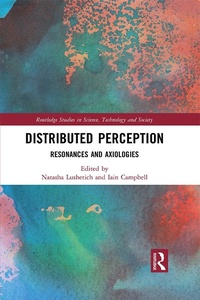
Distributed Perception
Resonances and Axiologies
1st Edition
Published on 29. December 2021
304 pages
978-1-000-52170-2 (ISBN)
Description

Who, what, and where perceives, and how? What are the sedimentations, inscriptions, and axiologies of animal, human, and machinic perception/s? What are their perceptibilities? Deleuze uses the word 'visibilities' to indicate that visual perception isn't just a physiological given but cues operations productive of new assemblages. Perceptibilities are, by analogy, spatio-temporal, geolocative, kinaesthetic, audio-visual, and haptic operations that are always already memory. In the case of strong inscriptions, they are also epigenetic events.
In physics, resonance is the tendency of a system to vibrate with increasing amplitudes at certain frequencies of excitation. In cybernetics and in theories of technology, it refers to systems' feedback. In Native science, resonance denotes the axiology of positions and events. It's a form of multi-species perception that emphasises emergent directionality and protean mnemonics.
This transdisciplinary volume brings together key theorists and practitioners from media theory, Native science, bio-media and sound art, philosophy, art his- tory, and design informatics to examine: a) the becoming-technique of animal- human-machinic perceptibilities; and b) micro-perceptions that lie beneath the threshold of known perceptions yet create energetic vibrations. The volume shows distributed perception to be a key notion in addressing the emergence and peristence of plant, animal, human, and machine relations.
In physics, resonance is the tendency of a system to vibrate with increasing amplitudes at certain frequencies of excitation. In cybernetics and in theories of technology, it refers to systems' feedback. In Native science, resonance denotes the axiology of positions and events. It's a form of multi-species perception that emphasises emergent directionality and protean mnemonics.
This transdisciplinary volume brings together key theorists and practitioners from media theory, Native science, bio-media and sound art, philosophy, art his- tory, and design informatics to examine: a) the becoming-technique of animal- human-machinic perceptibilities; and b) micro-perceptions that lie beneath the threshold of known perceptions yet create energetic vibrations. The volume shows distributed perception to be a key notion in addressing the emergence and peristence of plant, animal, human, and machine relations.
Reviews / Votes
"What is perception? A presentation, as Husserl said? A bodily shaping, as Merleau-Ponty defined it? Or the mere illusion of reality, as Derrida affirmed? Neither, Lushetich and Campbell answer. Delocalising perception from the scene of the human world, they show, through this extraordinary set of essays, that perception does not focus on objects but navigates between thresholds. Trans-materiality, trans-temporality, natural artificiality or biological mechanisms are currently deconstructing the deconstruction of presence itself. A major achievement."---Catherine Malabou, Kingston University, London"Distributed Perception arrives just in time. Confusion is at a fever pitch about the technological qualities of perception and how natural and machine intelligence are inextricable from its cuts and continuities. This diverse collection provides multifaceted perspectives on what is at stake, what we know, what we don't know and what may have been forgotten."---Benjamin Bratton, University of California San Diego
"Distributed Perception is a truly imaginative and novel intervention into media studies of perception. A collection of some of the most innovative thinkers in digital media studies, the book creatively avoids reductive discourses concerning planetary scale computing and the denaturalization of human perception to ask a new set of questions. At stake in these many accounts is a fundamental investigation about how we produce and "feel" difference-in scales, in species, in social systems--and ultimately how we hope to construct our relationship to others and the world in the future."---Orit Halpern, Concordia University, Montreal
More details
Series
Edition
1. Auflage
Language
English
Place of publication
London
United Kingdom
Publishing group
Taylor & Francis Ltd
Target group
College/higher education
Product notice
Reflowable
Illustrations
4 Line drawings, black and white; 19 Halftones, black and white; 23 Illustrations, black and white
ISBN-13
978-1-000-52170-2 (9781000521702)
Copyright in bibliographic data and cover images is held by Nielsen Book Services Limited or by the publishers or by their respective licensors: all rights reserved.
Schweitzer Classification
Other editions
Additional editions
Book
09/2023
1st Edition
Routledge
€65.70
Shipment within 15-20 days
Book
12/2021
1st Edition
Routledge
€206.00
Shipment within 15-20 days
Persons
Natasha Lushetich is Professor of Contemporary Art and Theory at the University of Dundee and AHRC Fellow (2020 - 2021). Her research is interdisciplinary and focuses on intermedia; biopolitics and performativity; the status of sensory experience in cultural knowledge; hegemony and complexity. Her books include Fluxus: The Practice of Non-Duality (Rodopi 2014), Interdisciplinary Performance (Pagrave 2016), The Aesthetics of Necropolitics (Rowman and Littlefield 2018), Beyond Mind, a special issue of Symbolism (De Gruyter 2019) and Big Data - A New Medium? (Routledge 2020).
Iain Campbell is an interdisciplinary researcher based in Edinburgh. He is Postdoctoral Rsearch Associate on the AHRC project The Future of Indeterminacy: Datification, Memory, Bio-Politics at the University of Dundee. He has written on topics across philosophy, music, sound studies, and art theory for publications including parallax, Deleuze and Guattari Studies, Sound Studies, and Contemporary Music Review. He is an associate member of the Scottish Centre for Continental Philosophy, and is part of the editorial board of Evental Aesthetics.
Iain Campbell is an interdisciplinary researcher based in Edinburgh. He is Postdoctoral Rsearch Associate on the AHRC project The Future of Indeterminacy: Datification, Memory, Bio-Politics at the University of Dundee. He has written on topics across philosophy, music, sound studies, and art theory for publications including parallax, Deleuze and Guattari Studies, Sound Studies, and Contemporary Music Review. He is an associate member of the Scottish Centre for Continental Philosophy, and is part of the editorial board of Evental Aesthetics.
Content
Introduction Part I: Entanglement 1. Relational Philosophy: The Stars are Our Relatives 2. Turning Around and Upside Down: The Nomadic Rhythms of Rain Ants in Sarayaku 3. Do Media Have a Sense of Time? Chrono-technical Interoception 4. Oscilloscopes, Slide Rules and Nematodes: Towards Heterogenetic Perception in/of AI 5. Composing with Resonance, Sounding the Inaudible and Listening for More-than-One 6. The Discrete Charm of Systems Theories: Cybernetic Intelligence and Posthuman Art Environments Part II: Plasticity 7. Unstable Brains and Ordered Societies: On the Conceptual Origins of Plasticity, ca 1900 8. The Human and Nonhuman in the Capitalist production of Subjectivity 9. Resonance Between Sense, Plasticity and Biosemiosis 10. How We Never Became Posthuman: Homeostasis as Conflict from Claude Bernard to Norbert Wiener 11. Intra-Action in Data-Driven Systems: A Case Study in Creative Praxis Part III: Organology 12. Becoming-Distributed Matter: Dreaming and Extended Relationality Among Indigenous Australians 13. Two Painted Flies: Improvised Arts of Perception in Uexkuell's Picture Book of Invisible Worlds 14. From Physiological Aesthetics to Anthropological Poetics: Activating the Pictographs of Cerro Azul 15. The Relativity of Life: Cinema as Time Microscope 16. Battlebots, Machine Surrogates and the Organology of Violence Televisual Entertainment 17. Autobiographing our Computing Organs: Rereading Pastw Uses of Intel CPUs as Xenotransplantation Concluding Thoughts
