

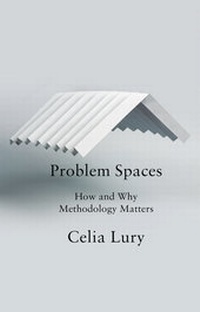
Problem Spaces
How and Why Methodology Matters
1st Edition
Published on 10. November 2020
256 pages
978-1-5095-0795-5 (ISBN)
Description

In this innovative book, Celia Lury argues that the time has come for us to explore the world not only with new methods, but with a new approach to methodology itself. Fundamental changes are taking place in how we produce knowledge, how we communicate it and, indeed, what we consider to be knowledge. These changes demand innovative and creative responses to research questions.
Lury's rethinking of the nature of social inquiry starts by reconceptualizing the 'problem space'. Problems are not static or a 'given'; rather, they are created and continually recomposed as part of the methodological process itself. Following the line of thought that methods are practices that articulate as much as capture a social problem, Lury further develops the notion of compositional methodology to think through its implications. With remarkable fluency, the book draws into conversation a range of hot-button issues, both longstanding and novel, from observation, reflexivity, recursive measurement and feminist methodologies, to participation, context, datafication and platformization.
Always with an eye to the methodological potential of new trends, the book provides a strong challenge to much received wisdom and argues that a combination of techniques can contribute to better understanding of the problem spaces we all inhabit.
Lury's rethinking of the nature of social inquiry starts by reconceptualizing the 'problem space'. Problems are not static or a 'given'; rather, they are created and continually recomposed as part of the methodological process itself. Following the line of thought that methods are practices that articulate as much as capture a social problem, Lury further develops the notion of compositional methodology to think through its implications. With remarkable fluency, the book draws into conversation a range of hot-button issues, both longstanding and novel, from observation, reflexivity, recursive measurement and feminist methodologies, to participation, context, datafication and platformization.
Always with an eye to the methodological potential of new trends, the book provides a strong challenge to much received wisdom and argues that a combination of techniques can contribute to better understanding of the problem spaces we all inhabit.
More details
Other editions
Additional editions
Book
11/2020
1st Edition
Polity Press
€65.50
Shipment within 15-20 days

Book
11/2020
1st Edition
Polity Press
€42.27
Shipment within 15-20 days
Person
Celia Lury is Professor of Sociology at the Centre for Interdisciplinary Methodologies at the University of Warwick.
Content
Introduction: The Compulsion of Composition
Part 1
Chapter 1: Problem Spaces
Part 2
Chapter 2: The Parasite and the Octopus
Chapter 3: Indexing the Human (with Ana Gross)
Chapter 4: Platforms and the Epistemic Infrastructure
Part 3
Chapter 5: More than Circular
Chapter 6: Know-ability and Answer-ability
Conclusion: How and Why Methodology Matters
Bibliography
Part 1
Chapter 1: Problem Spaces
Part 2
Chapter 2: The Parasite and the Octopus
Chapter 3: Indexing the Human (with Ana Gross)
Chapter 4: Platforms and the Epistemic Infrastructure
Part 3
Chapter 5: More than Circular
Chapter 6: Know-ability and Answer-ability
Conclusion: How and Why Methodology Matters
Bibliography
