

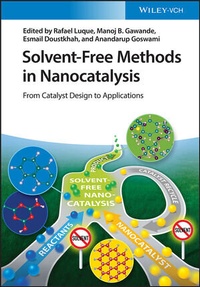
Solvent-Free Methods in Nanocatalysis
Description

More details
Other editions
Additional editions

Persons
Manoj B. Gawande is an Associate Professor at the Department of Industrial and Engineering Chemistry, Mumbai Marathwada Campus Jalna, India. He is also visiting Professor at RCPTM-CATRIN, Palacky University, Czech Republic. His research is focused on the development of greener raw materials, single-atom catalysts, materials and their applications in sustainable chemistry. He has published more than 150 scientific publications.
Esmail Doustkhah is a senior Research Fellow at the Koc University Tüpras Energy Center (KUTEM), Istanbul, Turkey. Before, he was a JSPS Fellow, postdoctoral researcher, and junior researcher at the National Institute for Materials Science (NIMS), Japan, from 2016 - 2022. His research interests are the design of new layered and porous materials for smart catalysis and photocatalysis.
Anandarup Goswami is an Associate Professor in the Department of Chemistry at Vignan's Foundation for Science, Technology and Research (VFSTR), Andhra Pradesh, India, since 2016. He received his Ph.D in Chemistry from Cornell University, New York, USA, in 2010, and did postdoctoral work in both the United States and Europe. His areas of research include applications of functional nanomaterials in catalysis, drug-delivery, and adsorption.
Content
Chapter 2: Strategies for the Preparation of Nanocatalysts and Supports under Solvent-Free Conditions
Chapter 3: Solvent and Catalyst-Free Organic Transformations
Chapter 4: Metal Oxides as Catalysts/Supports in Solvent-Free Organic Reactions
Chapter 5: Silica-Based Materials as Catalysts or Supports in Solvent-Free Organic Reactions
Chapter 6: Carbon-Based Materials as Catalysts/Supports in Solvent-Free Organic Reactions
Chapter 7: Nitride Nanostructures in Solvent-Free Catalysis
Chapter 8: Supported Ionic Liquids for Solvent-Free Catalysis
Chapter 9: Present Status & Future Outlook
1
Introduction: Scope of the Book
Anil Kumar Nallajarla and Anandarup Goswami
Vignan's Foundation for Science, Technology and Research (VFSTR deemed to be University), Department of Chemistry, School of Applied Science and Humanities, Vadlamudi, Guntur 522 213, Andhra Pradesh, India
1.1 Introduction: Green Chemistry, Solvent-free Synthesis, and Nanocatalysts
Since the realization that the future of chemical/industrial processes primarily depends on their sustainable quotient, the path of modern science has shifted toward the improvement of processes/products following green chemistry principles [1, 2]. Green chemistry as a branch of chemistry primarily deals with developing chemical processes using environmentally benign protocols, including inexpensive renewable less-toxic precursors. In that respect, the "12 rules of green chemistry," first formally introduced by Anastas and Warner in their book "Green Chemistry: Theory and Practices" [3], play a pivotal role in identifying the areas that should be focused to achieve the expected sustainability goals [4]. For chemical processes, the main aim of introducing these 12 principles is to save the environment and society by reducing the usage of toxic and hazardous chemicals and solvents without affecting the product yield/selectivity. While the 12 principles are quite self-explanatory, as depicted in Figure 1.1, the emphasis in certain areas often depends on the convenience of implementing them for specific protocols and the outcome. Of these 12 principles, this book focuses on the historical and recent developments of strategies that minimize solvent use in a chemical process, often termed "solvent-free synthesis," and the associated catalytic procedures involving nanomaterials.
The use of a solvent in a reaction creates a homogeneous solution phase where the reactants can interact effectively. While ideally, any liquid can be used as a solvent, the focus is largely on solvents based on their polarity and protic nature (e.g. methanol, ethanol, chloroform, dichloromethane, dimethylformamide [DMF], dimethyl sulfoxide [DMSO], toluene). The primary reasons can be attributed to their ability to solubilize various organic reactants/products as well as to control the stability of the transition state/intermediates (leading to modifications of the thermodynamic and kinetic reaction parameters) [5]. However, with the growth of industrial chemical processes along with growing interest in developing sustainable protocols, emphasis has been shifted toward choosing the best solvent based on not only their solubilizing power but also their abundance, cost, and, last but not least, short- and long-term impacts on environment [6]. In that context, water has long been considered a sustainable choice. However, the poor solubility of organic species in aqueous solution has limited its wide use primarily at the industrial scale [7, 8]. While some of the current choices, such as ionic liquids (ILs), often come as rescue options, their selection has remained an area of concern for the processes related to bulk scale production of materials [9]. Around this debate regarding the choice of solvent, the idea of "no solvent is best solvent" was also considered. However, it did not receive its due because of the lack of initial appreciation, especially for industrial purposes. However, with the advent of eco-friendly and greener approaches, the idea of "solvent-free synthesis" resurfaced, and presently, it is being explored as one of the viable options for the synthesis of chemicals as well as various materials (Figure 1.2a) [10]. Initially, synthesis under solvent-free conditions was associated with the solid-phase synthesis where the reactants were made to react in the solid phase. However, recent advances in the area of materials syntheses (which include thermal treatment, plasma etching, etc.) have extended its scope significantly [11, 12]. Modern-day scientific and technological developments are primarily governed by the utilization of materials for specific purposes. Thus, the choice of their synthetic strategies is often determined by the type of materials, their subsequent use, and their sustainable quotient. Considering these, the class of "nanomaterials" has emerged as a crucial player. Hence, a brief introduction of nanomaterials with special emphasis on their catalytic applications seems timely before moving to a detailed discussion on their solvent-free synthetic procedures.
Figure 1.1 12 principles of green chemistry.
Nanomaterials are the class of materials size that falls under 1-100 nm in at least one dimension (Figure 1.2b) [13, 14]. The exceptional growth in the development of nanomaterials can be attributed to high surface area, quantum confinement effect, and the possibility of fine-tuning their surface properties utilizing relatively straightforward methods. While the natural origin of nanomaterials can be traced back to the time of big-bang, Prof. Feynman, in his great lecture series "There is plenty of room at the bottom," first introduced the enormous potential of nanomaterials [15, 16]. Since then, progress in nanomaterials has been significant, and in the modern world, it is nearly impossible not to encounter nanomaterials in daily lives [17, 18]. Among the various fields in which nanomaterials have been explored, one of the areas involves their catalytic applications due to their unique size and shape-dependent surface properties [19, 20].
Figure 1.2 Introduction to (a) solvent-free synthesis, (b) nanomaterials, (c) catalysts, and (d) nanocatalysis. CNTs = Carbon nanotubes.
The term "catalyst" (or "catalysis") was first introduced in 1835 by Swedish chemist J.J. Berzelius [21, 22]. Since then, the catalyst is defined as a substance/material that improves the reaction rate by minimizing the activation energy of the process without being consumed during the process (Figure 1.2c). The initial developments in catalysis were concentrated on relatively expensive transition metal-derived systems primarily due to their intrinsic catalytic properties. However, the need for sustainable results has allowed the recent advancements to focus on less-toxic, low-cost, and highly abundant and recyclable catalytic alternatives [23, 24]. Though the categorization of catalysts may vary depending on the classification criteria, catalysts are commonly divided into two classes: homogeneous and heterogeneous [25]. Homogeneous catalysts are the compounds that remain in the same phase as reactants/products during the catalytic reactions (mostly in the presence of a suitable solvent). While homogeneous catalysts often exhibit higher catalytic activity, poor separation and recyclability appear significant challenges. In contrast, heterogenous systems involve different reactants/products and catalyst phases and ideally have better separation and reusability. However, due to various mass transfer and diffusion limitations, the catalytic activity of heterogeneous catalysts remains inferior to their homogeneous counterparts. Thus, a combination of advantageous factors for both systems is essential to overcome the existing challenges of both sides to achieve the desired goals. In that context, the utilization of nanomaterials (often termed "nanocatalysts," [s], Figure 1.2d) either as catalysts or as support materials for various homogeneous/heterogeneous catalytic entities has opened newer avenues as they often exhibit the potential to overcome the respective challenges in homo- and heterogenous catalysts [26].
The synthesis of NCs does not deviate too much from the synthesis of nanomaterials. It hence can primarily be classified into "top-down" and "bottom-up" approaches [27, 28], each of which can further be divided based on specific techniques. In "top-down" approaches, NCs are prepared from the bulk using various "cutting" techniques, whereas the "bottom-up" approaches involve synthesis of NCs from their atomic and/or molecular precursors. Both approaches have their own advantages and disadvantages, and often, the choice of synthetic methods is dictated by the NCs' specific properties and applications. For instance, while various "top-down" strategies are preferred for carbon-based nanomaterials (e.g. graphene, nanotubes), metal-oxide nanoparticles (NPs) are generally synthesized using "sol-gel" techniques [29]. Irrespective of the synthetic processes, "solvent-free" methods are always preferred as they can be directly related to the goals of green and sustainable transformations.
This brief introduction provides a general idea about various related topics interlinked with a common theme of sustainability and hopefully allows the readers to have a smooth transition in the remaining parts of the chapter.
1.2 Topics Covered in this Book
The chapters in this book are carefully designed to provide a...
