

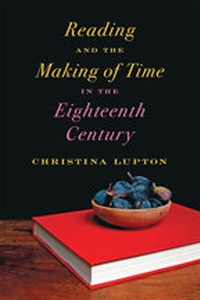
Reading and the Making of Time in the Eighteenth Century
Published on 10. October 2018
216 pages
978-1-4214-2577-1 (ISBN)
Description

How did eighteenth-century readers find and make time to read?
Books have always posed a problem of time for readers. Becoming widely available in the eighteenth century-when working hours increased and lighter and quicker forms of reading (newspapers, magazines, broadsheets) surged in popularity-the material form of the codex book invited readers to situate themselves creatively in time. Drawing on letters, diaries, reading logs, and a range of eighteenth- and early nineteenth-century novels, Christina Lupton's Reading and the Making of Time in the Eighteenth Century concretely describes how book-readers of the past carved up, expanded, and anticipated time.
Placing canonical works by Elizabeth Inchbald, Henry Fielding, Amelia Opie, and Samuel Richardson alongside those of lesser-known authors and readers, Lupton approaches books as objects that are good at attracting particular forms of attention and paths of return. In contrast to the digital interfaces of our own moment and the ephemeral newspapers and pamphlets read in the 1700s, books are rarely seen as shaping or keeping modern time. However, as Lupton demonstrates, books are often put down and picked up, they are leafed through as well as read sequentially, and they are handed on as objects designed to bridge temporal distances. In showing how discourse itself engages with these material practices, Lupton argues that reading is something to be studied textually as well as historically.
Applying modern theorists such as Niklas Luhmann, Bruno Latour, and Bernard Stiegler, Lupton offers a rare phenomenological approach to the study of a concrete historical field. This compelling book stands out for the combination of archival research, smart theoretical inquiry, and autobiographical reflection it brings into play.
Books have always posed a problem of time for readers. Becoming widely available in the eighteenth century-when working hours increased and lighter and quicker forms of reading (newspapers, magazines, broadsheets) surged in popularity-the material form of the codex book invited readers to situate themselves creatively in time. Drawing on letters, diaries, reading logs, and a range of eighteenth- and early nineteenth-century novels, Christina Lupton's Reading and the Making of Time in the Eighteenth Century concretely describes how book-readers of the past carved up, expanded, and anticipated time.
Placing canonical works by Elizabeth Inchbald, Henry Fielding, Amelia Opie, and Samuel Richardson alongside those of lesser-known authors and readers, Lupton approaches books as objects that are good at attracting particular forms of attention and paths of return. In contrast to the digital interfaces of our own moment and the ephemeral newspapers and pamphlets read in the 1700s, books are rarely seen as shaping or keeping modern time. However, as Lupton demonstrates, books are often put down and picked up, they are leafed through as well as read sequentially, and they are handed on as objects designed to bridge temporal distances. In showing how discourse itself engages with these material practices, Lupton argues that reading is something to be studied textually as well as historically.
Applying modern theorists such as Niklas Luhmann, Bruno Latour, and Bernard Stiegler, Lupton offers a rare phenomenological approach to the study of a concrete historical field. This compelling book stands out for the combination of archival research, smart theoretical inquiry, and autobiographical reflection it brings into play.
More details
Language
English
Place of publication
Baltimore
United States
Target group
Professional and scholarly
Illustrations
1 s/w Photographie bzw. Rasterbild
1 Halftones, black and white
File size
2,38 MB
ISBN-13
978-1-4214-2577-1 (9781421425771)
DOI
10.1353/book.59660
Copyright in bibliographic data and cover images is held by Nielsen Book Services Limited or by the publishers or by their respective licensors: all rights reserved.
Schweitzer Classification
Other editions
Additional editions
Christina Lupton
Reading and the Making of Time in the Eighteenth Century
Book
10/2018
Johns Hopkins University Press
€51.50
Article not available at the moment
Person
Christina Lupton is an associate professor at the University of Warwick. She is the author of Knowing Books: The Consciousness of Mediation in Eighteenth-Century Britain.
Content
Acknowledgments
Introduction: When Do We Read?
The Shortness of Time / The Tense of Reading / Literature as Resistance / The Difference Time Makes / Media History as Literary Method
Chapter One: Time Divided
No Difference / Talbot's Lack of Time / Breaking the Weekly Round / Some Sunday Readers / Sir Charles Comes and Goes
Chapter Two: Joining Up Time
Rereading for Happiness / Slow Translation / Grenville's Reading Journals /Lifetimes of Reading
Chapter Three: Other Times
Reading in the Field / Linear and Random Access / Literature and Contingency / Amelia's Beginning with the End / Sidney Bidulph and the Twice-Told Marriage / The Griffiths' Marriage by the Book
Chapter Four: Time to Come
Stockpiling / Romantic Media / A Simple Story: Reading Comes Later / Godwin: The Future Is Now / Hardcover Truths / You Can't Skip Pages
Coda: Academic Time
Notes
Works Cited
Index
Introduction: When Do We Read?
The Shortness of Time / The Tense of Reading / Literature as Resistance / The Difference Time Makes / Media History as Literary Method
Chapter One: Time Divided
No Difference / Talbot's Lack of Time / Breaking the Weekly Round / Some Sunday Readers / Sir Charles Comes and Goes
Chapter Two: Joining Up Time
Rereading for Happiness / Slow Translation / Grenville's Reading Journals /Lifetimes of Reading
Chapter Three: Other Times
Reading in the Field / Linear and Random Access / Literature and Contingency / Amelia's Beginning with the End / Sidney Bidulph and the Twice-Told Marriage / The Griffiths' Marriage by the Book
Chapter Four: Time to Come
Stockpiling / Romantic Media / A Simple Story: Reading Comes Later / Godwin: The Future Is Now / Hardcover Truths / You Can't Skip Pages
Coda: Academic Time
Notes
Works Cited
Index
