

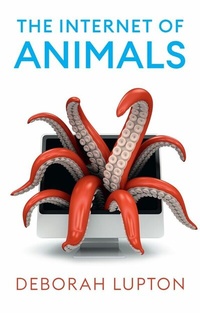
The Internet of Animals
Description

In this book, Deborah Lupton explores how digital technologies and datafication are changing our relationships with other animals. Playfully building on the concept of 'The Internet of Things', she discusses the complex feelings that have developed between people and animals through the use of digital devices, from social media to employing animal-like robots as companions and carers. The book brings together a range of perspectives, including those of sociology, cultural geography, environmental humanities, critical animal studies and internet studies, to consider how these new digital technologies are contributing to major changes in human-animal relationships at both the micropolitical and macropolitical levels. As Lupton shows, while digital devices and media have strengthened people's relationships to other creatures, these technologies can also objectify animals as things for human entertainment, therapy or economic exploitation.
This original and engaging book will be of interest to scholars and students across the social sciences and humanities.
More details
Other editions
Additional editions
Person
Content
1 Conceptualising Humans, Animals and Human-Animal Relations
2 Animal Enthusiasts, Activism and Politics in Digital Media
3 The Quantified Animal and Dataveillance
4 Animal Cuteness, Therapy and Celebrity Online
5 Animal Avatars and Zoomorphic Robots
Conclusion: Reimagining Human-Animal Relations
Appendix
References
Index
1
Conceptualizing Humans, Animals and Human-Animal Relations
This chapter presents an overview of the theoretical perspectives and concepts that underpin the analysis of human-animal relations that is undertaken throughout the book. This discussion provides a springboard for surfacing and understanding the rationales, social imaginaries and practices that contribute to animal-human-digital assemblages. Changes in Western perspectives on humans and animals are traced from pre-modern to contemporary times, and the insights offered by more-than-human philosophies, including that of non-Western and First Nations' worldviews, are explained. The position of moral philosophy and animal ethics in considering the status of animals is contrasted with a more-than-human approach to recognizing the complexities of onto-ethico-epistemological dimensions of multispecies relations.
Humans and animals: Western conceptual approaches
Especially in the contemporary cultures of the wealthy countries constituting the Global North (which includes Western countries located outside the northern hemisphere such as Australia and New Zealand), denial of the animal nature of humans is a frequent trope. Drawing on Christian belief and Cartesian divisions between mind and body, since the Enlightenment and the scientific revolution, philosophical and scientific perspectives on living creatures have increasingly sought to distinguish humans as both separate from, and superior to, other living things - including other animals (Chan, 2018; Chiew, 2014; TallBear, 2015). According to this dualistic conceptual opposition, the nonhuman animal is associated with dumb flesh, while the human (positioned as non-animal) is defined by rational thought (Chan, 2018). Simultaneously with worldviews which position people as separate from animals, there has emerged in Western cultures in the post-Enlightenment period a growing sentimentality about some (but not all) animals. This perspective does not necessarily grant equality of status to the animals at which it is directed, but it does position animals as more human-like than in recent eras, even if humans are not equally positioned as more animal-like.
The notion of Otherness pervades contemporary Western portrayals and treatment of both animals and humans, often based on concepts of control over the boundaries of the body. The ideal human body is tight, contained, exercising full control over what comes inside and goes outside. At its most extreme, this ideal disavows the very existence of the material body, seeking the perfection and purity of rational thought over the impurities of fleshly desires, affects and needs (Ahmed, 2004; Grosz, 1994; Shildrick, 1997). As cultural anthropologist Mary Douglas (Douglas, 1966, 1992) argued, that which is seen to be anomalous, difficult to classify, creates feelings of unease and repulsion. Otherness is a product of observations of difference/strangeness. Otherness is dangerous because it confounds order and control. The Other represents the unknown and the threat of loss of one's own identity through contact with this unknown, the dissipation of boundaries and the realization of our own limits. Otherness does not only involve that which is placed directly in opposition to the self/us, as part of a binary opposition, but also that which is uncertain, confusing and blurs the ordering of binary oppositions - the hybrid and the liminal. The liminal is that which represents a transitional, middle stage between two distinctly different entities, identities or sites. It thus cannot be categorized into either: it is 'in-between' (Kristeva, 1982).
The white, able-bodied, bourgeois, heterosexual and cisgendered masculine body is valued as most closely conforming to this idea of the contained, 'civilized' body. The bodies of women, members of the poor or the working class, people of colour, disabled people and queer or nonbinary people are frequently represented as Other - incapable of fully achieving this ideal. Such bodies are culturally represented as subject to the will of the flesh rather than that of reason, prone to emotionality, excessive desire, violence or disarray (Baquero et al., 2021; Belcourt, 2015; Plumwood, 2002). Bodies that are seen to transgress or blur culturally important boundaries are the source of confusion, fear, anxiety and even hatred, revulsion and disgust. Those things that are not easily categorized, that fail to stay in their categories, or that simply are too different from the self, tend to arouse anxieties and fears. They are culturally designated as potentially polluting and contaminating to the self. As a result, people or things that are categorized as Other are typically dealt with using exclusionary tactics that seek to locate them as far as possible, both symbolically and literally, from the self (Ahmed, 2004; Grosz, 1994; Shildrick, 1997).
The contemporary Western ideal of the individuated human body/self is only a few centuries old, emerging from social and political changes in the sixteenth century in Europe (Hartnell, 2018; Taylor, 1989). German sociologist Norbert Elias (1978) traced an increasing individuation of people's bodies/selves from each other, and a strengthening of awareness of human rights and initiatives against cruelty, violence, slavery and physical punishment, in his scholarship on 'the civilizing process' during the early modern period in Europe. Historical accounts have demonstrated that pre-modern Western concepts of human bodies/selves saw them as highly porous, entangled with each other and open to the more-than-human world. Everyday bodily functions often took place in public spaces, with little sense of shame or concerns about privacy, and public displays of violence and excessive indulgence were accepted. People and livestock often lived in the same spaces, and even strangers commonly shared beds or bedchambers when finding a place to sleep (Elias, 1978; Hartnell, 2018).
Legends and folklore circulating during the pre-modern era often depicted animals as taking on human form, or shapeshifting, becoming part of families by marrying humans and giving birth to children. Such narratives demonstrate a fluidity of boundaries between the human body/self and that of other animals. They positioned people as part of the natural world, as well as portraying strong ties of intimacy and kinship between humans and other animals and the importance of respecting the autonomy and agencies of animals (Blackie, 2021). Extreme cruelty to animals, however, was culturally accepted. Just as public beheadings and floggings of humans were common entertainments in pre-modern times, so too were displays of animal torture or killings, such as cockfights, bear or dog fights and rituals such as the mass burning of cats, simply for the pleasure of seeing them suffer (Elias, 1978).
Elias (1978) argued that, from the sixteenth century, wealthy Europeans began to move away from these beliefs and practices. Moderation became a virtue. There was a far greater focus on the regulation of emotions, the restraint of impulses, and the mastery of the body, as demonstrated by a growing set of rules about table manners, clean clothing and the appropriate ways and places to engage in sexual activity or expelling body wastes. Violent actions and cruelty towards other people became viewed as more repugnant. To some extent, these new values were extended towards animals. The torturing and killing of animals no longer took place as public spectacles, and slaughtering of animals for food was moved to sites that were less open to public view. However, ideas of 'civilized' behaviour were based on the notion that humans should not behave like animals: thus emphasizing the difference between humans as ideally rational, highly self-disciplined beings, and animals as irrational creatures ruled by their bodily impulses.
In the contemporary era, humans continue to be portrayed in Western thought as superior to and masters of all other living things by virtue of their capacity for reason and self-discipline over their bodies (Plumwood, 2002; Taylor and Twine, 2014; Tester, 1991). Despite some evidence of greater recognition of the needs and feelings of other animals, humans in most societies still treat them as Other to the self. The notion of human exceptionalism and superiority to all other species is used to support extractive, exploitative and often downright damaging and cruel practices directed at other members of the animal kingdom. Animals - even the most loved companion animals - are still treated as commodities and the property of humans, to be bought and sold at will. In current processes of industrialization and commodity capitalism, the economic value of animals for human benefit predominates in most regulations about their treatment. Farm animals and their products (offspring, flesh, milk, wool, eggs, feathers, skins) are managed as if they are industrial goods. Animals that are considered pests, disease carrying, not physically appealing or that are destined for the tables of humans continue to be killed or tortured - often with very little regard for the quality of their lives, their wellbeing, any pain and suffering they may endure, or the nature of their deaths (Mather, 2019; Riley, 2022). These practices have contributed to large-scale environmental devastation, species extinction and biodiversity loss across the planet, harming the health and wellbeing of all living things: human and nonhuman.
Social researchers are beginning to explore the social, cultural and political dimensions of animal life. An...
