

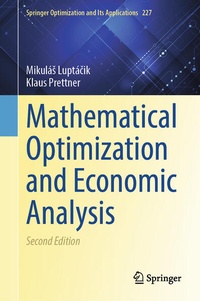
Mathematical Optimization and Economic Analysis
Description

This book offers a comprehensive exploration of mathematical optimization and its critical role in economic analysis. As the scarcity of resources, environmental degradation, and the effects of industrial robots and artificial intelligence (AI) become ever-pressing issues, this second edition expands on the foundational theories of static optimization to include dynamic optimization and new applications in areas such as automation and sustainability.
The authors examine key concepts such as the optimal allocation of resources, the interplay between economic growth and environmental impacts, and the integration of automation in production systems. As renowned experts in the field, the authors provide a robust framework for understanding single and multi-objective optimization models as well as dynamic optimization in continuous and discrete time, emphasizing their use in qualitative analysis. This second edition offers deep insights into investment strategies and resource management over time, making it an indispensable resource for those seeking to navigate the complexities of modern economic landscapes.
Ideal for graduate students, university educators, and researchers in economics, business, and operations research, this book bridges the gap between theoretical rigor and practical application. It is also a valuable resource for practitioners and students of applied mathematics interested in economic applications.
More details
Other editions
Additional editions
Persons
Mikulás Luptácik is an emeritus professor at the Vienna University of Economics and Business (WU) and the scientific Director of the Institute for Industrial Research (IWI) in Vienna. He has held academic positions at the Institute for Advanced Studies in Vienna, Vienna University of Technology, Comenius University in Bratislava (Slovakia) and University of Economics Bratislava. Mikulas Luptacik obtained his Ph.D in Operations Research and his habilitation in Operations Research and Mathematical Economics from the Vienna University of Technology. The main areas of his research work are mathematical optimization and economic analysis, input - output modelling, efficiency and productivity analysis with applications in the environmental economics and industrial economics. He wrote five books (like "Mathematical Optimization and Economic Analysis", Springer edition, New York, 2010) and published in journals such as: Journal of Economic Dynamics and Control; Economic Systems Research; Empirica: Journal of European Economics; Ecological Economics; European Journal of Operational Research; Journal of the Operational Research Society; Central European Journal of Operations Reserach; Socio-Economic Planning Sciences and others. He is a member of Academia Europaea and several scientific societies and editorial boards.
Klaus Prettner is a Professor of Economics at the Vienna University of Economics and Business (WU). In his work, Klaus Prettner applies the methods of static and dynamic optimization to analyze the interrelations between economic growth and inequality, the economic consequences of automation, and the impacts of demographic developments on long-run economic outcomes. He has published in journals such as the Journal of Monetary Economics, The Economic Journal, Journal of Economic Literature, Journal of Economic Growth, Journal of Health Economics, Research Policy, Journal of Urban Economics, Health Affairs, and The BMJ. Together with David E. Bloom, he has authored the book "Automation and Its Macroeconomic Consequences: Theory, Evidence, and Social Impacts", which was published in 2020. Klaus Prettner has held academic positions at the University of Hohenheim, Vienna University of Technology, University of Göttingen, Harvard University, and the Austrian Academy of Sciences. He obtained his Ph.D. in Economics in 2009 from the University of Vienna and his habilitation in Mathematical Economics in 2014 from the Vienna University of Technology.
Content
Part 1. Single-Objective Optimization.- Scarcity and Efficiency.- Kuhn-Tucker Conditions.- Convex Programming.- Linear Programming.- Data Envelopment Analysis.- Geometric Programming.- Part 2. Multiobjective Optimization.- Fundamentals of Multiobjective Optimization.- Multiobjective Linear Programming.- Multiobjective Geometric Programming.- Part 3. Dynamic Optimization.- Dynamic Optimization.- Applications of Dynamic Optimization.
