

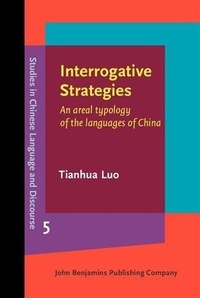
Interrogative Strategies
An areal typology of the languages of China
1st Edition
Published on 15. September 2016
260 pages
978-90-272-6659-0 (ISBN)
Description

This book deals with how to ask questions in the languages of China. The syntactic, morphological, and lexical forms for distinguishing interrogatives take centre stage; intonation is also dealt with, but more peripherally than question particles, disjunctive and negative constructions, and word order. 140 languages spoken in China are covered coming from four major families: Sino-Tibetan, Altaic, Austronesian and Austro-Asiatic, accompanied by a few mixed languages. The approach is areal-typological, i.e. these focal languages are compared to the languages of the world as represented in typological samples, and within China areal patterns of the structural variables are examined.The book will be an indispensable reference for future work on interrogatives in a typological context and for areal studies of the language situation in China and more generally East Asia.
More details
Other editions
Additional editions
Book
09/2016
John Benjamins Publishing Co
€123.30
Shipment within 10-15 days
Content
- Intro
- Interrogative Strategies
- Editorial page
- Title page
- LCC data
- Table of contents
- Acknowledgements
- Notational conventions
- Abbreviations
- IPA and Standard Chinese Pinyin
- Tone system of Standard Chinese
- 1. Introduction
- 1.1 The grammar of interrogatives
- 1.1.1 Interrogative forms
- 1.1.2 Asymmetries in form and meaning
- 1.2 Motivation
- 1.3 Material
- 1.4 Methodology
- 1.5 Outline of the work
- 2. A survey of polar interrogative strategies in the languages of China
- 2.1 Sino-Tibetan
- 2.1.1 Sinitic
- 2.1.1.1 Standard Chinese
- 2.1.1.1.1 Interrogative types in Standard Chinese
- 2.1.1.1.2 Interrogative intonation only
- 2.1.1.1.3 Question particles
- 2.1.1.1.4 Alternative questions
- 2.1.1.1.5 X-neg-X questions
- 2.1.1.1.6 Summary
- 2.1.1.2 Yongxin Gan
- 2.1.1.2.1 Introduction
- 2.1.1.2.2 Interrogative intonation only
- 2.1.1.2.3 Question particles
- 2.1.1.2.4 Alternative questions
- 2.1.1.2.5 X-neg-X questions
- 2.1.1.2.6 Summary
- 2.1.1.3 Comparative Sinitic
- 2.1.2 Miao-Yao (Hmong-Mien)
- 2.1.3 Tai-Kadai
- 2.1.3.1 Kam-Shui
- 2.1.3.2. Kra, Li, Tai, and Caijia
- 2.1.4. Tibeto-Burman
- 2.1.4.1. Burmese
- 2.1.4.2. Jingpo
- 2.1.4.3. Qiangic
- 2.1.4.4. Tibetan
- 2.1.4.5. Yi and others
- 2.2. Austronesian
- 2.3 Austro-Asiatic
- 2.4. Altaic
- 2.4.1. Manchu-Tungusic
- 2.4.2. Mongolian
- 2.4.3. Turkic
- 2.5. Mixed languages
- 2.6. Summary
- 3. Question particles and final particles
- 3.1 The position of question particles
- 3.2 ma ne polar questions in Sinitic languages
- 3.2.1 ma ne polar questions
- 3.2.2 The nature of ma ne polar questions
- 3.3 Final particles in wh-questions
- 3.3.1 Final particles in wh-questions
- 3.3.2 Final particles in reduced wh-questions
- 3.4 Summary
- 4. Disjunctions and alternative questions
- 4.1 Alternative vs. X-neg-X questions
- 4.2 Alternative questions: The or vs. or/whether typology
- 4.2.1 Introducing the or vs. or/whether typology
- 4.2.2 The or vs. or/whether typology
- 4.2.3 The position of or and or/whether
- 4.2.4 The or vs. or/whether typology and clause order
- 4.3 Particles as disjunctions
- 4.3.1 Alternative questions through particles
- 4.3.2 Patterns of particle disjunctions in alternative questions
- 4.4 Alternative islands in Sinitic
- 4.5 Summary
- 5. Wh-phrases and wh-questions
- 5.1 The position of wh-phrases
- 5.2 Wh-fronting in Standard Chinese
- 5.3 The syntax of wh-questions
- 5.3.1 Wh-questions and word order change
- 5.3.2 Wh-questions with coordination in Sinitic
- 5.4 The reduplication of wh-phrases
- 5.4.1 Languages with reduplication of wh-phrases
- 5.4.2 Which wh-phrases can be reduplicated?
- 5.4.3 The semantics of reduplicated wh-phrases
- 5.4.4 Syllable patterns of reduplicated wh-phrases
- 5.5 Summary
- 6. Three types of verb-related questions
- 6.1 q-VP questions
- 6.1.1 q-VP in Sinitic
- 6.1.2 q-VP in Tibeto-Burman
- 6.1.3 Summary
- 6.2 Verb-reduplicating questions
- 6.2.1 Verb-reduplication in Sinitic
- 6.2.2 Verb-reduplication in Yi
- 6.2.3 Verb-reduplication in Miao-Yao
- 6.2.4. Summary
- 6.3 Interrogative verbs
- 6.3.1 Interrogative verbs in Sinitic
- 6.3.2 Interrogative verbs in Formosan
- 6.3.3 Hagège (2008)
- 6.4 Conclusion
- 7. Typological and area-historical assessment
- 7.1 Universals vs. "areoversals"
- 7.1.1 Greenberg (1966)
- 7.1.2 Ultan (1978)
- 7.1.3 Areoversals
- 7.2 Changes in questions: Areal and historical perspectives
- 7.2.1 Yes/no questions
- 7.2.2 X-neg-X questions
- 7.2.3 Alternative questions
- 7.2.4 Three types of verb-related questions in Sinitic
- 7.2.4.1 Verb-reduplicating questions
- 7.2.4.1.1 Ancient Chinese
- 7.2.4.1.2 Middle Chinese
- 7.2.4.1.3 Early Modern Chinese and Modern Chinese
- 7.2.4.2 q-VP questions
- 7.2.4.2.1 q VP in Ancient, Middle, and Early Modern Chinese
- 7.2.4.2.2 q-VP in contemporary Sinitic languages
- 7.2.4.3 The interrogative verb gan-ma
- 7.2.4.3.1 A history of ma
- 7.2.4.3.2 The suffixation of -ma and its equivalents
- 7.2.4.4 Summary
- 7.3 Further topics: Interrogation and negation
- 7.3.1 Negation and interrogation in asking and answering
- 7.3.2 Diachronic negation and interrogation
- 8. Conclusion
- References
- Features of 140 languages of China
- Language Index
- Name Index
- Subject Index
