

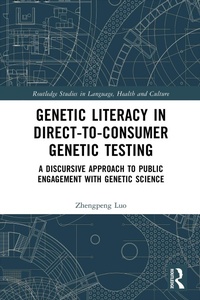
Genetic Literacy in Direct-to-Consumer Genetic Testing
A Discursive Approach to Public Engagement with Genetic Science
Published on 14. November 2025
162 pages
978-1-040-44127-5 (ISBN)
Description

This book examines language and communication in a novel area of digital health. Situating itself within the sociocultural paradigm of literacy research, the book proposes a discourse-oriented approach to genetic literacy and applies it to the study of public engagement with direct-to-consumer (DTC) genetic testing-an emergent biotechnology operating at the intersection of personal genomics, consumer culture, and online health.
The author draws on a rich dataset comprising marketing materials from a leading genetic company in China, interviews with genetic test users, and online forum interactions involving consumers and members of the genetic company. Using in-depth analyses of authentic discourse data, the book examines how key stakeholders in DTC genetic testing discursively construct and negotiate socially situated knowledges about genetics and health to pursue a range of interactional goals. Challenging the static and cognitive view of genetic literacy as a set of decontextualised knowledge and skills in scientific and medical fields, this book argues for a reconceptualisation of genetic literacy as a dynamic and socially situated discursive practice. Building on key insights from medical sociology, the author discusses genetic literacy within the context of broader societal shifts, including the biomedicalisation of health and the rise of neoliberal ideologies and practices in contemporary healthcare.
Written in a clear and accessible style, this book will appeal to researchers and students working in the areas of sociolinguistics, discourse analysis, and health communication. It will also be of particular interest to practitioners in genetics and health, as well as members of the general public seeking to understand the social aspects of public engagement with genetics and health.
The author draws on a rich dataset comprising marketing materials from a leading genetic company in China, interviews with genetic test users, and online forum interactions involving consumers and members of the genetic company. Using in-depth analyses of authentic discourse data, the book examines how key stakeholders in DTC genetic testing discursively construct and negotiate socially situated knowledges about genetics and health to pursue a range of interactional goals. Challenging the static and cognitive view of genetic literacy as a set of decontextualised knowledge and skills in scientific and medical fields, this book argues for a reconceptualisation of genetic literacy as a dynamic and socially situated discursive practice. Building on key insights from medical sociology, the author discusses genetic literacy within the context of broader societal shifts, including the biomedicalisation of health and the rise of neoliberal ideologies and practices in contemporary healthcare.
Written in a clear and accessible style, this book will appeal to researchers and students working in the areas of sociolinguistics, discourse analysis, and health communication. It will also be of particular interest to practitioners in genetics and health, as well as members of the general public seeking to understand the social aspects of public engagement with genetics and health.
More details
Series
Language
English
Place of publication
London
United Kingdom
Publishing group
Taylor & Francis Ltd
Target group
College/higher education
Professional and scholarly
File size
12,42 MB
ISBN-13
978-1-040-44127-5 (9781040441275)
Copyright in bibliographic data and cover images is held by Nielsen Book Services Limited or by the publishers or by their respective licensors: all rights reserved.
Schweitzer Classification
Other editions
Additional editions
Zhengpeng Luo
Genetic Literacy in Direct-to-Consumer Genetic Testing
A Discursive Approach to Public Engagement with Genetic Science
Book
11/2025
1st Edition
Routledge
€205.00
Shipment within 10-20 days
Person
Zhengpeng Luo is an Assistant Professor at the Institute of Linguistics and Applied Linguistics, School of Foreign Languages, Peking University. He received his doctoral degree from The University of Hong Kong. His research interests lie primarily at the intersection of language, health, and digital communication.
Content
1. Genetic literacy and direct-to-consumer genetic testing. An introduction 2. Literacy, discourse and knowledge 3. Contextualising direct-to-consumer genetic testing 4. Discourse-centred online ethnography 5. Commodification and marketisation of genetic testing 6. "It's just scientific fortune-telling": Consumers' accounts of direct-to-consumer genetic testing 7. Doing genetic literacy in online forum interactions 8. Conclusion
