

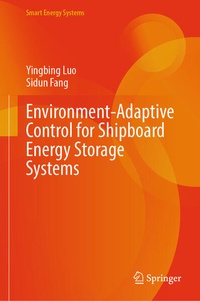
Environment-Adaptive Control for Shipboard Energy Storage Systems
Description

This book investigates in environment-adaptive power control technology of shipboard energy storage systems (ESSs), assessing its potential use to enhance the adaptability of large-scale ESS in marine environments characterized by swaying, high temperatures, and high humidity, etc., which can promote sustainable and eco-friendly electrified ship system applications under multiple navigation conditions. Studies on shipboard ESS control have attracted engineers and scientists from various disciplines, such as electrical, mechanical, marine engineering, and power engineering. Pursuing a holistic approach, the book establishes a fundamental framework for this topic, while emphasizing the importance of integrated state-power control of shipboard ESSs under uncertain navigation conditions. The book is intended for undergraduate and graduate students who are interested in marine energy storage application technology, researchers investigating efficient energy control systems, and circuit/system design engineers working on large-scale powered shipboard mcirogrids or other energy conversion applications.
More details
Other editions
Additional editions
Persons
Yingbing Luo received the M.S. degree in electrical engineering from the Hunan University of Technology, Zhuzhou, China, in 2022. He is currently working toward the Ph.D. degree with the School of Electrical Engineering, Chongqing University, Chongqing, China. He once interned with CRRC Zhuzhou Institute Company, Ltd., and was responsible for test work of electric drive. He has been awarded the Chinese National Student Scholarship and is currently working toward a co-training program at University College London. His research interest is dynamic power management of shipboard microgrid systems.
Prof. Sidun Fang received the B.E. degree from the School of Electrical Engineering, Chongqing University, Chongqing, China, in 2012, and the Ph.D. degree in power system and its automation from the School of Electronics Information and Electrical Engineering, Shanghai Jiao Tong University, Shanghai, China, in 2017. He is currently a full Professor in Chongqing University, and his research interests include integrated energy system and energy-transport integration. Prof. Fang was the recipient of the Outstanding Graduate Prize of Shanghai Jiao Tong University. His doctoral dissertation was nominated as the Excellent Dissertation Papers in Shanghai Jiao Tong University in 2017. He is also an Associate Editor for IEEE Transactions on Industrial Cyber-Physical Systems, IEEE Transactions on Industry Applications and IET Renewable Power Generation.
Content
Chapter 1 Shipboard Microgrid System.- Chapter 2 Multi Senario Shipboard Load Model.- Chapter 3 Marine Battery Energy Storage System Model.
