

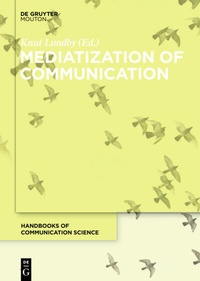
Mediatization of Communication
Description

This handbook on Mediatization of Communication uncovers the interrelation between media changes and changes in culture and society. This is essential to understand contemporary trends and transformations.
"Mediatization" characterizes changes in practices, cultures and institutions in media-saturated societies, thus denoting transformations of these societies themselves.
This volume offers 31 contributions by leading media and communication scholars from the humanities and social sciences, with different approaches to mediatization of communication. The chapters span from how mediatization meets climate change and contribute to globalization to questions on life and death in mediatized settings. The book deals with mass media as well as communication with networked, digital media.
The topic of this volume makes a valuable contribution to the understanding of contemporary processes of social, cultural and political changes. The handbook provides the reader with the most current state of mediatization research.
More details
Other editions
Additional editions
Person
Content
2 - Acknowledgements [Seite 9]
3 - I. Introduction [Seite 15]
3.1 - 1 Mediatization of Communication [Seite 17]
4 - II. Global changes [Seite 51]
4.1 - 2 Scopic media and global coordination: the mediatization of face-to-face encounters [Seite 53]
4.2 - 3 Climate change challenges: an agenda for de-centered mediatization research [Seite 77]
4.3 - 4 Mediatization with Chinese characteristics: political legitimacy, public diplomacy and the new art of propaganda [Seite 101]
5 - III. The long history [Seite 121]
5.1 - 5 Understanding mediatization in "first modernity": sociological classics and their perspectives on mediated and mediatized societies [Seite 123]
5.2 - 6 Mediatization as a mover in modernity: social and cultural change in the context of media change [Seite 145]
5.3 - 7 Mediatization theory: a semio-anthropological perspective [Seite 177]
6 - IV. Media in society [Seite 187]
6.1 - 8 Institution, technology, world: relationships between the media, culture, and society [Seite 189]
6.2 - 9 Mediatization and cultural and social change: an institutional perspective [Seite 213]
6.3 - 10 Mediatization and the future of field theory [Seite 241]
7 - V. Movement and interaction [Seite 261]
7.1 - 11 Human interaction and communicative figurations. The transformation of mediatized cultures and societies [Seite 263]
7.2 - 12 Indispensable things: on mediatization, materiality, and space [Seite 287]
7.3 - 13 Digitization: new trajectories of mediatization? [Seite 311]
7.4 - 14 Polymedia communication and mediatized migration: an ethnographic approach [Seite 337]
8 - VI. Power, law and politics [Seite 361]
8.1 - 15 Mediatization: rethinking the question of media power [Seite 363]
8.2 - 16 Mediatization of politics: transforming democracies and reshaping politics [Seite 389]
8.3 - 17 Mediatization of public bureaucracies [Seite 419]
8.4 - 18 Mediatization of corporations [Seite 437]
8.5 - 19 Law in the age of media logic [Seite 457]
9 - VII. Art and the popular [Seite 477]
9.1 - 20 Art: multiplied mediatization [Seite 479]
9.2 - 21 Mediatization of popular culture [Seite 497]
9.3 - 22 Barbie in a meat dress: performance and mediatization in the 21st century [Seite 519]
9.4 - 23 Mediatization of sports [Seite 539]
10 - VIII. Faith and knowledge [Seite 559]
10.1 - 24 Mediatization and religion [Seite 561]
10.2 - 25 The media in the labs, and the labs in the media: what we know about the mediatization of science [Seite 585]
10.3 - 26 Mediatization and education: a sociological account [Seite 609]
11 - IX. To be or not to be [Seite 629]
11.1 - 27 Selfhood, moral agency, and the good life in mediatized worlds? Perspectives from medium theory and philosophy [Seite 631]
11.2 - 28 Home is where the heart is? Ontological security and the mediatization of homelessness [Seite 655]
11.3 - 29 The mediatization of memory [Seite 675]
11.4 - 30 Mediatization of public death [Seite 695]
12 - X. Critical afterthought [Seite 715]
12.1 - 31 Mediatization: an emerging paradigm for media and communication research? [Seite 717]
13 - Biographical sketches [Seite 739]
14 - Index [Seite 749]
