

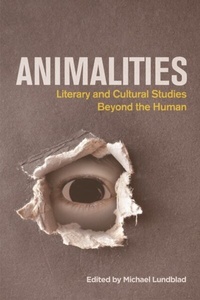
Animalities
Description

New and cutting-edge work in animality studies, human-animal studies, and posthumanism
Representations of animality continue to proliferate in various kinds of literary and cultural texts. This pioneering volume explores the critical interface between animal and animality studies, marking out the terrain in relation to twentieth-century literature and film. The range of texts considered here is intentionally broad, answering questions like, how do contemporary writers such as Amitav Ghosh, Terry Tempest Williams, and Indra Sinha help us to think about not only animals but also humans as animals? What kinds of creatures are being constructed by contemporary artists such as Patricia Piccinini, Alexis Rockman, and Michael Pestel? How do 'animalities' animate such diverse texts as the poetry of two women publishing under the name of 'Michael Field', or an early film by Thomas Edison depicting the electrocution of a circus elephant named Topsy? Connecting these issues to fields as diverse as environmental studies and ecocriticism, queer theory, gender studies, feminist theory, illness and disability studies, postcolonial theory, and biopolitics, the volume also raises further questions about disciplinarity itself, while hoping to inspire further work 'beyond the human' in future interdisciplinary scholarship.
Key Features
- 10 provocative case studies focused on representations and discourses of animals and animality in twentieth- and twenty-first-century literature, art, and film in English
- New work from both internationally renowned and emerging figures in the burgeoning fields of animality studies, human-animal studies, and posthumanism, suggesting innovative and significant new directions to explore
- Broad introduction to the kinds of questions scholars in the humanities have considered in relation to animals and animality
More details
Other editions
Additional editions
Content
- Intro
- Animalities
- Edinburgh University Press
- Contents
- Figures
- Acknowledgements
- Introduction: The End of the Animal - Literary and Cultural Animalities
- 1 Each Time Unique: The Poetics of Extinction
- 2 Posthuman New York: Ground Zero of the Anthropocene
- 3 J. G. Ballard's Dark Ecologies: Unsettling Nature, Animals, and Literary Tropes
- 4 Staging Humanimality: Patricia Piccinini and a Genealogy of Species Intermingling
- 5 "Sparks Would Fly": Electricity and the Spectacle of Animality
- 6 The Nature of Birds, Women, and Cancer: Terry Tempest Williams's Refuge and When Women Were Birds
- 7 Animality, Biopolitics, and Umwelt in Amitav Ghosh's The Hungry Tide
- 8 Looking the Beast in the Eye: Re-animating Meat in Nordic and British Food Culture
- 9 Love Triangle with Dog: Whym Chow, the "Michael Fields," and the Poetic Potential of Human-Animal
- 10 Bestial Humans and Sexual Animals: Zoophilia in Law and Literature
- Notes on Contributors
- Index
