

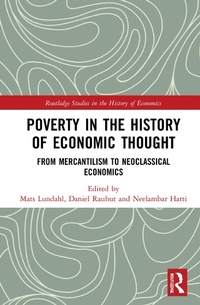
Poverty in the History of Economic Thought
From Mercantilism to Neoclassical Economics
1st Edition
Published on 28. December 2020
196 pages
978-1-000-29760-7 (ISBN)
Description

Poverty in the History of Economic Thought: From Mercantilism to Neoclassical Economics aims to describe and critically examine how economic thought deals with poverty and the poor, including its causes, consequences, reduction, and abolition.
This edited volume traces the economic ideas of key writers and schools of thought across a significant period, ranging from Adam Smith and Malthus through to Wicksell, Cassel, and Heckscher. The chapters relate poverty to income distribution, asserting that poverty is not always conceived of in absolute terms, and that relative and social deprivation matter also. Furthermore, the contributors deal with both individual poverty and the poverty of nations in the context of international economy. By providing such a thorough exploration, this book shows that the approach to poverty differs from economist to economist, depending on their particular interests and the main issues related to poverty in each epoch, as well as the influence of the intellectual climate that prevailed at the time when the contribution was made.
This key text is valuable reading for advanced students and researchers of the history of economic thought, economic development, and the economics of poverty.
This edited volume traces the economic ideas of key writers and schools of thought across a significant period, ranging from Adam Smith and Malthus through to Wicksell, Cassel, and Heckscher. The chapters relate poverty to income distribution, asserting that poverty is not always conceived of in absolute terms, and that relative and social deprivation matter also. Furthermore, the contributors deal with both individual poverty and the poverty of nations in the context of international economy. By providing such a thorough exploration, this book shows that the approach to poverty differs from economist to economist, depending on their particular interests and the main issues related to poverty in each epoch, as well as the influence of the intellectual climate that prevailed at the time when the contribution was made.
This key text is valuable reading for advanced students and researchers of the history of economic thought, economic development, and the economics of poverty.
More details
Series
Edition
1. Auflage
Language
English
Place of publication
London
United Kingdom
Publishing group
Taylor & Francis Ltd
Target group
College/higher education
ISBN-13
978-1-000-29760-7 (9781000297607)
Copyright in bibliographic data and cover images is held by Nielsen Book Services Limited or by the publishers or by their respective licensors: all rights reserved.
Schweitzer Classification
Other editions
Additional editions
Mats Lundahl | Daniel Rauhut | Neelambar Hatti
Poverty in the History of Economic Thought
From Mercantilism to Neoclassical Economics
Book
08/2022
1st Edition
Routledge
€65.00
Shipment within 15-20 days
Mats Lundahl | Daniel Rauhut | Neelambar Hatti
Poverty in the History of Economic Thought
From Mercantilism to Neoclassical Economics
Book
12/2020
1st Edition
Routledge
€192.21
Shipment within 15-20 days
Poverty in the History of Economic Thought
From Mercantilism to Neoclassical Economics
Book
12/2020
Routledge
Unfortunately, price unknown
Available (delivery time upon request)
Persons
Mats Lundahl is Professor Emeritus of Development Economics at the Stockholm School of Economics, Sweden.
Daniel Rauhut is Associate Professor and holds a PhD in Economic History. He works as senior researcher at the University of Eastern Finland in Joensuu, Finland.
Neelambar Hatti is Professor Emeritus in the School of Economics and Management at Lund University, Sweden.
Daniel Rauhut is Associate Professor and holds a PhD in Economic History. He works as senior researcher at the University of Eastern Finland in Joensuu, Finland.
Neelambar Hatti is Professor Emeritus in the School of Economics and Management at Lund University, Sweden.
Content
Introduction: economic thought and poverty; 1 Were good times really that bad? Mercantilist views on poverty and employment; 2 Adam Smith-a champion for the poor!; 3 Malthus and the poor; 4 David Ricardo on poverty; 5 Saving the poor: John Stuart Mill on poverty and the poor; 6 Marx and his followers on poverty; 7 Alfred Marshall, poverty and economic theory: a historical perspective; 8 Knut Wicksell and the causes of poverty: population growth and diminishing returns; 9 Gustav Cassel on poverty: growth, not grants!; 10 Eli Heckscher on poverty: causes and cures
