

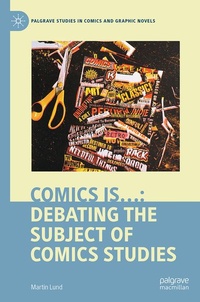
Comics is.: Debating the Subject of Comics Studies
Description

Taking the contested and contestable meaning of "comics" as its starting point, Comics is. brings together ten comics scholars from different disciplines and with different approaches to what some of us call comics, to debate and discuss the foundations of Comics Studies in a provocative and thought-provoking way.
The book is built around a three-part structure: each contributor writes a sentence or brief statement, starting from the prompt "Comics is."; a colleague replies to the statement with a reflection, critique, or application of the statement or the position it advances; and, finally, the author of the statement responds to the reply in a brief essay.
Through its dialogical format, the book is likely to spark new conversations in the field; the statement-response-reply format will illustrate that the ways we think as comics scholars are processual, and any reader will find things they agree and disagree with in its pages - and, more importantly, will find occasion to reevaluate their own thinking.
Furthermore, when taken together, the "Comics is." statements along with the responses and replies provide a barometer of the state of Comics Studies at present, exemplifying current approaches within the field and some of the thinking behind why some of us do our work in certain ways, while others choose sometimes radically different ones.
More details
Other editions
Additional editions
Person
Martin Lund is a senior lecturer in religious studies at the Department of Society, Culture and Identity at Malmö University, Sweden. His main research interest is comics. His research is particularly focused on urban cultural formation, racial formation and identification, religion, and politics. He has edited several collections and published widely in the area of Comics Studies, including the monograph Re-Constructing the Man of Steel: Superman 1938-1941 , Jewish American History, and the Invention of the Jewish-Comics Connection (Palgrave Macmillan, 2016). He is also co-editor of the book series Encapsulations: Critical Comics Studies (with Julia Round).
Content
Preface.- Contributor Bios.- Introduction.- Chapter 1. Comics is. plural? No, Singular!-no-.- Chapter 2. Comics is a Name Some of us Give to Telling Stories with Pictures.- Chapter 3. Comics is a Way to Circulate Experience.- Chapter 4. Comics is a Space for Sharing Experiences.- Chapter 5. Comics is a Multimodal Art Form.- Chapter 6. Comics is an Inherently Physiognomic Artform.- Chapter 7. Comics is Dynamic Interplay.- Chapter 8. Comics is Best Understood as a Field.- Chapter 9. Comics is as Comics Does.- Index.
