

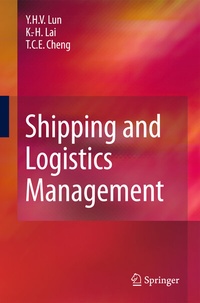
Shipping and Logistics Management
Description

Shipping and Logistics Management serves to consolidate the knowledge its authors have acquired from being educators and observers of the shipping industry. Against the background of a global business environment, it explains how the shipping market functions, examining the strategic and operational issues that affect entrepreneurs in this industry.
The authors discuss global trends and strategies in the shipping business, looking at the role of logistics service providers and at how the use of information technology can help shipping operations. Shipping and Logistics Management also aims to answer several important questions in the shipping industry, including: what are the shipping cost structures?, what are the patterns of sea transport? and how do companies in the shipping industry operate?
An invaluable source of information for researchers and advanced, or graduate, students, Shipping and Logistics Management is also a useful reference for shipping practitioners and consultants.
More details
Other editions
Additional editions
Persons
Content
Abstract In the container shipping industry, the importance of adopting technology for enhancing transport security has been well acknowledged. Institutional pressures can be a key driver of change for firms in a container transport chain and these firms include shippers, consignees, freight forwarders, transport operators, maritime carriers, container terminal operators, customs authorities, and government agencies. Technological devices such as radio-frequency identification, the smart box initiative, and non-intrusive inspection are adopted to enhance container transport security.
This chapter discusses the implications of the different types of institutional isomorphism from the perspectives of container transport operators that have taken the initiative to adopt technology for container transport security enhancement and those that have followed other firms to adopt technology. The possible impacts of the different types of institutional isomorphism, namely, coercion, mimesis, and norms, elaborated in this study can help shipping and logistics managers better understand the institutional pressures that are put on them, and the institutional pressures that drive them to adopt technologies in the container transport chain.
12.1 Container Transport Chain and Container Transport Security
A transport network consists of nodes and links (Song et al. 2005). In a container transport chain, the nodes are physical locations, such as container terminals and depots, where containers are handled and transferred from one transport mode to another. In addition, the links between nodes are served by various modes of transport, such as trucks, trains, and ships.
From the perspective of transport security, the risk of a breach of security at any one of the nodes or links can compromise the security of the entire container transport chain (Lee and Whang 2005). For outbound shipment, the stuffing area of a container transport chain is crucial to container transport security because it represents the last point in the container transport chain where the contents of a container can be visually identified and reconciled with related documents such as container load plans.
Once the container has been sealed by the shipper, the contents of the containers cannot be verified until the container is reopened. From this perspective, shippers play a critical role in container transport security by providing accurate and complete sets of data about the cargo in the containers. On the other hand, containers moving through different transport modes need to tackle many security challenges. Door-to-door container transport involves multiple stops (such as cargo stuffing areas and container terminals), where containers are stored and handled, and open transport infrastructure (such as highways and rail stations), which can be accessed by different parties (Vis 2006)."
