

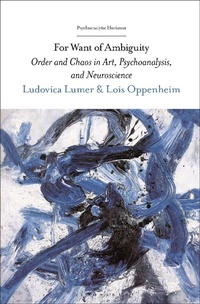
For Want of Ambiguity
Order and Chaos in Art, Psychoanalysis, and Neuroscience
1st Edition
Published on 21. February 2019
200 pages
978-1-5013-4884-6 (ISBN)
Description

Nominated for the 2019 Gradiva (R) Award for Best Book by the National Association for the Advancement of Psychoanalysis (NAAP)
For Want of Ambiguity investigates how the dialogue between psychoanalysis and neuroscience can shed light on the transformational capacity of contemporary art.
Through neuroscienfitic and psychoanalytic exploration of the work of Diamante Faraldo, Ai Weiwei, Ida Barbarigo, Xavier Le Roy, Bill T. Jones, Cindy Sherman, Francis Bacon, Agnes Martin, and others, For Want of Ambiguity offers a new perspective on how insight is achieved and on how art opens us up to new ways of being.
For Want of Ambiguity investigates how the dialogue between psychoanalysis and neuroscience can shed light on the transformational capacity of contemporary art.
Through neuroscienfitic and psychoanalytic exploration of the work of Diamante Faraldo, Ai Weiwei, Ida Barbarigo, Xavier Le Roy, Bill T. Jones, Cindy Sherman, Francis Bacon, Agnes Martin, and others, For Want of Ambiguity offers a new perspective on how insight is achieved and on how art opens us up to new ways of being.
Reviews / Votes
Authors Lumer (independent scholar) and Oppenheim (Montclair State Univ.) are trained in psychoanalysis, neuroscience, and literary theory, and they are to be congratulated on crafting such an original, wide-ranging work. * CHOICE * If the purpose of learning is to better predict how to meet your needs in the world, then what is the purpose of art? This fascinating book explores how the brain deals with things that are inherently ambiguous and unpredictable, and therefore cannot be mastered through learning. Interestingly, as this book reveals, such things abound in aesthetic experience. * Mark Solms, Professor and Director of Neuropsychology, Neuroscience Institute, University of Cape Town, South Africa * This extraordinary book is a pioneering work that breaks new ground for psychoanalysts and neuroscientists alike. By utilizing art to explore key relationships between analysis and neuroscience, the authors have shed new light on how metaphor and symbol shape our perceptions, and our lives. This is one of the most original books to appear in many years. It will prove invaluable to anyone interested in the behavioral sciences and the innovative work that is taking place in those fields. * Theodore J. Jacobs, M.D., Training and Supervising Analyst, The New York and the IPE Psychoanalytic Institutes, and author of The Possible Profession: The Analytic Process of Change (2013) * In their deft, sensitive, and probing examination of art as a function of the need to create meaning and form from the often inchoate realities of human subjectivity, Lumer and Oppenheim move from insights about particular works by numerous artists to the theory and practice of psychoanalysis to the mechanisms of neurobiology. For Want of Ambiguity is a model for what genuine interdisciplinary scholarship can do. By illuminating their subject through several disciplinary lenses but never conflating them or reducing one view to the other, they have enhanced our understanding of artists and the art they make. * Siri Hustvedt, Lecturer in Psychiatry, Weill Cornell Medical College, USA, author of A Woman Looking at Men Looking at Women: Essays on Art, Sex, and the Mind (2016) *More details
Series
Edition
1. Auflage
Language
English
Place of publication
New York
United States
Publishing group
Bloomsbury Publishing PLC (Digital)
Target group
Professional and scholarly
Illustrations
20 images
ISBN-13
978-1-5013-4884-6 (9781501348846)
Copyright in bibliographic data and cover images is held by Nielsen Book Services Limited or by the publishers or by their respective licensors: all rights reserved.
Schweitzer Classification
Other editions
Additional editions
Ludovica Lumer | Lois Oppenheim
For Want of Ambiguity
Order and Chaos in Art, Psychoanalysis, and Neuroscience
Book
08/2020
Bloomsbury Academic USA
€60.84
Shipment within 15-20 days
Persons
Ludovica Lumer is a psychoanalyst with a private practice in New York City, USA. She earned her PhD from University College London, UK, where she worked in the Department of Anatomy and Developmental Biology conducting research in the field of neuroaesthetics on the relationship between visual perception and artistic representation. She is the co-author (with Marta Dell'Angelo) of C'e da perderci la testa: scoprire il cervello giocando con l'arte (2010), and (with Semir Zeki) La bella e la Bestia (2011).
Lois Oppenheim is University Distinguished Scholar, Professor of French, and Chair of the Department of Modern Languages and Literatures at Montclair State University, USA. Dr. Oppenheim is the author of over ninety papers and the author or editor of thirteen books, including Psychoanalysis and the Artistic Endeavor: Conversations with Literary and Visual Artists (2015), Imagination from Fantasy to Delusion - awarded the 2013 Courage to Dream Prize from the American Psychoanalytic Association - and A Curious Intimacy: Art and Neuro-psychoanalysis (2005).
Lois Oppenheim is University Distinguished Scholar, Professor of French, and Chair of the Department of Modern Languages and Literatures at Montclair State University, USA. Dr. Oppenheim is the author of over ninety papers and the author or editor of thirteen books, including Psychoanalysis and the Artistic Endeavor: Conversations with Literary and Visual Artists (2015), Imagination from Fantasy to Delusion - awarded the 2013 Courage to Dream Prize from the American Psychoanalytic Association - and A Curious Intimacy: Art and Neuro-psychoanalysis (2005).
Content
List of Figures
Foreword by Semir Zeki
Acknowledgments
Introduction: (Re) Making Meaning
Chapter 1 Shaping Private Demons
Chapter 2 A Play of Selves: Art as Play
Chapter 3 Narrating the Self
Chapter 4 Mapping: The Need for Borders
Chapter 5 The Fluidity of Time and Space in Art, Psychoanalysis, and Neuroscience
Chapter 6 Resisting Representation
Conclusion: Order and Chaos or Framing Ambiguity
Bibliography
Index
About the Authors
Foreword by Semir Zeki
Acknowledgments
Introduction: (Re) Making Meaning
Chapter 1 Shaping Private Demons
Chapter 2 A Play of Selves: Art as Play
Chapter 3 Narrating the Self
Chapter 4 Mapping: The Need for Borders
Chapter 5 The Fluidity of Time and Space in Art, Psychoanalysis, and Neuroscience
Chapter 6 Resisting Representation
Conclusion: Order and Chaos or Framing Ambiguity
Bibliography
Index
About the Authors
