

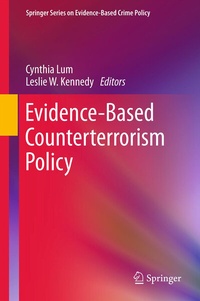
Evidence-Based Counterterrorism Policy
Description

More details
Other editions
Additional editions
Persons
Cynthia Lum researches in the area of crime prevention, international and domestic policing concerns, democratization and justice, place-based criminology, and research methodology. She has consulted with numerous police agencies in the areas of deployment and crime analysis both in the United States and abroad and also works with the U.S. State Department's International Law Enforcement Academy, where she helps train police commanders from multiple nations. Her recent projects include developing protocols and technologies for tip lines in high-intensity events (funded by the Department of Defense/Department of Justice), conducting a multi-language survey of law enforcement officials across thirty nations, empirically testing social disorganization theory, and conducting a systematic review of research evaluating anti-terrorism strategies.
Leslie W. Kennedy, a Professor at Rutgers University, served as Dean of the Rutgers School of Criminal Justice from 1998 to2007. Dr. Kennedy has published extensively in the areas of fear of crime, victimology, and violence. His current research in public security builds upon his previous work in event analysis and understanding the social contexts in which dangers in society are identified and deterred. Dr. Kennedy is also the Director of the Rutgers Center for the Study of Public Security.
Content
Preface: Evidence-based policy movement.- A. Introduction.- 1. Evidence Based Counter Terrorism Policy: Issues and Prospects.- B. Obtaining Data for Counterterrorism Evaluations.- 2. Generating Evidence - A Review of Projects from the START Center .- 3. Data Archives for Terrorism Research.- 4. The Role of Fusion Centers as Sources of Information .- 5. Data from courts and prisons.- 6. Dynamic Data Analysis and Data Mining.- C. Methodological Concerns in Evaluating Counterterrorism Policy.- 7. Methodological Challenges of Evaluation: The Qualitative Critique of the Campbell Review.- 8. Quantitative Methods in Evaluating Counterterrorism policy.- 9. Longitudinal Methods of Evaluation: Hazard Modeling and Trajectory Analysis.- 10. Alternative Methods of Evaluation - Advanced Events Data Analysis and Simulations
