

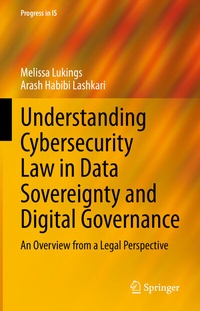
Understanding Cybersecurity Law in Data Sovereignty and Digital Governance
Description

Cumulatively, this book provides the full spectrum of information, from foundational principles underlining the described topics, through to the larger, more complex, evolving issues which we can foresee ahead of us.
More details
Other editions
Additional editions
Persons
Melissa Lukings is a Research Assistant at York University (Canada). She is a graduated Juris Doctor (JD) from the Faculty of Law, University of New Brunswick (Canada), a former graduate of Memorial University of Newfoundland (MUN), and an intersectional research assistant with a background in social justice, grassroots organization, data privacy and cybersecurity law. Lukings is currently working on a handful of research projects covering a wide variety of topics, ranging from cybersecurity and privacy law to legal reform and access to justice within the Canadian judicial system.
During 2020 and 2021, Melissa Lukings co-authored a ten-part article series, entitled "Understanding Canadian Cybersecurity Laws", which was published by IT World Canada. The article series was recognized with a Gold Medal for the Best Blog Column in the Business Division of the 2020 Canadian Online Publishing Awards, which was remotely held in February 2021. Following the publication of thefinal series article, in April 2021, Lukings was invited to appear as an experiential witness and individual advocate in a hearing before the Parliamentary Ethics Committee for the House of Commons of Canada - formally known as the Standing Committee on Access to Information, Privacy and Ethics.
Arash Habibi Lashkari is a Canada Research Chair (CRC) in Cybersecurity. He is a senior member of the IEEE and an Associate Professor at York University (Canada). Prior to this, he was an Associate Professor at the Faculty of Computer Science, University of New Brunswick (Canada), and the Research Coordinator of the Canadian Institute for Cybersecurity (CIC). His research focuses on cyber threat modeling and detection, malware analysis, big data security, internet traffic analysis, and cybersecurity dataset generation.
Arash Lashkari has over 22 years of teaching experience, spanning several international universities, and was responsible for designing the first cybersecurity Capture the Flag (CTF) competition for post-secondary students in Canada. He has been the recipient of 15 awards at international computer security competitions - including three gold awards - and was recognized as one of Canada's Top 150 Researchers for 2017. In 2020, Dr. Lashkari was recognized with the University of New Brunswick's prestigious Teaching Innovation Award for his personally created teaching methodology, the Think-Que-Cussion Method.
He is the author of ten published books and more than 100 academic articles on a variety of cybersecurity-related topics and the co-author of the national award-winning article series, "Understanding Canadian Cybersecurity Laws," which was recently recognized with a Gold Medal at the 2020 Canadian Online Publishing Awards.
