

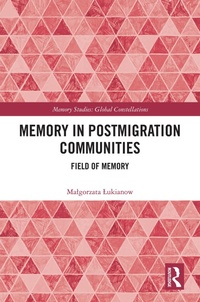
Memory in Post-Migration Communities
Field of Memory
Published on 30. April 2026
156 pages
978-1-040-88767-7 (ISBN)
Description

This book offers an exploration of post-migration memory fields-spaces where multiple and often conflicting memory narratives of the same past event intersect within a limited locality. Focusing on Poland and the remembrance of the post-war and post-communist periods, it examines what happens when diverse mnemonic trajectories converge in small communities: how memories coexist, clash, merge, or become silenced.
By defining and illustrating diverse modes of social memory formation, the book explores how communities decide what becomes their heritage and how families, local authorities, and cultural institutions work to balance overlapping, and sometimes conflicting, memories within a shared space. Can a local museum that strives to encompass multiple narratives still act as a cohesive bearer of identity? Can families with ancestors from dispersed regions weave a coherent story about themselves?
Combining theoretical insight with grounded ethnographic analysis, Memory in Post-Migration Communities provides conceptual and methodological tools for studying societies shaped by total or large-scale population exchange. It will appeal to scholars and students of sociology, anthropology, history, and memory studies interested in collective remembrance, local identity, and post-displacement heritage.
By defining and illustrating diverse modes of social memory formation, the book explores how communities decide what becomes their heritage and how families, local authorities, and cultural institutions work to balance overlapping, and sometimes conflicting, memories within a shared space. Can a local museum that strives to encompass multiple narratives still act as a cohesive bearer of identity? Can families with ancestors from dispersed regions weave a coherent story about themselves?
Combining theoretical insight with grounded ethnographic analysis, Memory in Post-Migration Communities provides conceptual and methodological tools for studying societies shaped by total or large-scale population exchange. It will appeal to scholars and students of sociology, anthropology, history, and memory studies interested in collective remembrance, local identity, and post-displacement heritage.
More details
Series
Language
English
Place of publication
London
United Kingdom
Publishing group
Taylor & Francis Ltd
Target group
College/higher education
Product notice
Reflowable
Illustrations
1 Tables, black and white
File size
0,72 MB
ISBN-13
978-1-040-88767-7 (9781040887677)
Copyright in bibliographic data and cover images is held by Nielsen Book Services Limited or by the publishers or by their respective licensors: all rights reserved.
Schweitzer Classification
Other editions
Additional editions
Book
approx. 04/2026
1st Edition
Routledge
€213.20
Not yet published
Person
Malgorzata Lukianow is a sociologist at the University of Warsaw. Her research focuses on memory studies, with particular expertise in oral history. She has previously held positions at the Polish Academy of Sciences, Chemnitz University of Technology, and University of Michigan. She co-chairs the Polish Regional Group of the Memory Studies Association.
Content
The Dynamics of Coexistence: An Introduction Evidence and Methodologies 1. Doxa and Memory, or Poland Is Born and Falls in "Recovered" Towns 2. National Memory as Heterodoxy 3. Changing Temporal Frameworks as Doxa-Making 4. Memory Consortia Postscript: Scenes of Mnemonic Struggle Appendix 1: Glossary of Key Terms Appendix 2: Detailed Data Overview
