

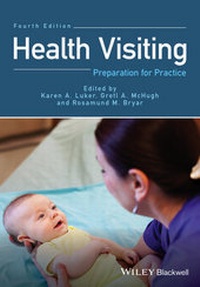
Health Visiting
Description

Reviews / Votes
"Overall, this is an excellent and easy to read resource for anyone wishing to extend their knowledge and challenge their practice in health visiting and beyond. It should certainly assist practitioners in delivering high-quality, evidence-based care...It is both thought provoking and practical, containing a wealth of information that can be applied to assist professional development and widen knowledge"(The Journal of Health Visiting, March 2017)More details
Other editions
Additional editions
Persons
Content
List of Contributors ix
Introduction 1 Karen A. Luker, Gretl A. McHugh and Rosamund M. Bryar
Prevention, public health, and health visiting 2
Health visiting: preparation for practice 4
1 Managing Knowledge in Health Visiting 8 Kate Robinson
Introduction 8
Defining health visiting practice 10
What do health visitors do ± and where do they do it? 13
Evidence-based practice 16
The current landscape of EBP 21
Managing knowledge and evidence in practice 26
Case study 1.1: Introducing new technology 26
Case study 1.2: Creating guidelines in primary care 27
Case study 1.3: Protocol-based decision making in nursing 29
Case study 1.4: Knowledge management in primary care 30
Communities of practice 35
Reflective practice 37
Clients: what do they know and how do they know it? 40
Social networking and the media 41
The debate 44
Summary 45
References 46
Activities 50
2 Health Visiting: Context and Public Health Practice 53 Martin Smith
Introduction 53
Public health 56
Defining 'public' 56
Defining 'health' 57
Defining 'public health' 59
Human rights and public health 60
The principles of health visiting 63
The search for health needs 65
The stimulation of an awareness of health needs 65
The influence on policies affecting health 66
The facilitation of health-enhancing activities 67
Summary 68
Health inequalities 69
Summary 76
References 77
Activities 82
3 The Community Dimension 85 Rosamund M. Bryar
Introduction 85
Public health and communities 87
Defining 'community' 89
Impact of communities on health 91
The role of health visitors in working with communities 96
Gaining an understanding of the health of your local community 100
Windshield survey 101
Public health walk 101
Health needs assessment 102
Building community capacity 110
Using health promotion models to support community working 113
Summary 116
References 118
Activities 124
4 Approaches to Supporting Families 127 Karen I. Chalmers and Karen A. Whittaker
Introduction 127
Models of intervention in family life 128
Three models relevant to health visiting practice in families with young children 129
Application of the models in practice 132
Policies 133
Evidence for interventions to support families 136
Characteristics of services and programmes to support families with young children 137
Early home visiting programmes 138
First Parent Health Visiting Programme 138
Community Mothers Programme (CMP) 139
Current home visiting programmes 140
Family Nurse Partnership (FNP) Programme 140
Flying Start ± Wales 143
The Triple-P (Positive Parenting Programme) 144
Maternal Early Childhood Sustained Home Visiting (MECSH) 145
Sure Start programmes 146
Summary 148
Working with families 148
Empirical evidence on relationship development 152
Challenges 154
Public health agenda 154
Level of evidence 155
Adhering to the programme criteria 155
High-needs families 156
Practice specialisation 157
Concerns about child safety 157
Adequate resources 157
Summary 158
Note 158
References 158
Activities 167
5 Safeguarding Children: Debates and Dilemmas for Health Visitors 170 Julianne Harlow and Martin Smith
Introduction 170
The key concepts 172
Defining 'child' 172
Defining 'childhood' 174
Defining 'safeguarding' 175
Defining 'child abuse' 180
Defining 'significant harm' 187
Incidence and prevalence of child abuse 193
Assessment of vulnerable children 197
Assessment of children in need and their families 198
Common Assessment Framework (CAF) 200
Graded Care Profile (GCP) 202
Working together 203
Confidentiality and information sharing 205
Supervision 206
Summary 210
References 211
Activities 217
6 Working with Diverse Communities 220 Sharin Baldwin and Mark R.D. Johnson
Introduction 220
Culture and migration 221
Cultural sensitivity and competence 222
Some useful tips for developing cultural competence 225
Institutional discrimination and organisational cultural competence 225
Understanding different cultural practices 226
Pregnancy 226
Birth customs 228
Confinement following birth 231
Breastfeeding 231
Diet, weaning, and feeding practices 232
Maternal mental health 235
Safeguarding, domestic violence, and abuse 237
Communication 239
Other communities 240
Case studies 241
Case study 6.1: Breastfeeding support project for Somali mothers in
Harrow 241
Case study 6.2: New ways of delivering health visiting services for
Orthodox Jewish community in Hackney 242
Summary 244
References 244
Activities 250
7 Evaluating Practice 252 Karen A. Luker and Gretl A. McHugh
Introduction 252
Sources of evidence for practice 253
Evaluation ± the problem of definition 257
Conceptualising evaluation 259
Example: tackling childhood obesity 261
Evaluation and evaluative research 263
Evaluation of health care 263
Structure, process, and outcome evaluation 266
Structure evaluation 266
Process evaluation 268
Outcome evaluation 270
Summary 272
The care planning process 272
Actual and potential problems 274
Problem solving 275
Additional issues in evaluating the practice of health visiting 275
Summary 280
References 281
Activities for Chapter 7 287
Index 291
Introduction
Karen A. Luker, Gretl A. McHugh and Rosamund M. Bryar
Our fourth edition of Health Visiting: Preparation for Practice is a key resource for health visitors, health visitor students, students on nursing, public health, early years, and health sciences programmes, and other health professionals working in public health, primary care, and community services. The practice of health visiting is focused on the promotion of health and the prevention of ill health. The fourth edition of Health Visiting: Preparation for Practice aims to inform, educate, and challenge you to deliver the most effective health visiting and so enable the promotion of health and prevention of ill health in the children, families, and communities with whom you work.
Prevention and public health have been the focus of health visiting since the early days of the sanitary visitors - the forerunners of health visitors - appointed by the Manchester and Salford Ladies Sanitary Reform Association in 1862. Since 1862, the living conditions, life expectancy, and health of the population have evolved, and alongside this there have been changes in the health challenges faced by the population. Over these more than 150 years, health visiting has responded to these changes by contributing to addressing public health issues from prevention of infectious diseases to prevention of long-term conditions; from addressing poverty and under-nutrition to working to reduce obesity in children and their parents. The aim of this edition of Health Visiting: Preparation for Practice is to provide you with the most up-to-date evidence to support your work on the front line of public health.
The fourth edition of this book is the latest in the line of works entitled Health Visiting which have aimed to support the delivery of health visiting. The first of these, Health Visiting: A Textbook for Health Visitor Students by Margaret McEwan, was first published in 1951. This was followed by three further editions, and, in 1977, by Health Visiting, edited by Grace M. Owen and written by Grace M. Owen and health visiting colleagues drawn from the health visiting programme at the Polytechnic of the South Bank (now London South Bank University). These books remind us of the changes in the preparation of health visitors during the past 60-plus years, but the statement by McEwan (1961: 17) of the purpose of health visiting is still the centre of today's practice: 'The health visitor is primarily a teacher and her aim is to teach the value of healthy living and to interpret the principles of health.' In addition, her observation that health visiting is: '.concerned with the little things of everyday life' (McEwan, 1961: 17) is also very pertinent. However, the evidence and knowledge base underpinning some of these 'little things of everyday life', such as weaning, play, and parenting, has grown enormously, as shown in the four editions of the present book. The first edition, by Karen Luker and Jean Orr, was published in 1985 and also entitled Health Visiting. The second edition followed in 1992 and was entitled Health Visiting: Towards Community Health Nursing, reflecting changes in the education of nurses and health visitors in the early 1990s. The third edition, edited by Karen Luker, Jean Orr, and Gretl McHugh, did not appear until 20 years later, in 2012, but the title, Health Visiting: A Rediscovery, shows the new confidence in health visiting and the role of health visitors in supporting families based on evidence concerning the importance of support for early child development and the need to reduce inequalities in health (Field, 2010; Marmot et al., 2010; Allen, 2011; Dartington Social Research Unit et al., 2015). The fourth edition, entitled Health Visiting: Preparation for Practice, builds on the third. It includes a new chapter on working with diverse communities, reflecting their multicultural make-up, and, critically, provides additional guidance on evaluation, enabling you to demonstrate the outcomes of your practice. What these books all illustrate are the ways that health visiting, over the past decades, has responded to and applied new and emerging evidence to support children, families, and communities to better promote their health.
Prevention, public health, and health visiting
Over the past 5 years, there has been investment into the education and employment of health visitors, with a subsequent increase in the number of health visitors, particularly in England and Scotland. Alongside this investment has been clarification of the health visiting service, with greater emphasis being placed on the public health role of health visitors working with children, their families, and communities. Health visitors have a long-standing role in helping communities to improve their health and well being; for example, in increasing immunisation uptake, preventing obesity, and tackling health inequalities. The Marmot Report, Fair Society, Healthy Lives (Marmot et al., 2010), sets out a framework for tackling the wider social determinants of health, stating that health inequalities will require action on:
- giving every child the best start in life;
- enabling all children, young people, and adults to maximise their capabilities and have control over their lives;
- creating fair employment and good work for all;
- ensuring a healthy standard of living for all;
- creating and developing healthy and sustainable places and communities;
- strengthening the role and impact of ill-health prevention.
Health visitors are the lead professionals for delivery of the Healthy Child Programme (DH, 2009; Public Health England, 2015), and therefore have a critical role in helping to improve the life chances of current and future generations by reducing the impact of inequalities on the immediate and long-term health of the population. Recognition of the important role that prevention has to play in improving health, and also in reducing health care costs, was identified in reports undertaken by Sir Derek Wanless in England and in Wales (Wanless, 2002; Project Team and Wanless, 2003) and reiterated for England in the NHS Five Year Forward View (DH, 2014a). In NHS Five Year Forward View: Time to Deliver (DH, 2015: 7), three gaps were identified: '.the health and wellbeing gap, the care and quality gap, and the funding and efficiency gap.' Health visitors have a key role in their work with children and their families in contributing to public health outcomes that address early on the health and well being gap. The six high-impact areas show where health visitors can have the greatest influence:[
- Transition to Parenthood and the Early Weeks
- Maternal Mental Health (Perinatal Depression)
- Breastfeeding (Initiation and Duration)
- Healthy Weight, Healthy Nutrition (to include Physical Activity)
- Managing Minor Illness and Reducing Accidents (Reducing Hospital Attendance/Admissions)
- Healthy Two Year Olds and School Readiness
(DH, 2014b)
Over the coming years, these areas for prevention will be the focus of health visiting services. From October 2015, local authorities took over from NHS England in the commissioning of public health services for children under 5 years (DH, 2014c). Currently, health visitors continue to be employed initially by the same employer, but service commissioning processes in coming years may see a range of new models of employment. The continued contribution of health visitors to the 0-5 years will remain key, but the greater integration of health and social care services (e.g. the Greater Manchester Health and Social Care Devolution (previously referred to as Devo Manc) project developments (Ham, 2015)) may present new opportunities, including wider integration of 0-19 services and the involvement of health visitors in population-based initiatives. In Northern Ireland, an integrated service for all children up to the age of 19 years is provided by health visitors and school nurses. There is an emphasis on working together, with a focus on delivery of child health promotion programmes and increased intensive home visiting for the 0-19 years (DHSSPS, 2010). In Wales, the recent nursing and midwifery strategy by Public Health Wales places nurses and midwives at the forefront of its public health strategy (Public Health Wales, 2014). In Scotland, in 2014, the government pledged to increase the number of health visitors by 500 over the next 4 years (The Scottish Government, 2014). Greater collaboration between services and practitioners (e.g. midwives and health visitors working with women in the antenatal period, social workers and health visitors working with families experiencing domestic violence or child safeguarding issues, school nurses and health visitors working to address obesity in 0-19 services) will be central to health visiting over the coming years. These additional resources and initiatives will assist with improving health visiting services. However, there remains a need to focus on measurable outcomes in order to evaluate these initiatives, which could lead to further changes and improvements in the methods of delivering health visiting services.
Health visiting: preparation for practice
The first and second editions of this book were pioneering in the quest for evidence to support practiceand in emphasising the need for evaluation of practice. Evidence-based practice and evaluation of impact now seem to be a given, and this...
