

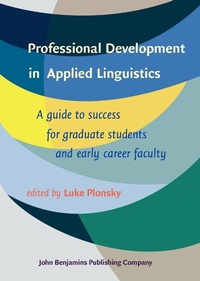
Professional Development in Applied Linguistics
A guide to success for graduate students and early career faculty
1st Edition
Published on 30. July 2020
210 pages
978-90-272-6097-0 (ISBN)
Description

Success in academia requires more than an understanding of discipline-specific literature and an ability to teach and do research. It is also necessary to develop an understanding of a range of professionally-oriented skills such as how to identify and apply to doctoral programs, how to make the most of conferences, how to achieve a semblance of work-life balance, and how to land a job. Unfortunately, however, training on such professional matters is often inconsistent and/or idiosyncratic. This book seeks to consolidate and demystify these critical and often-misunderstood aspects of professional development in the context of applied linguistics. Put another way, this book is an attempt at the text many of us wish we had as we began our graduate studies. Throughout the book, readers will find anecdotes and insights informed by individual authors' first-hand experiences. The resulting tone across the volume is that of a meet-up with a trusted and thoughtful mentor. As readers "e;meet"e; with these mentors, it is the hope of this volume that their guidance will help move readers closer to realizing their professional goals in applied linguistics.
More details
Other editions
Additional editions
Luke Plonsky
Professional Development in Applied Linguistics
A guide to success for graduate students and early career faculty
Book
07/2020
John Benjamins Publishing Co
€119.04
Shipment within 10-15 days
Content
- Intro
- Professional Development in Applied Linguistics
- Title page
- Copyright page
- Table of contents
- Chapter 1. On the state of professional development in applied linguistics
- What does this book have to offer?
- Conclusion
- Chapter 2. Demystifying the process: Choosing, applying to, and getting accepted to a doctoral program in applied linguistics
- Introduction
- Choosing programs
- Applying
- Getting accepted and accepting an offer
- Conclusion
- References
- Chapter 3. Navigating graduate school and academia: Key questions and answers
- Advising
- Choosing an advisor
- Interviewing prospective advisors (and other advisees)
- Balancing senior, mid-career, or junior scholars as advisors and committee members
- Co-advising: The best of both worlds or a multitude of sins?
- What about when you have no choice?
- Problems: What happens when it's not working?
- Academic life in a Ph.D. program
- RA Jobs
- Department reading or working groups
- Professional organizations
- Developing your CV
- Social media
- A note of caution
- Teaching experience
- Manuscript editing
- Navigating department or committee politics
- Putting it out there: Conferences
- What conferences should I submit to?
- Where can I get feedback on my abstract?
- How will I fund my travel to the conference?
- What sort of logistical issues should I plan for in delivering my paper?
- How can I make the best of networking at a conference?
- Putting it out there: Publishing
- When you should start thinking about publishing
- Where should you publish
- How to get published
- Rejection, or is it?
- Acknowledgement
- References
- Chapter 4. Making the most of your applied linguistics conference experience: Things to do before, during and after the event
- Introduction
- Before the conference
- During the conference
- After the conference
- Concluding remarks
- Chapter 5. Towards achieving work-life balance in academia: Comments and personal essays from six applied linguists
- Introduction
- Theme 1: The blessing and curse of having a flexible schedule
- Theme 2: Efficiency strategies
- Theme 3: Boundary-setting
- Theme 4: Kids
- Theme 5: Sacrifices, and trade-offs, and priorities
- Managing work-life balance: The rule that saved both my sanity and my social life
- What I've learned about being an academic
- Achieving a life-work balance: What teacher training (and my children) taught me
- Living on the periphery: Cause of despair or source of hope?
- About me
- How to cope with disadvantages
- Conclusion
- Work-life balance: My work-in-progress
- References
- Chapter 6. Towards the successful completion of a doctoral dissertation
- The pre-enrolment period
- The provisional enrolment period
- An initial discussion about supervisor and student expectations, requirements, and preferred approaches
- A discussion about the initial research proposal and what is required for confirmation in the doctoral programme
- Preparing the confirmation proposal
- Assessing the readiness for you to become a confirmed doctoral student
- The confirmation of candidature period
- Pre-research and pre-writing advice meetings and post-research and post-writing feedback meetings
- Research activities
- Chapter writing
- Feedback from other people
- The submission and viva period
- Preparing for the viva or oral defence of your dissertation
- Conclusion
- References
- Chapter 7. Navigating the academic job market
- Preparing for the job market: Start early!
- Early market analysis
- Establishing a record of research: Presentations and publications
- Document academic activity
- Starting the search
- Developing application materials
- Cover letter
- CV
- Recommendation letters
- Others
- Wider marketing
- Interview process
- General interview guidelines
- Preliminary interviews at professional meetings
- Videoconference/phone interviews
- Campus visit
- Negotiating and accepting an offer
- Conclusion
- References
- Additional resources
- Chapter 8. Handling interpersonal and departmental dynamics
- Service
- Shooting yourself in the foot
- Aim to please, but don't be a sucker!
- Dealing with students
- Service, gender, and race
- Teaching
- Research
- Other aspects of dealing with interpersonal and departmental dynamics
- Dealing with your chair or unit head
- Territorial issues
- Hierarchies, competitiveness, and politics
- Knowledge is your friend
- Who to ask for advice
- Final words
- References
- Chapter 9. Reviewing manuscripts for academic journals
- What to expect
- Benefits
- Access
- Intellectual and professional development
- Intrinsic rewards
- Influence
- Considerations
- Other priorities and obligations
- Personal impact
- Contribution: Effort ratio
- Approaches
- Fair and constructive criticism
- Specificity
- Clarity and organization
- Hows and what ifs
- How long should a review be, and how long should it take?
- How soon should you prioritize writing a review?
- What tends to work as a general approach?
- How do you decide on an overall recommendation?
- What if you think you know the identity of the author?
- Some final thoughts
- Acknowledgment
- References
- Additional resources
- Chapter 10. Engaging with professional organizations
- Making the case
- Charting the course
- The American Council on the Teaching of Foreign Languages (ACTFL) and the American Association of Teachers of German (AATG)
- What were the real world issues?
- ACTFL, AATG, and the proficiency and Standards movements
- What did I learn?
- The Northeast Conference On The Teaching Of Foreign Languages (NECTFL)
- What were the real-world issues?
- What did I learn?
- The Modern Language Association (MLA)
- What were - and are - the real-world issues?
- What did I learn?
- The College Board
- The American Association For Applied Linguistics (AAAL) - and concluding reflections
- What were the real-world issues?
- What might we yet learn?
- References
- Chapter 11. Supervising doctoral students and managing the supervisor-supervisee relationship
- References
- Chapter 12. Crossing over: Writing (and talking) for general (as compared to academic) audiences
- Two audiences, two voices
- Mutual suspicion, mutual misunderstanding
- A bumpy road
- Moving between two worlds
- References
- Chapter 13. Preparing for tenure & promotion
- Introduction
- Early and often. in voting and on the tenure-track, too!
- Getting organized: Lots of ways to skin a cat
- Join the club! .Or find your groove.
- Rome was not built in a day. and the academic cha-cha (a few steps forward, one step back)
- Starting out on the right foot: The early years
- Understand what is expected of you
- Finding your (inner) resting bitch face.
- Not my circus, not my monkeys.
- Yes! Yes! A thousand times yes! (Or maybe just a few.)
- Are you my mother? And other helpful relationships
- Squirrel! Stay the course and don't get (too) distracted
- The mid-term review
- Finding your voice.
- The home stretch (not to be confused with the seventh-inning stretch - you can rest later!)
- Speak now or forever hold your peace. (AKA the tenure statement)
- The big picture: Advice for the long-term
- The Cliffs Notes version (or, as some know it, Conclusion)
- Index
