

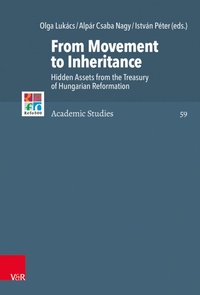
From Movement to Inheritance
Hidden Assets from the Treasury of Hungarian Reformation
1st Edition
Published on 12. August 2019
206 pages
978-3-647-50349-3 (ISBN)
Description

This book does not only deal with the history, but also with the effects of the Reformation over the mentality, education and scientifical research among Hungarians during the last five centuries. The spirit of the Reformation has not only been a church-forming factor, but also a force of nation-building and salvation. This volume includes 17 studies of Hungarian Reformed theologians presented at a conference in November 2016. The main goal was to give an overview of the most recent research results in history and theology regarding Reformation and its effects over society and mentality among Hungarians. The contributors come from various Hungarian theological universities from the Carpathian basin, thus the book is an overview of their research topics and results. The City Cluj-Napoca was, became and remained an important center of the Reformation, as significant events took place in its surroundings as well. The Faculty of Reformed Theology of the Babe?-Bolyai University and the Protestant Theological Institute has always functioned in an environment, where the challenges of multi-confessionalism and multiethnicity are also present beside interdisciplinarity.
Olga Lukács, PhD is Associate Professor at the Faculty of Reformed Theology of the Babe?-Bolyai University of Cluj-Napoca and is currently the Dean of the Faculty and a Reformed pastor.
Olga Lukács, PhD is Associate Professor at the Faculty of Reformed Theology of the Babe?-Bolyai University of Cluj-Napoca and is currently the Dean of the Faculty and a Reformed pastor.
More details
Other editions
Additional editions
Olga Lukács | Alpár Csaba Nagy | István Péter
From Movement to Inheritance
Hidden Assets from the Treasury of Hungarian Reformation
Book
08/2019
1st Edition
Vandenhoeck & Ruprecht
€89.00
Shipment within 7-9 days
Persons
Olga Lukács, PhD is Associate Professor at the Faculty of Reformed Theology of the Babe¿-Bolyai University of Cluj-Napoca and is currently the Dean of the Faculty and a Reformed pastor.
Content
- Intro
- Title Page
- Copyright
- Foreword
- Table of Contents
- Zsolt Czinke: The First Hungarian Translator of the Second Helvetic Confession
- Body
- Summary
- 1. Who was Péter Szenci Csene?
- 2. The bishop
- 3. The translator and the translation
- 4. The confession in Hungarian language
- 5. The heritage
- 6. Another Hungarian translations
- Bibliography
- Attila Lévai: Notes on Czech-Hungarian Historical Relations - Aspects of the Life and Work of Antal János Valesius
- Summary
- 1. Notes on the History of the Era
- 2. A Short Detour - A Glimpse at his Life
- 3. The Role of Valesius in the Development of Czech-Hungarian Relations
- 4. Valesius and his Relations with the Persecuted Czech and Moravian Protestants in Hungary
- 5. His last years
- 6. Letters of Dean Valesius 1725-1740
- Bibliography
- József Pálfi: The role of Sámuel Teleki in the Second Reformation of Nagyvárad
- Summary
- 1. The solitary abandoned life of the Protestant Church of Nagyvárad during the eighteenth century
- 2. József Keresztesi
- 3. Teleki's role in the events of Nagyvárad
- Bibliography
- Alfréd Somogyi: Károly Patay: An Undeservedly Forgotten Hungarian Church Governor from Felvidék
- Summary
- 1. Biography
- 2. Of his ecclesiastical role during the period of the unity of the Transdanubian Reformed Church District, i.e., up to the end of WWI
- 3. His work as a church leader and church governor
- Bibliography
- István Szabadi: Attracted by Transylvania - Contributions to the Early Modern Reformed Church History of Partium
- Summary
- Bibliography
- István Pocze: Suffering and the Cross in the Theology of Martin Luther
- Summary
- 1. Introduction
- 2. The "theologia crucis", as the cornerstone of Luther's theological thinking
- 3. God as a hidden God seemingly in contradiction to Himself
- 4. Viewing Christ's suffering and approaches to the subject
- Bibliography
- S. Béla Visky: Introduction to the Protestant Interpretation of the Ethics of Speech
- Summary
- 1. The Scriptural Approach: The Word that determines the ontic order of human speech
- 2. Lies in our relationship with God - a sign of mistrust
- 3. Lies in the relationship with the other - suspending the autonomy of one's fellow human beings, denying their personal existence and cancelling the relationship of trust with them
- 4. Lying and identity - self-deception, the loss of freedom and openness
- Bibliography
- Lehel Lészai: The Disciples in Hellenism and Rabbinism
- Summary
- 1. The disciples in Hellenism
- 2. The disciples in Rabbinism
- Bibliography
- Judit Bognárné Kocsis: The Guardian and Mediator of the Values of the Reformation in Pedagogy: Sándor Karácsony
- Abstract
- 1. Introduction
- 2. Sándor Karácsony's view on the role of the Reformed religion
- 3. The stages and products of Sándor Karácsony's religious development
- 4. Reformed values in Sándor Karácsony's system of views
- 5. Sándor Karácsony's image of pedagogues
- 6. Summary
- Bibliography
- Gabriella Gorbai: The view of children in the age of Reformation
- Summary
- 1. Martin Luther on children and religious education
- 2. Calvin on children and religious education
- 3. The materials and methods of religious education in the age of the Reformation
- 4. The age of Reformation and care for the children
- 5. Reformation era schools and attention to the needs of the child
- 6. Outlook - aims and tasks then and now
- 7. Religious education begins in the family
- 8. Education with authority?
- 9. Corporal punishment, beating, as a tool of religious education
- 10. We have to translate the Bible
- 11. Conclusions
- Bibliography
- József Kurta: Lajos Gönczy, representative figure of the Transylvanian dialectical theology (1889-1986)
- Summary
- 1. Childhood and early schooling
- 2. Theological studies 1907-1912
- 3. The early years of his formation. 1912-1914
- 4. Service of ministry. 1914-1926
- 5. Teaching between 1926 and 1948
- 6. Lajos Gönczy and the liturgy reform of 1929-1932
- 7. The "Liturgika" book of liturgy
- 8. "Retirement" 1948-1986
- Bibliography
- Olga Lukács: Re-formation or Quo Vadis Ecumenism?
- Summary
- Bibliography
- Alpár Csaba Nagy: Saul at the Witch of Endor - Attempt at Reinterpreting an Old Testament Story
- Summary
- Bibliography
- Károly Zsolt Nagy: The Heritage and the Heirs
- Summary
- Bibliography
- Sarolta Püsök: Interplay of Tradition and Innovation in the Transylvanian Reformed Church after 1989
- Summary
- Bibliography
- Edit Somfalvi: Lajos Imre - The Renewer of Teaching Catechism at the Reformed Theology in Kolozsvár
- Summary
- 1. Biography
- 2. Studies
- 3. Professor of Practical Theology - The Renewer of the Catechisation Work in Transylvania
- Bibliography
- List of Contributors
