

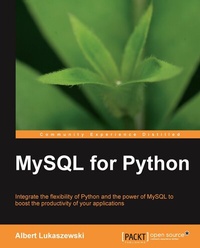
MySQL for Python
Integrating MySQL and Python can bring a whole new level of productivity to your applications. This practical tutorial shows you how with examples and explanations that clarify even the most difficult concepts.
Published on 13. January 2025
440 pages
978-1-84951-019-6 (ISBN)
Description

Integrating MySQL and Python can bring a whole new level of productivity to your applications. This practical tutorial shows you how with examples and explanations that clarify even the most difficult concepts.
Key Features
Implement the outstanding features of Python's MySQL library to their full potential
See how to make MySQL take the processing burden from your programs
Learn how to employ Python with MySQL to power your websites and desktop applications
Apply your knowledge of MySQL and Python to real-world problems instead of hypothetical scenarios
A manual packed with step-by-step exercises to integrate your Python applications with the MySQL database server
Book DescriptionPython is a dynamic programming language, which is completely enterprise ready, owing largely to the variety of support modules that are available to extend its capabilities. In order to build productive and feature-rich Python applications, we need to use MySQL for Python, a module that provides database support to our applications. Although you might be familiar with accessing data in MySQL, here you will learn how to access data through MySQL for Python efficiently and effectively.This book demonstrates how to boost the productivity of your Python applications by integrating them with the MySQL database server, the world's most powerful open source database. It will teach you to access the data on your MySQL database server easily with Python's library for MySQL using a practical, hands-on approach. Leaving theory to the classroom, this book uses real-world code to solve real-world problems with real-world solutions.The book starts by exploring the various means of installing MySQL for Python on different platforms and how to use simple database querying techniques to improve your programs. It then takes you through data insertion, data retrieval, and error-handling techniques to create robust programs. The book also covers automation of both database and user creation, and administration of access controls. As the book progresses, you will learn to use many more advanced features of Python for MySQL that facilitate effective administration of your database through Python. Every chapter is illustrated with a project that you can deploy in your own situation.By the end of this book, you will know several techniques for interfacing your Python applications with MySQL effectively so that powerful database management through Python becomes easy to achieve and easy to maintain.What you will learn
Explore the various means to install MySQL for Python, from using an egg to unrolling a tarball
Query the database and retrieve records through MySQL for Python
Implement insertion of data into a MySQL database in Python
Carry out error-handling in MySQL for Python in order to ensure the robustness of programs
Use secure logging techniques to record how your users use your programs
Carry out record-by-record retrieval to save a lot of overhead while retrieving data
Handle insertion of large amounts of data using iteration and the executemany function
Automate the creation and removal of databases and tables using MySQL for Python
Use the MySQL for Python library to automate user creation and to administer access controls
Log user activity with MySQL for Python by using MySQL s date and time support
See how to revise database programs to include more functionality
Use aggregate functions to make MySQL take the burden off your web server
Save time and processing resources by scripting JOINs and subqueries
Who this book is forThis book is meant for intermediate users of Python who want hassle-free access to their MySQL database through Python. If you are a Python programmer who wants database-support in your Python applications, then this book is for you. This book is a must-read for every focused user of the MySQL for Python library who wants real-world applications using this powerful combination of Python and MySQL.
Key Features
Implement the outstanding features of Python's MySQL library to their full potential
See how to make MySQL take the processing burden from your programs
Learn how to employ Python with MySQL to power your websites and desktop applications
Apply your knowledge of MySQL and Python to real-world problems instead of hypothetical scenarios
A manual packed with step-by-step exercises to integrate your Python applications with the MySQL database server
Book DescriptionPython is a dynamic programming language, which is completely enterprise ready, owing largely to the variety of support modules that are available to extend its capabilities. In order to build productive and feature-rich Python applications, we need to use MySQL for Python, a module that provides database support to our applications. Although you might be familiar with accessing data in MySQL, here you will learn how to access data through MySQL for Python efficiently and effectively.This book demonstrates how to boost the productivity of your Python applications by integrating them with the MySQL database server, the world's most powerful open source database. It will teach you to access the data on your MySQL database server easily with Python's library for MySQL using a practical, hands-on approach. Leaving theory to the classroom, this book uses real-world code to solve real-world problems with real-world solutions.The book starts by exploring the various means of installing MySQL for Python on different platforms and how to use simple database querying techniques to improve your programs. It then takes you through data insertion, data retrieval, and error-handling techniques to create robust programs. The book also covers automation of both database and user creation, and administration of access controls. As the book progresses, you will learn to use many more advanced features of Python for MySQL that facilitate effective administration of your database through Python. Every chapter is illustrated with a project that you can deploy in your own situation.By the end of this book, you will know several techniques for interfacing your Python applications with MySQL effectively so that powerful database management through Python becomes easy to achieve and easy to maintain.What you will learn
Explore the various means to install MySQL for Python, from using an egg to unrolling a tarball
Query the database and retrieve records through MySQL for Python
Implement insertion of data into a MySQL database in Python
Carry out error-handling in MySQL for Python in order to ensure the robustness of programs
Use secure logging techniques to record how your users use your programs
Carry out record-by-record retrieval to save a lot of overhead while retrieving data
Handle insertion of large amounts of data using iteration and the executemany function
Automate the creation and removal of databases and tables using MySQL for Python
Use the MySQL for Python library to automate user creation and to administer access controls
Log user activity with MySQL for Python by using MySQL s date and time support
See how to revise database programs to include more functionality
Use aggregate functions to make MySQL take the burden off your web server
Save time and processing resources by scripting JOINs and subqueries
Who this book is forThis book is meant for intermediate users of Python who want hassle-free access to their MySQL database through Python. If you are a Python programmer who wants database-support in your Python applications, then this book is for you. This book is a must-read for every focused user of the MySQL for Python library who wants real-world applications using this powerful combination of Python and MySQL.
All prices
More details
Edition
Digital original
Language
English
Place of publication
Birmingham
United Kingdom
Target group
Professional and scholarly
US School Grade: College Graduate Student
Edition type
Digital original
Product notice
Reflowable
File size
0,57 MB
ISBN-13
978-1-84951-019-6 (9781849510196)
Copyright in bibliographic data and cover images is held by Nielsen Book Services Limited or by the publishers or by their respective licensors: all rights reserved.
Schweitzer Classification
Other editions
Additional editions
Book
09/2010
Packt Publishing
€64.20
Shipment within 3-4 weeks
Person
Lukaszewski Albert :
Albert Lukaszewski is a principal consultant for Lukaszewski Consulting Services in southeast Scotland. He has programmed computers for nearly 30 years. Much of his experience is related to text processing, database systems, and natural language processing (NLP). Currently he consults on database applications for companies in the financial and publishing industries.
Albert Lukaszewski is a principal consultant for Lukaszewski Consulting Services in southeast Scotland. He has programmed computers for nearly 30 years. Much of his experience is related to text processing, database systems, and natural language processing (NLP). Currently he consults on database applications for companies in the financial and publishing industries.
Content
Table of Contents
