

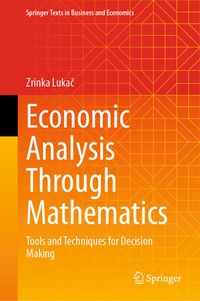
Economic Analysis Through Mathematics
Description

This textbook introduces readers to the mathematical topics fundamental for the study of economics through a combination of formal definitions, theorems, and proofs, including intuitive and easy-to-follow explanations and visualizations. Its goal is to help students understand the underlying concepts and develop an intuitive understanding of each notion, conclusion, and method presented, supported by formal proofs and approximately 270 worked-out examples. After covering these formal definitions and theorems, the book uses plain language and numerous illustrations (including visual and step-by-step examples) to clarify them and to hone readers' problem-solving skills. Additionally, it demonstrates how these concepts and mathematical methods are applied in economics, highlighting their relevance. It contains a set of theoretical questions and practice problems with solutions at the end of each subchapter.
The book is useful not only for undergraduate students, but also for graduate and PhD students, early-career researchers, and any academic who would like to review, strengthen, and consolidate knowledge and skills, and become a powerful researcher.
More details
Other editions
Additional editions
Person
Zrinka Lukac is a full professor at the Department of Mathematics, Faculty of Economics and Business - Zagreb, University of Zagreb, Croatia. She has developed curricula for several quantitative courses at the doctoral, graduate, and undergraduate levels and authored five university textbooks. From 2016-2020 she served as the president of the Croatian Operational Research Society. She was also a Fulbright Scholar at the University of Colorado, Boulder, USA. Her research interests include metaheuristic optimization, bilevel programming and modelling optimization problems in microeconomics.
Content
Matrices and types of matrices.- Basic matrix operations.- Determinants.- Systems of linear equations.- Vectors and Vector Spaces.- Applications of linear algebra in economics.- Real functions of one real variable.- The concept of a limit.- Continuous functions.- Single-Variable Differentiation.- Approximating functions with polynomials and mean value theorems.- Optimization of Functions of One Variable.- Some economic applications.- The concept of a function of several variables.- Differential calculus of functions of several variables.- Homogeneous functions.- Convex and concave functions.- Optimization of functions of several variables.- Applications of multivariable calculus in economics.- Integrals.- Differential equations.- Application of integrals and differential equations in economics.- Interest.- Simple Interest.- Compound Interest.- Simple Annuities.- Amortization Schedules.
