

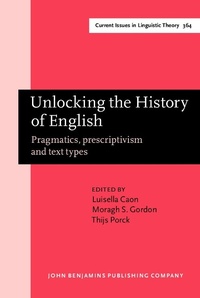
Unlocking the History of English
Pragmatics, prescriptivism and text types. Selected papers from the 21st ICEHL
1st Edition
Published on 15. April 2024
261 pages
978-90-272-4699-8 (ISBN)
Description

This volume brings together contributions selected from papers delivered at the 21st International Conference on English Historical Linguistics (ICEHL, Leiden 2021). The chapters deal with aspects of language use throughout the history of English, including efforts to prescribe and regulate language in texts that share specific forms, functions and audiences. They feature both quantitative and qualitative analyses of changing language use, often in relation to trends of language advice in such metalinguistic works as grammars, spelling books and usage guides. The authors showcase work on pragmatics and prescriptivism (understatement between Middle and Late Modern English, capitalization of common nouns from Early to Late Modern English and the use of stigmatized grammatical variants in eighteenth-century plays), specific text types (case studies of political, legal and medical English) and the language of late modern letters (diachronic stylistic changes, letter-copying practices, the role of letter-writing manuals and changing spelling practices). This volume will be of interest to those working on pragmatics, prescriptivism and sociolinguistics of English, historical linguistics, language change, computational historical linguistics and related sub-disciplines.
More details
Other editions
Additional editions

Luisella Caon | Moragh S. Gordon | Thijs Porck
Unlocking the History of English
Pragmatics, prescriptivism and text types. Selected papers from the 21st ICEHL
Book
04/2024
John Benjamins Publishing Co
€150.05
Shipment within 10-15 days
Content
- Intro
- Foreword
- Introduction
- 1. Introduction
- 2. Pragmatics and prescriptivism
- 3. Political, legal and medical text types
- 4. The language of late modern letters
- 5. Conclusion
- Bibliography
- Part I Pragmatics and prescriptivism
- Researching understatement in the history of English
- 1. Introduction
- 2. Delimiting understatement
- 3. Understatement in the history of English
- 4. Data and methodology
- 5. The metalinguistic approach
- 6. The form-to-function approach
- 6.1 Metapragmatic marking
- 6.2 Negation
- 6.3 Quantity and degree expressions
- 7. Conclusion
- References
- The rise and fall of sentence-internal capitalization in English
- 1. Introduction
- 2. The evolution of sentence-internal capitalization
- 3. Sentence-internal capitalization
- 3.1 Corpus study
- 3.2 Spelling books and grammars
- 4. Conclusion
- Acknowledgements
- References
- Appendix. Grammars and spelling books (short titles)
- Chapter 3 Gender, genre, and prescriptivism
- 1. Introduction
- 2. Context
- 3. Methods
- 4. A broadly quantitative overview
- 5. Accounting for idiolects
- 5.1 Frances (Chamberlaine) Sheridan (1724-1766)
- 5.2 Elizabeth (Griffith) Griffith (1727-1793)
- 5.3 Charlotte (Ramsay) Lennox (1730/31?-1804)
- 5.4 Dorothea (Mallet) Celesia (1738-1790)
- 5.5 The insufficiency of demographics
- 6. Dramatic functions of you was
- 6.1 Insults, lies, and teasing
- 6.2 Anger, offense, and "being out of control"
- 6.3 Modeling the indexical field of you was
- 7. Discussion
- 8. Conclusion
- Acknowledgements
- References
- Part II Political, legal and medical text types
- A manipulative technique in a congressional debate
- 1. Introduction
- 2. An argument by James Jackson in the debate of June 8, 1789
- 3. Conclusion
- References
- Is legal discourse really "outside the ravages of time"?
- 1. Introduction
- 2. Nominalizations in legal discourse
- 3. Sources and methodology
- 4. Results
- 4.1 Overall distribution
- 4.2 Diachronic distribution
- 5. Conclusion
- Funding
- Acknowledgments
- References
- Appendix 1. Raw frequencies of nominalizing suffixes per subperiod in CHELAR and CoCELD
- Appendix 2. Raw frequencies of aggregation of new types per suffix and per subperiod in CHELAR and CoCELD
- Duties, offices, and conduct
- 1. General and specific aims
- 2. Socio-cultural background
- 3. Sources
- 4. Methods
- General issues
- Word selection
- 5. Results
- 6. Discussion
- 6.1 Gregory's Observations (1770) and Lectures (1772)
- 6.2 Percival's Jurisprudence (1794) and Ethics (1803)
- 7. Final remarks
- Funding
- References
- Part III The language of late modern letters
- Changing styles of letter-writing?
- 1. Introduction
- 2. Background
- 2.1 Analysing colloquialization and involved style
- 2.2 Colloquialization and gendered styles in personal correspondence
- 3. Material and methods
- 3.1 Material
- 3.2 Methods
- 4. Analysis
- 4.1 Initial exploration
- 4.2 Results
- 4.3 Results
- 5. Discussion
- 6. Conclusion
- Funding
- Acknowledgements
- References
- "No criticism or remarks & pray burn it as fast as you read it"
- 1. Introduction
- 2. Eighteenth-century letters and copies
- 2.1 Eighteenth-century letters as linguistic data
- 2.2 Writing and copying letters in the eighteenth century
- 3. Copying journal letter entries by the same author
- 3.1 Changes
- 3.2 Discussion
- 4. Copying an in-letter by the recipient
- 4.1 Changes
- 4.2 Discussion
- 5. Concluding remarks
- Acknowledgments
- References
- Filled-in petition forms and hand-drafted petitions to the Foundling Hospital
- 1. Introduction
- 2. The context of the petitions
- 2.1 The Foundling Hospital in eighteenth-century London
- 2.2 The petitioners
- 3. Petitions in letter-writing manuals in eighteenth-century Britain
- 4. Spelling in letter writing in Late Modern England
- 5. The present study
- 5.1 Data and method
- 5.2 Analysis
- 5.2.1 Formal aspects
- 5.2.1.1 Filled-in petitions
- 5.2.1.2 Hand-drafted petitions
- 5.2.1.3 Filled-in petition forms and hand-drafted petitions compared
- 5.2.1.4 Model petitions in manuals and real petitions compared
- 5.2.2 Spelling in the filled-in petition forms and the hand-drafted petitions
- 5.2.2.1 Spelling in the filled-in petition forms
- 5.2.2.2 Spelling in the hand-drafted petitions
- 5.2.2.3 Spelling in filled-in petition forms and hand-drafted petitions compared
- 5.2.2.4 Spelling in model petitions and in real petitions compared
- 6. Concluding remarks
- Funding
- Acknowledgements
- References
- "Quhen I am begun to write I really knou not what to say"
- 1. Introduction
- 2. Divergence and convergence in the history of Scots
- 2.1 Defining 'Older' Scots?
- 2.2 The variable &quh-&
- 3. Research questions
- 4. Data and methods
- 5. Results
- 5.1 Use of &quh-& across author
- 5.2 Professional background
- 5.3 Use of &quh-& across lexical item
- 5.4 The role of abbreviation
- 5.5 The influence of topic
- 6. Conclusion
- References
- Appendix
- Index
