

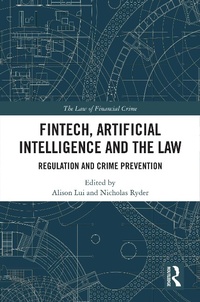
FinTech, Artificial Intelligence and the Law
Regulation and Crime Prevention
1st Edition
Published on 29. July 2021
302 pages
978-1-000-41262-8 (ISBN)
Description

This collection critically explores the use of financial technology (FinTech) and artificial intelligence (AI) in the financial sector and discusses effective regulation and the prevention of crime.
Focusing on crypto-assets, InsureTech and the digitisation of financial dispute resolution, the book examines the strategic and ethical aspects of incorporating AI into the financial sector. The volume adopts a comparative legal approach to: critically evaluate the strategic and ethical benefits and challenges of AI in the financial sector; critically analyse the role, values and challenges of FinTech in society; make recommendations on protecting vulnerable customers without restricting financial innovation; and to make recommendations on effective regulation and prevention of crime in these areas.
The book will be of interest to teachers and students of banking and financial regulation related modules, researchers in computer science, corporate governance, and business and economics. It will also be a valuable resource for policy makers including government departments, law enforcement agencies, financial regulatory agencies, people employed within the financial services sector, and professional services such as law, and technology.
Focusing on crypto-assets, InsureTech and the digitisation of financial dispute resolution, the book examines the strategic and ethical aspects of incorporating AI into the financial sector. The volume adopts a comparative legal approach to: critically evaluate the strategic and ethical benefits and challenges of AI in the financial sector; critically analyse the role, values and challenges of FinTech in society; make recommendations on protecting vulnerable customers without restricting financial innovation; and to make recommendations on effective regulation and prevention of crime in these areas.
The book will be of interest to teachers and students of banking and financial regulation related modules, researchers in computer science, corporate governance, and business and economics. It will also be a valuable resource for policy makers including government departments, law enforcement agencies, financial regulatory agencies, people employed within the financial services sector, and professional services such as law, and technology.
Reviews / Votes
"The edited collection FinTech, Artificial Intelligence and the Law raises critical legal and ethical issues in the important and contemporary topic of technology in finance. Ryder and Lui's book incorporates a range of chapters on the opportunities and challenges that come with Artificial Intelligence, and contains interesting recommendations on FinTech and Law. Lui and Ryder's editing has brought together a roster of diverse contributors on topical issues, while leaving room for new perspectives that will shape the future of fintech globally. As such, this interdisciplinary collection will be beneficial to international development and non-governmental organisation practitioners, employees within the financial services sector, as well as professional services such as law, technology and corporate governance."Ronda Zelezny-Green, PhD
More details
Series
Edition
1. Auflage
Language
English
Place of publication
London
United Kingdom
Publishing group
Taylor & Francis Ltd
Target group
College/higher education
Professional and scholarly
Illustrations
3 Tables, black and white; 7 Line drawings, black and white; 7 Illustrations, black and white
ISBN-13
978-1-000-41262-8 (9781000412628)
Copyright in bibliographic data and cover images is held by Nielsen Book Services Limited or by the publishers or by their respective licensors: all rights reserved.
Schweitzer Classification
Other editions
Additional editions
Alison Lui | Nicholas Ryder
FinTech, Artificial Intelligence and the Law
Regulation and Crime Prevention
Book
01/2023
1st Edition
Routledge
€63.70
Shipment within 10-20 days
Alison Lui | Nicholas Ryder
FinTech, Artificial Intelligence and the Law
Regulation and Crime Prevention
Book
07/2021
1st Edition
Routledge
€216.90
Shipment within 15-20 days
Persons
Alison Lui is Reader in Corporate and Financial Law, Liverpool John Moores University, UK.
Nicholas Ryder is Professor of Law, Bristol Law School, University of the West of England, UK.
Nicholas Ryder is Professor of Law, Bristol Law School, University of the West of England, UK.
Content
Part 1
1. Introduction-Mind the Gaps
Part 2-The FinTech Ecosystem
2. Automation, Virtualisation, and Value
3. InsurTech's Assurance - Value Research through an Array of ABCs
4. Improving the digital financial services ecosystem through collaboration of regulators and FinTech companies
5. Designing Social-Purpose FinTech: A UK Case Study
Part 3-Regulation of Cryptoassets and Blockchains
6. Should we trade market stability for more financial inclusion? The case of crypto-assets' regulation in EU
7. Initial Coin Offerings: Financial Innovation or Scam
8. Cryptocurrency and Crime
9. Technology and tax evasion in the world of finance: an indispensable helping hand or a facade for crime facilitation?
10. The Bank of England's approach to Central Bank Digital Currencies - Considerations regarding a native digital pound and the regulatory aspects
Part 4-Artificial Intelligence and the Law
11. AI, Big Data, Quantum Computing and Financial Exclusion: tempering enthusiasm and offering a human centric approach to policy
12. Risk of discrimination in AI systems: evaluating the effectiveness of current legal safeguards in tackling algorithmic discrimination
13. Unprecedented times: Artificial Intelligence and the implications for Intellectual Property
14. Towards a Responsible Use of Artificial Intelligence (AI) and Fintech in Modern Banking
1. Introduction-Mind the Gaps
Part 2-The FinTech Ecosystem
2. Automation, Virtualisation, and Value
3. InsurTech's Assurance - Value Research through an Array of ABCs
4. Improving the digital financial services ecosystem through collaboration of regulators and FinTech companies
5. Designing Social-Purpose FinTech: A UK Case Study
Part 3-Regulation of Cryptoassets and Blockchains
6. Should we trade market stability for more financial inclusion? The case of crypto-assets' regulation in EU
7. Initial Coin Offerings: Financial Innovation or Scam
8. Cryptocurrency and Crime
9. Technology and tax evasion in the world of finance: an indispensable helping hand or a facade for crime facilitation?
10. The Bank of England's approach to Central Bank Digital Currencies - Considerations regarding a native digital pound and the regulatory aspects
Part 4-Artificial Intelligence and the Law
11. AI, Big Data, Quantum Computing and Financial Exclusion: tempering enthusiasm and offering a human centric approach to policy
12. Risk of discrimination in AI systems: evaluating the effectiveness of current legal safeguards in tackling algorithmic discrimination
13. Unprecedented times: Artificial Intelligence and the implications for Intellectual Property
14. Towards a Responsible Use of Artificial Intelligence (AI) and Fintech in Modern Banking
