

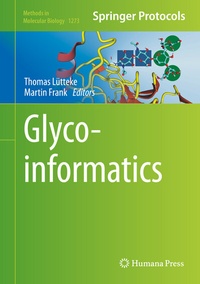
Glycoinformatics
Description

This book provides current glycoinformatics methods and protocols used to support the determination of carbohydrate structures in biological samples as well as carbohydrate structure databases, the interaction of carbohydrates with proteins, and theoretical and experimental methods to study their three-dimensional structure and dynamics. Glycoinformatics explores this recently emerged field, which has come into being in order to address the needs of encoding, storing, and analyzing carbohydrate 'sequences' and their taxonomy using computers. Written in the highly successful Methods in Molecular Biology series format, chapters contain the kind of detailed description and key implementation advice to ensure successful results.
Authoritative and timely, Glycoinformatics demonstrates the progress that has been achieved in glycoinformatics, which indicates that it is no longer a niche subject covered by only a few scientists but is truly coming of age.More details
Other editions
Additional editions
Content
Annotation of Glycomics MS and MS/MS Spectra Using the GlycoWorkbench Software Tool.- GlycoBase and autoGU: Resources for Interpreting HPLC-Glycan Data.- NMR Chemical Shift Prediction of Glycans: Application of the Computer Program CASPER in Structural Analysis.- Handling and Conversion of Carbohydrate Sequence Formats and Monosaccharide Notation.- Bacterial, Plant, and Fungal Carbohydrate Structure Databases: Daily Usage.- Using NMR Data on GLYCOSCIENCES.- Glycomic Analysis Using KEGG GLYCAN.- GlycomeDB.- Eukaryotic Glycosylation: Online Methods for Site-Prediction on Protein Sequences.- Analyzing Glycan Structure Synthesis with the Glycan Pathway Predictor (GPP) Tool.- Functional Network in Post-Translational Modifications: Glyco-Net in Glycoconjugate Data Bank.- JCGGDB: Japan Consortium for Glycobiology and Glycotechnology DataBase.- Glycan Array Data Management at Consortium for Functional Glycomics.- Analyzing Glycan Binding Patterns with the ProfilePSTMM Tool.- Exploring the Specificities of Glycan-Binding Proteins Using Glycan Array Data and the GlycoSearch Software.- Statistical Analysis of Amino Acids in the Vicinity of Carbohydrate Residues Performed by GlyVicinity.- Tools to Assist Determination and Validation of Carbohydrate 3D Structure Data.- Glyco3D : A Portal for Structural Glycosciences.- Solution Conformation of Carbohydrates: A View by Using NMR Assisted by Modeling.- Informing Saccharide Structural NMR Studies with Density Functional Theory Calculations.- Energy Maps for Glycosidic Linkage Conformations.- Conformational Analysis of Oligo- and Polysaccharides Using Molecular Dynamics Simulations.- Molecular Dynamics Simulations of Membrane- and Protein-Bound Glycolipids Using GLYCAM.- Lipopolysaccharide Membrane Building and Simulation.- Molecular Dynamics Simulations of Glycoproteins Using CHARMM.- Calculating Binding Free Energies for Protein-Carbohydrate Complexes.- Scoring Functions for AutoDock.- Structures of Glycans Bound toReceptors from Saturation Transfer Difference (STD) NMR Spectroscopy: Quantitative Analysis by Using CORCEMA-ST.- QM/MM Methods for Studying Enzymatic Reactions of Glycosyltransferases.
