

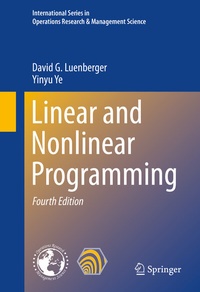
Linear and Nonlinear Programming
Description

David G. Luenberger received the B.S. degree from the California Institute of Technology and the M.S. and Ph.D. degrees from Stanford University, all in Electrical Engineering. Since 1963 he has been on the faculty of Stanford University. He helped found the Department of Engineering-Economic Systems, now merged to become the Department of Management Science and Engineering, where his is currently a professor.
He served as Technical Assistant to the President's Science Advisor in 1971-72, was Guest Professor at the Technical University of Denmark (1986), Visiting Professor of the Massachusetts Institute of Technology (1976), and served as Department Chairman at Stanford (1980-1991).
His awards include: Member of the National Academy of Engineering (2008), the Bode Lecture Prize of the Control Systems Society (1990), the Oldenburger Medal of the American Society of Mechanical Engineers (1995), and the Expository Writing Award of the Institute of Operations Research and Management Science (1999). He is a Fellow of the Institute of Electrical and Electronic Engineers (since 1975).
Yinyu Ye is currently the Kwoh-Ting Li Professor in the School of Engineering at the Department of Management Science and Engineering and Institute of Computational and Mathematical Engineering and the Director of the MS&E Industrial Affiliates Program, Stanford University. He received the B.S. degree in System Engineering from the Huazhong University of Science and Technology, China, and the M.S. and Ph.D. degrees in Engineering-Economic Systems and Operations Research from Stanford University.
Ye's research interests lie in the areas of optimization, complexity theory, algorithm design and analysis, and applications of mathematical programming, operations research and system engineering. He is also interested in developing optimization software for various real-world applications. Current research topics include Liner Programming Algorithms, Markov Decision Processes, Computational Game/Market Equilibrium, Metric Distance Geometry, Dynamic Resource Allocation, and Stochastic and Robust Decision Making, etc. He is an INFORMS (The Institute for Operations Research and The Management Science) Fellow, and has received several research awards including the inaugural 2012 ISMP Tseng Lectureship Prize for outstanding contribution to continuous optimization, the 2009 John von Neumann Theory Prize for fundamental sustained contributions to theory in Operations Research and the Management Sciences , the inaugural 2006 Farkas prize on Optimization, and the 2009 IBM Faculty Award.
More details
Other editions
New editions
Additional editions
Previous edition
Persons
David G. Luenberger received the B.S. degree from the California Institute of Technology and the M.S. and Ph.D. degrees from Stanford University, all in Electrical Engineering. Since 1963 he has been on the faculty of Stanford University. He helped found the Department of Engineering-Economic Systems, now merged to become the Department of Management Science and Engineering, where his is currently a professor.
He served as Technical Assistant to the President's Science Advisor in 1971-72, was Guest Professor at the Technical University of Denmark (1986), Visiting Professor of the Massachusetts Institute of Technology (1976), and served as Department Chairman at Stanford (1980-1991).
His awards include: Member of the National Academy of Engineering (2008), the Bode Lecture Prize of the Control Systems Society (1990), the Oldenburger Medal of the American Society of Mechanical Engineers (1995), and the Expository Writing Award of the Institute of Operations Research and Management Science (1999). He is a Fellow of the Institute of Electrical and Electronic Engineers (since 1975).
Yinyu Ye is currently the Kwoh-Ting Li Professor in the School of Engineering at the Department of Management Science and Engineering and Institute of Computational and Mathematical Engineering and the Director of the MS&E Industrial Affiliates Program, Stanford University. He received the B.S. degree in System Engineering from the Huazhong University of Science and Technology, China, and the M.S. and Ph.D. degrees in Engineering-Economic Systems and Operations Research from Stanford University.
Ye's research interests lie in the areas of optimization, complexity theory, algorithm design and analysis, and applications of mathematical programming, operations research and system engineering. He is also interested in developing optimization software for various real-world applications. Current research topics include Liner Programming Algorithms, Markov Decision Processes, Computational Game/Market Equilibrium, Metric Distance Geometry, Dynamic Resource Allocation, and Stochastic and Robust Decision Making, etc. He is an INFORMS (The Institute for Operations Research and The Management Science) Fellow, and has received several research awards including the inaugural 2012 ISMP Tseng Lectureship Prize for outstanding contribution to continuous optimization, the 2009 John von Neumann Theory Prize for fundamental sustained contributions to theory in Operations Research and the Management Sciences, the inaugural 2006 Farkas prize on Optimization, and the 2009 IBM Faculty Award.
