

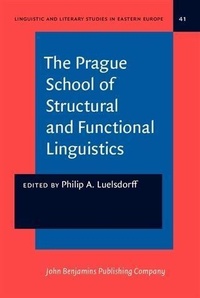
The Prague School of Structural and Functional Linguistics
1st Edition
Published on 7. November 1994
VII, 385 pages
978-90-272-7663-6 (ISBN)
Description

The importance of the Prague School for the rise of structuralism and for integration of the theoretical linguistics of today can hardly be overestimated. The volume brings together 13 papers showing the main results of the research of the Prague School and of its continuation in the domains of phonemics and written language, morphemics and word formation, lexicon, syntax and semantics, text structures, stylistics and typology. The authors all actively contributed to the domain they are treating here.
More details
Other editions
Additional editions
Philip A. Luelsdorff
The Prague School of Structural and Functional Linguistics
Book
11/1994
John Benjamins Publishing Co
€132.50
Shipment within 10-15 days
Person
Content
- THE PRAGUE SCHOOL OF STRUCTURAL AND FUNCTIONAL LINGUISTICS A SHORT INTRODUCTION
- Editorial page
- Title page
- Copyright page
- Table of contents
- Index of Abbreviations
- 0. Introduction
- Notes
- References
- 1. Phonology and Graphemics
- APPENDIX
- References
- 2. Prague School Morphonology
- 1. Morphonological works of Trubetzkoy
- 2. The morphonologicai conception of Trubetzkoy
- 3. Variations of morphemes - the morphoneme
- 4. An evaluation of Trubetzkoy's approach to morphonology
- 5. The development of morphonology in Prague after 1945
- References
- 3. Morphological Categories in the Prague School
- 1. What do the CLP Thèses say about the topic of this chapter?
- 2. What preceded the Thèses?
- 3. Individual conception of morphological categories in the CLP
- 4. V. Mathesius' morphological categories
- 5. R. Jakobson's theory of invariant meanings
- 6. Morphological categories in the stratification model of B. Trnka
- 7. V. Skalicka's typological model of grammatical structure
- 8. Conclusion and outlook
- Notes
- References
- 4. The Prague School's Theoretical and Methodological Contribution to "Word Formation" (Derivology)
- 1. Introductory remarks
- 2. The application of the functional and structural approach
- 3. The object of the theory of word formation and its position in a complex description of language
- 3.1 Basic notion of word formation: foundation and motivation
- 3.2 The concept of onomasiological category (OC) and the classification of OCs
- 3.3 The formation of new naming units and its means
- 3.4 The concepts of the word-formative type, the word-formative category and of productiveness
- 3.5 The morphological and the word-formative structure of the word and the morphological and word-formative analysis
- 3.6 The alternation of sounds within the base in morphological word formation
- 3.7 Problems concerning the system of word-formation and its description
- 4. Research on Czech word formation and general studies since 1962
- 5. The contribution of Czech studies in Russian to the theory and methods of word formation
- Notes
- References
- 5A. Lexicology and Lexicography: Development and State of the Research
- 1. The Development of Czech lexicology
- 2. Lexicology
- 2.1 Theory
- 2.2 Semasiology
- 2.3 Lexical onomasiology
- 2.4 External relations of lexical units
- 2.5 Lexical system
- 3. Lexicography
- References
- 5B. Idiomatics
- 1. Idioms in language and linguistics
- 2. The scope of idiomatics
- 3. The idiom
- 4. The idiom system
- 5. Transformations
- 6. Functions of idioms
- References
- 6. The Sentence-Pattern Model of Syntax
- Notes
- References
- 7. Valency Frames and the Meaning of the Sentence
- Notes
- References
- 8. Topic/Focus and Related Research
- 1. Historical background
- 2. Vilém Mathesius and his immediate followers
- 3. Topic and comment (focus) as an autonomous dichotomy
- 4. How to specify the basic notions
- 5. Articulation of what?
- 6. TFA and the levels
- 7. An explicit account of topic and focus
- 8. Response to Praguian approaches
- 9. Conclusion
- Notes
- References
- 9. Meaning, Reference and Discourse Patterns
- Notes
- References
- 10. Approach to Standard Language, its Culture, and to Style
- Notes
- References
- 11. Praguian Typology of Languages
- Notes
- References
- Indexof Names
- Indexof Subjects
