

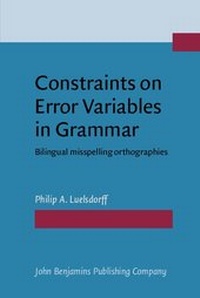
Constraints on Error Variables in Grammar
Bilingual misspelling orthographies
1st Edition
Published on 1. January 1986
VII, 442 pages
978-90-272-7447-2 (ISBN)
Description

An in-depth investigation of constraints on error variables in grammar with special reference to bilingual misspelling orthographies. A corpus of errors is examined in minute detail. In the course of this analysis, received categories and standard assumptions about linguistic errors are critically scrutinized; some are sharpened, and others are abandoned. Many conceptual snarls having to do with the notion of error in linguistic performance are untangled in this book.
More details
Other editions
Additional editions
Book
01/1986
John Benjamins Publishing Co
€153.70
Shipment within 10-15 days
Content
- CONSTRAINTS ON ERROR VARIABLES IN GRAMMAR: Bilingual Misspelling Orthographies
- Title page
- Copyright page
- Table of contents
- PREFACE
- Acknowledgements
- INTRODUCTION
- I.0. Summary
- I.1. Variation in Grammar
- I.1.1. Introduction.
- I.1.2. Syntactic dialectology.
- I.1.3. Phonological dialectology
- I.1.4. Grammars: ideal and real
- I.2. Differential Linguistics: A Program for Research
- I.2.1. Introduction
- I.2.2. Differential Linguistics
- I.2.2.1. Trait or Factor Linguistics
- I.2.2.2. Typology
- I.2.2.3. Idiographic Linguistics
- I.2.2.4. Differential Phonology
- I.2.2.5. Differential Syntax/Semantics
- I.2.2.6. Differential Vocabulary
- I.2.2.7. Differential Pragmatics
- I.2.3. Clinical Linguistics
- I.2.4. Conclusion
- I.2.5. Retrospect and prospect
- I.3. Orthography in grammar
- I.3.1. On linguistic error
- I.3.1.1. The notion ' linguistic error'
- I.3.1.2. The notion 'error' in the organon-model of language.
- I.3.2. The notion 'possible error'
- I.3.3. The sign-template and linguistic error
- I.3.4. Sign Mutation
- NOTES
- Chapter I. On Putative "Transpositions" in Spelling
- 1.0. Introduction
- 1.1. The notion "transposition
- 1.2. On taxonomies of spelling errors
- 1.3. An identity crisis
- 1.4. Displacements and conventional errors
- 1.5. A proposed security check
- 1.6. Constraints on displacement
- 1.7. A disappointing development
- 1.8. Appendix: The Displacement Corpus
- Chapter II. Letter Naming as a Spelling Strategy
- 2.0. Introduction
- 2.1. Preconventional spelling
- 2.2. Literal use and mention
- 2.3. Letter naming
- 2.4. Major patterns for primary vowels
- 2.5. Spelling: A teaching strategy
- Chapter III. Substitutions: Vowels
- 3.0. Introduction.
- 3.1. English vowel misspelings: types and causes.
- 3.1.1. English /i/.
- 3.1.2 English /I/.
- 3.1.3 English /e/.
- 3.1.4 English /e/.
- 3.1.5 English /æ/.
- 3.1.6 English /?/.
- 3.1.7 English /?/.
- 3.1.8 English /?/.
- 3.1.9 English /u/.
- 3.1.10 English /u/.
- 3.1.11 English /o/.
- 3.1.12 English /?/.
- 3.1.13 English /a/.
- 3.1.14 English /oy/
- 3.1.15 English /aw/.
- 3.1.16 English /ay/.
- 3.2. Summary.
- 3.2.1 English /i/.
- 3.2.1.1 Transfer from German
- 3.2.1.2 German letter-naming:
- 3.2.1.3 English letter-naming:
- 3.2.1.4 Phonetic spelling:
- 3.2.1.5 Slips-of-the-pen:
- 3.2.2. English /I/.
- 3.2.2.1 Regularization:
- 3.2.2.2 German spelling-pronunciation:
- 3.2.2.4 Cognatization
- 3.2.3 English /e/.
- 3.2.3.1 German letter-naming:
- 3.2.3.2 English letter-naming:
- 3.2.3.3 Irregularization:
- 3.2.3.4 Regularization:
- 3.2.4 English /e/,
- 3.2.4.1 Place of articulation of English letter-name:
- 3.2.4.2 Place of articulation of German letter-name:
- 3.2.4.3 Overgeneralization:
- 3.2 4.4 Regularization:
- 3.2.4.5 Strong conventional error:
- 3.2.4.6 Negative transfer from German:
- 3.2.4.7 Irregularization:
- 3.2.4.8 Slip-of-the-pen:
- 3.2.4.9 Decognatization:
- 3.2.5 English /æ/.
- 3.2.5.1 Interlanguage representation by approximation to German:
- 3.2.5.2 Negative paradigmatic interference from English :
- 3.2.6 English /?/.
- 3.2.6.1 Lexicalized misrepresentation:
- 3.2.6.2 German cognate spelling pronunciation
- 3.2.6.2 German cognate spelling pronunciation
- 3.2.6.3 Negative transfer from German:
- 3.2.6.4 Slip-of-the-pen:
- 3.2.7 English /?/.
- 3.2.7.1 Negative transfer from German:
- 3.2.7.2 Overgeneralization:
- 3.2.7.3 Slip-of-the-pen:
- 3.2.7.4 Lexicalized misrepresentation:
- 3.2.8 English /?/.
- 3.2.8.1 Interlanguage representation by approximation to German :
- 3.2.9 English /u/.
- 3.2.9.1 Negative transfer from German:
- 3.2.9.2 Simplification:
- 3.2.9.3 Slip-of-the-pen:
- 3.2.9.4 Irregularization:
- 3.2.9.5 Total cognatization:
- 3.2.9.6 German/English letter-naming:
- 3.2.10 English /U/.
- 3.2.10.1 German spelling pronunciation :
- 3.2.10.2 Cognatization (partial):
- 3.2.11 English /o/.
- 3.2.11.1 Negative transfer from German:
- 3.2.11.2 German letter-naming sequence:
- 3.2.11.3 Simplification:
- 3.2.11.4 Complication:
- 3.2.11.5 System-internal transfer:
- 3.2.12 English /?/.
- 3.2.12.1 Negative transfer from German:
- 3.2.12.2 Cognatization (partial):
- 3.2.12.3 Irregularization:
- 3.2.13 English /a/.
- 3.2.13.1 Negative transfer from German:
- 3.2.13.2 German letter-naming:
- 3.2.13.3 Overgeneralization:
- 3.2.13.4 Orthographic hypercorrection:
- 3.2.14 English /oy/.
- 3.2.14.1 Suppression of negative transfer from German:
- 3.2.15 English /aw/.
- 3.2.15.1 Negative transfer from German:
- 3.2.16 English /ay/.
- 3.2.16.1 Negative transfer from German:
- 3.2.16.2 Cognatization (total):
- Chapter IV. Substitutions: Consonants
- 4.0. Introduction.
- 4.1. English consonant misspellings: types and causes.
- 4.1.1 English /p/.
- 4.1.2 English /b/.
- 4.1.3 English /t/.
- 4.1.4 English /d/.
- 4.1.5 English /k/.
- 4.1.6 English /g/.
- 4.1.7 English /?/.
- 4.1.8 English /ð/.
- 4.1.9 English /f/.
- 4.1.10 English /v/.
- 4.1.11 English /s/.
- 4.1.12 English /z/.
- 4.1.13 English /s/.
- 4.1.14 English /z/.
- 4.1.15 English /c/.
- 4.1.16 English /j/.
- 4.1.17 English /m/.
- 4.1.18 English /n/.
- 4.1.19 English /?/.
- 4.1.20 English /l/.
- 4.1.21 English /r/.
- 4.1.22 English /w/.
- 4.1.23 English /j/,
- 4.1.24 English /h/.
- 4.2. Summary.
- 4.2.1 English /p/.
- 4.2.1.1 Inconsistent application of final-consonant doubling in monosyllables:
- 4.2.1.2 Doubling-rule displacement:
- 4.2.1.3 English letter-naming:
- 4.2.2 English /b/.
- 4.2.3 English /t/.
- 4.2.3.1 Negative transfer of German syllable-final obstruent devoic-ing:
- 4.2.3.2 Orthographic hypercorrection:
- 4.2.3.3 Phonetic spelling:
- 4.2.3.4 Partial phonetic spelling:
- 4.2.3.5 English letter-naming
- 4.2.3.6 Conventional errors:
- 4.2.3.7 Transfer from German:
- 4.2.4 English /d/.
- 4.2.4.1 Transfer of German syllable-final obstruent devoicing:
- 4.2.4.2 Tense substitution:
- 4.2.4.3 Slip-of-the-pen:
- 4.2.5 English/k/.
- 4.2.5.1 German/English letter-naming :
- 4.2.5.2 English intralingual interference:
- 4.2.5.3 German syllable-final obstruent devoicing:
- 4.2.5.4 Orthographic hypercorrection:
- 4.2.5.5 Conventional error:
- 4.2.5.6 Slip-of-the-pen:
- 4.2.6 English /g/.
- 4.2.6.1 Doubling-rule suspension:
- 4.2.7 English /?/.
- 4.2.7.1 Articulatory proximity:
- 4.2.8 English/ð/.
- 4.2.8.1 Mispronunciation by articulatory proximity:
- 4.2.8.2 Negative transfer of German PGC:
- 4.2.8.3 Negative intralingual transfer of misrepresentation strategy:
- 4.2.9 English /ƒ/.
- 4.2.9.1 Negative transfer of German GPC:
- 4.2.9.2 Negative transfer of German rule of syllable-final obstruent devoicing:
- 4.2.9.3 Orthographic hypercorrection:
- 4.2.9.4 Cognatization (partial):
- 4.2.9.5 Simplification:
- 4.2.9.6 Regularization:
- 4.2.9.7 Conventional error:
- 4.2.10 English /v/.
- 4.2.10.1 Negative transfer of the German rule of syllable-final obstruent devoicing:
- 4.2.10.2 Phonetic spelling:
- 4.2.10.3 Spelling by analogy:
- 4.2.10.4 Morpheme-by-morpheme spelling:
- 4.2.10.5 Conventional error:
- 4.2.11 English /s/.
- 4.2.11.1 Regularization:
- 4.2.11.2 Simplification:
- 4.2.11.3 Negative transfer of German GPC:
- 4.2.11.4 Cognatization (total):
- 4.2.11.5 Decognatization:
- 4.2.11.6 Negative transfer of German cluster:
- 4.2.11.7 Cognatization (partial):
- 4.2.11.8 Orthographic hypercorrection:
- 4.2.11.9 Interlingual allomorphic substitution:
- 4.2.12 English /z/.
- 4.2.12.1 Cognatization (total):
- 4.2.12.2 Decognatization:
- 4.2.12.3 Slip of the pen:
- 4.2.12.4 Syntagmatic interference:
- 4.2.12.5 Dual interlingual representation of preterit:
- 4.2.13 English /s/.
- 4.2.13.1 Negative transfer of German GPC:
- 4.2.13.2 Letter-deletion from native trigraph:
- 4.2.14 English /z/.
- 4.2.14.1 Negative transfer of German rule of syllable-final obstruent devoicing:
- 4.2.14.2 Negative intralingual transfer of misrepresentation strategy:
- 4.2.15 English /c/.
- 4.2.15.1 Negative transfer of German GPC:
- 4.2.15.2 Articulatory proximity:
- 4.2.15.3 German letter-naming:
- 4.2.15.4 Phonetic spelling:
- 4.2.15.5 Cluster analysis:
- 4.2.16 English /j/.
- 4.2.16.1 Negative transfer of German rule of syllable-final obstruent devoicing:
- 4.2.16.2 Morpheme-by-morpheme spelling:
- 4.2.163 Negative intralingual transfer of misrepresentation strategy:
- 4.2.17 English /m/.
- 4.2.17.1 Phonetic spelling:
- 4.2.18 English /n/.
- 4.2.18.1 Phonetic spelling:
- 4.2.18.2 Doubling-rule suspension:
- 4.2.18.3 Cognatization
- 4.2.19 English /?/.
- 4.2.19.1 Negative transfer of German rule of syllable-final obstruent devoicing:
- 4.2.19.2 Slip-of-the-pen:
- 4.2.20 English /l/.
- 4.2.20.1 Phonetic spelling:
- 4.2.21 English /r/.
- 4.2.21.1 Phonetic spelling:
- 4.2.21.2 Slip-of-the-pen:
- 4.2.22 English /w/.
- 4.2.22.1 Phonetic spelling:
- 4.2.23 English /j/.
- 4.2.23.1 Negative transfer of German GPC:
- 4.2.24 English /h/.
- 4.2.24.1 Phonetic approximation:
- Chapter V. Additions and Omissions
- 5.0. Introduction.
- 5.1 Additions.
- 5.1.1 Vowel additions.
- 5.1.2 Consonant additions.
- 5.1.3 Capitalization additions.
- 5.1.4 Letter additions.
- 5.1.5 Word additions.
- 5.1.6 Morpheme additions.
- 5.1.7 Syllable additions.
- 5.1.8 Non-letter additions.
- 5.1.9 Word-token length.
- 5.1.10 Letter position and letter addition.
- 5.2. Omissions.
- 5.2.1 Vowel omissions.
- 5.2.2 Consonant omissions.
- 5.2.3 Capitalization omissions.
- 5.2.4 Letter omissions.
- 5.2.5 Word omissions.
- 5.2.6 Morpheme omissions.
- 5.2.7 Syllable omissions.
- 5.2.8 Non-letter omissions.
- 5.2.9 Word-token length.
- 5.2.10 Letter position and letter omission.
- 5.3. Appendices.
- 5.3.1 Appendix 1 : A dditions
- 5.3.2 Appendix 2: Omissions
- Chapter VI. Anticipations and Perseverations
- 6.0. Introduction.
- 6.1. Anticipations: Definitions.
- 6.1.1 Anticipations: Lexical and literal.
- 6.1.2 Anticipates.
- 6.1.3 Anticipations: Environments.
- 6.1.4 Anticipations: Distances.
- 6.1.5 Edited anticipations.
- 6.2. Perseverations: Definitions.
- 6.2.1 Perseverations: Lexical and literal.
- 6.2.2 Perseverates.
- 6.2.3 Perseverations: Environments.
- 6.2.4 Perseverations: Distances.
- 6.2.5 Edited perseverations.
- 6.3. Alliteration, assonance, anticipations, perseverations.
- 6.4. Appendices
- 6.4.1 Appendix I: Anticipations
- 6.4.1.1 Unedited
- 6.4.1.2 Edited
- 6.4.2 Appendix II: Perseverations
- 6.4.2.1 Unedited
- 6.4.2.2 Edited
- Chapter VII. Orthographic Conduits d'Approche: Some Quantitative Aspects
- 7.0. Introduction.
- 7.1. Orthographic conduits d'approche: structure.
- 7.1.1 Substitutions.
- 7.1.2 Omissions.
- 7.1.3 Additions.
- 7.1.4 Displacements.
- 7.1.5 Erroneous error perceptions.
- 7.1.6 Homophones.
- 7.2. Differential ranks
- 7.3. Monitor strength.
- 7.4. Error salience.
- 7.5. Error correction vs. error creation.
- 7.6. Correction frequency and correction site.
- 7.7 Appendix: Orthographic conduits d'approche
- Chapter VIII. Processing Strategies in Bilingual Spellers: A Group Study
- 8.0. Introduction.
- 8.1. The group experiment.
- 8.2. The error framework.
- 8.3. English vowel misspellings: types and causes.
- 8.3.1. English /i/.
- 8.3.2. English /I/.
- 8.3.3. English /e/.
- 8.3.4 English /e/
- 8.3.5. English /æ/.
- 8.3.6. English /?/.
- 8.3.7. English /?/.
- 8.3.8. English /?/.
- 8.3.9. English /u/.
- 8.3.10. English /U/.
- 8.3.11. English /o/.
- 8.3.12. English /? /.
- 8.3.13. English /a/.
- 8.3.14. English /oy/.
- 8.3.15. English /aw/.
- 8.3.16. English /ay/.
- 8.4. Conclusions.
- 8.5. Appendix: Dictation test.
- CONCLUSION
- C.0. Conclusion.
- C.1. The relativity of categorization.
- C.2. Norms and abnorms.
- C.3. Constraints on error variables: Misspelling orthographies.
- C.3.1. Bilingual misspelling orthographies.
- C.3.2 Finger agnostics and aphasics.
- C.3.3. Spelling errors of older dyslexics.
- C.3.4. Oral and written errors.
- C.3.5. Normal native misspelling orthographies.
- C.4. On monolingual and bilingual phonological intrusions.
- C.4.1. Consonant substitutions.
- C.4.2. The relativity of intrudibles.
- C.5. Oral reading errors.
- C.5.1. From product to process.
- C.5.2. The taxonomy of oral reading errors.
- C.5.3. The graphic similarity index.
- C.6. Linguistic errors in normals and aphasics: The theory of similar constraints.
- C.6.1. Similar constraints: phonology
- C.6.1.1. Similar constraints: segmental phonology.
- C.6.1.2. Similar constraints: suprasegmental phonology.
- C.6.1.3. Lexical stress errors.
- C.6.1.4. Isochronicity and syllable additions/omissions.
- C.7. From intention to action.
- C.7.1. The theory of act selection.
- C.7.2. The theory of action and the theory of slips.
- C.7.3. The linguistic monitor: Structure and function.
- C.7.4. Cognition and Feedback.
- C.7.5. The morphology of the monitor.
- C.7.6. On the axiomatization of the linguistic monitor.
- C.8. Processing structure.
- C.9 Appendices
- C.9.1. Appendix: Widely applicable spelling rules
- C.9.2. Appendix: Scope and sequence chart for spelling
- Appendix: The Corpus
- Bibliography
- NAME INDEX
- SUBJECT INDEX
