

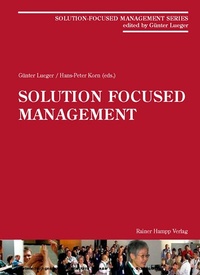
Solution-Focused Management
1st Edition
Published on 1. January 2006
470 pages
978-3-86618-098-7 (ISBN)
Description

The Solution-Focused Approach developed by Steve de Shazer and Insoo Kim Berg has been well established across many areas of society. In this book, the practical uses of solution-focused work in companies and management are shown. By means of conceptual contributions, as well as many case studies and projects in practice, current developments in Leadership, Marketing and Sales, Project Management, Work Design, Human Resources, Organisational Development and Learning, Training and Coaching, as well as Conflict Management are described. In addition, we also present empirical studies on the effect of solution-focused work in enterprises.
The Authors
Günter Lueger looks for opportunities to do things in management differently. He specialises in designing and redesigning management instruments and paper work in companies in a solution-focused way. Innovations include Solution Focused Rating (SFR) and Solution-focused Management Instruments, like FMT, which allow more appreciative assessments and analysis in organisations (www.solutionmanagement.net, www.fit-management.at).
Hans-Peter Korn started to work as a scientist (PhD) in nuclear physics. He was then active in line- and project-management on different levels in power plant engineering, the financial industries, air transport industries and software engineering. Fascinated with systemic and solution-focused management in theory and practice, he started his own business as an OD- and PD-consultant (www.korn.ch).
Keywords: solution-focused approach, solution-focused management, solution orientation, consulting, coaching, change management
The Authors
Günter Lueger looks for opportunities to do things in management differently. He specialises in designing and redesigning management instruments and paper work in companies in a solution-focused way. Innovations include Solution Focused Rating (SFR) and Solution-focused Management Instruments, like FMT, which allow more appreciative assessments and analysis in organisations (www.solutionmanagement.net, www.fit-management.at).
Hans-Peter Korn started to work as a scientist (PhD) in nuclear physics. He was then active in line- and project-management on different levels in power plant engineering, the financial industries, air transport industries and software engineering. Fascinated with systemic and solution-focused management in theory and practice, he started his own business as an OD- and PD-consultant (www.korn.ch).
Keywords: solution-focused approach, solution-focused management, solution orientation, consulting, coaching, change management
More details
Other editions
Additional editions
Günter Lueger | Hans-Peter Korn
Solution Focused Management
Book
12/2006
Edition Rainer Hampp
€34.80
Article exhausted; check different version
Content
1 - Preface [Seite 6]
2 - Contents [Seite 8]
3 - Introduction [Seite 12]
3.1 - Solution-Focused Management: Towards a Theory of Positive Differences [Seite 12]
3.1.1 - Summary [Seite 12]
3.1.2 - A concept spreads in the world of consulting and management [Seite 12]
3.1.3 - Towards a Theory of Positive Differences [Seite 13]
3.1.4 - The Principle of "Finding Differences" - what is different when it works? [Seite 14]
3.1.5 - The Interactional View [Seite 17]
3.1.6 - Social Construction of Meaning [Seite 20]
3.1.7 - Solution-Focused Management [Seite 20]
3.1.8 - REFERENCES [Seite 24]
4 - Principles of Solution-Focused Work in Management and Organisations [Seite 26]
4.1 - Steve de Shazer - a Different Kind of Cleverness [Seite 28]
4.2 - Constructing the Roots of Solution-Focused Practices [Seite 30]
4.2.1 - Summary [Seite 30]
4.2.2 - Becoming a both/and practitioner [Seite 31]
4.2.3 - Complex response processes [Seite 32]
4.2.4 - Conclusions [Seite 36]
4.2.5 - REFERENCES [Seite 36]
4.3 - "SF-Topology": mapping manageable solution components & contexts- [Seite 38]
4.3.1 - Summary: [Seite 38]
4.3.2 - Maps of maps and territories- [Seite 38]
4.3.3 - What's "a solution"? The linear parts - [Seite 39]
4.3.4 - Model Questions (for the linear part) [Seite 41]
4.3.5 - Multiple causes and effects [Seite 42]
4.3.6 - Solutions - the reciprocal part - [Seite 43]
4.3.7 - Towards the core topology: combining the parts - [Seite 45]
4.3.8 - CORFU-questions [Seite 47]
4.3.9 - Some examples of applications: [Seite 47]
4.3.10 - Possible extensions of the model: [Seite 48]
4.3.11 - Conclusion [Seite 49]
4.3.12 - REFERENCES [Seite 50]
4.4 - Solution-Focused Transverbality: How to keep the Essence of the Solution-Focused Approach by extending it [Seite 52]
4.4.1 - Summary: [Seite 52]
4.4.2 - I ] [Seite 52]
4.4.3 - II ] [Seite 53]
4.4.4 - III ] [Seite 53]
4.4.5 - IV ] [Seite 54]
4.4.6 - V ] [Seite 55]
4.4.7 - VI ] [Seite 55]
4.4.8 - VII ] [Seite 55]
4.4.9 - VIII ] [Seite 57]
4.4.10 - IX ] [Seite 58]
4.4.11 - X ] [Seite 58]
4.4.12 - XI ] [Seite 58]
4.4.13 - XII ] [Seite 59]
4.4.14 - XIII ] [Seite 62]
4.4.15 - REFERENCES: [Seite 63]
4.5 - Creating Attraction - Is there a hidden secret in the miracle question? [Seite 66]
4.5.1 - Summary [Seite 66]
4.5.2 - 1. Establishing attraction: Creating a preferred future by distinguishing outcome, effects and benefits. [Seite 66]
4.5.3 - 2. Experiencing attraction: discovering our own influence and impact [Seite 69]
4.5.4 - 3. The fuel of attraction: creating and maintaining positive" states of minds" [Seite 70]
4.5.5 - 4. Creating and maintaining a big attractive picture: bringing( a new) "sense" into our lives [Seite 70]
4.5.6 - REFERENCES [Seite 71]
4.6 - Solution-Focused Situation Management: Finding Cooperation Quickly [Seite 72]
4.6.1 - Summary [Seite 72]
4.6.2 - Introduction [Seite 72]
4.6.3 - Method [Seite 73]
4.6.4 - Ask for a behavioural description: [Seite 74]
4.6.5 - Discussion [Seite 75]
4.6.6 - Practical exercise [Seite 77]
4.6.7 - REFERENCES [Seite 77]
4.7 - If it doesn't work, be someone else! [Seite 78]
4.7.1 - Summary [Seite 78]
4.7.2 - The background [Seite 78]
4.7.3 - The Be-Do-Have Model [Seite 79]
4.7.4 - The practical part [Seite 82]
4.7.5 - Conclusion [Seite 85]
4.7.6 - REFERENCES [Seite 85]
4.8 - Learning how to act simply in complex situations [Seite 86]
4.8.1 - Summary [Seite 86]
4.8.2 - Introduction [Seite 86]
4.8.3 - Simplicity [Seite 86]
4.8.4 - How is simplicity useful - to managers? [Seite 87]
4.8.5 - Simplicity and Solutions Focus [Seite 87]
4.8.6 - Simplicity in action [Seite 88]
4.8.7 - How to be simple [Seite 89]
4.8.8 - Conveying simplicity [Seite 90]
4.8.9 - A functionalist perspective [Seite 91]
4.8.10 - Staying focused on what's wanted [Seite 92]
4.8.11 - A linguistic perspective [Seite 92]
4.8.12 - Our workshop [Seite 93]
4.8.13 - REFERENCES [Seite 93]
4.9 - Creating Comfort Places in Discomfort Situations [Seite 94]
4.9.1 - Introduction [Seite 94]
4.9.2 - REFERENCES: [Seite 97]
5 - Research on Effects of Solution-Focused Work in Organisations [Seite 98]
5.1 - Effects of SF training on productivity and leadership behaviour [Seite 100]
5.1.1 - Introduction [Seite 100]
5.1.2 - Evaluation and solution-focused training approach [Seite 100]
5.1.3 - Training goals [Seite 101]
5.1.4 - Structure and timetable of the leadership training and evaluation instruments [Seite 101]
5.1.5 - Results of the evaluation study [Seite 102]
5.1.6 - Conclusion [Seite 108]
5.1.7 - REFERENCES [Seite 108]
5.2 - Solution-Focused leadership: The range between theory and practical application [Seite 110]
5.2.1 - Summary [Seite 110]
5.2.2 - The claim to work in a solution-focused manner [Seite 110]
5.2.3 - Description of solution-focused leadership (in literature). [Seite 111]
5.2.4 - The initial Pilot Study [Seite 113]
5.2.5 - How managers describe solution focus [Seite 113]
5.2.6 - Where solution orientation shows up [Seite 114]
5.2.7 - Results of the observations [Seite 115]
5.2.8 - Conclusions [Seite 118]
5.2.9 - REFERENCES [Seite 119]
5.2.10 - Appendix 1: [Seite 120]
5.2.11 - Observation manual [Seite 120]
5.2.12 - Appendix 2: Overview of the observation results [Seite 121]
6 - Solution-Focused Leadership [Seite 132]
6.1 - Solution-Focused Leadership through Appreciation [Seite 134]
6.1.1 - Introduction [Seite 134]
6.1.2 - The SF-Approach [Seite 135]
6.1.3 - To give and to receive appreciation [Seite 138]
6.1.4 - Different forms of appreciation [Seite 139]
6.1.5 - Appreciation in human evolution [Seite 141]
6.1.6 - REFERENCES [Seite 144]
6.2 - "Dancing with your boss" - A Solution-Focused Management Development Program [Seite 146]
6.2.1 - Summary [Seite 146]
6.2.2 - The title [Seite 146]
6.2.3 - To get the job [Seite 146]
6.2.4 - Reflection on my presentation [Seite 147]
6.2.5 - The expectations from the Management Team [Seite 148]
6.2.6 - Preparation on the training [Seite 149]
6.2.7 - The program [Seite 149]
6.2.8 - The program for the first module: "Learning how to learn" [Seite 149]
6.2.9 - The program for the second module: Solution-Focused approach of [Seite 150]
6.2.10 - management and coaching [Seite 150]
6.2.11 - The pilot [Seite 152]
6.2.12 - Evaluation scores including all the groups [Seite 152]
6.2.13 - Conclusions [Seite 152]
6.2.14 - REFERENCES [Seite 156]
6.3 - Advanced training for basic leadership skills [Seite 158]
6.3.1 - Introduction [Seite 158]
6.3.2 - More leadership and less management [Seite 158]
6.3.3 - Stimulation by acknowledgement [Seite 161]
6.3.4 - Stimulation by asking good questions [Seite 161]
6.3.5 - Types of questions [Seite 162]
6.3.6 - Examples [Seite 163]
6.3.7 - Stipulating by feedback and sharing responsibility [Seite 163]
6.3.8 - Solution-Focused leadership training [Seite 164]
6.3.9 - Conclusion: Advanced training methods for basic leadership skills [Seite 165]
6.3.10 - REFERENCES [Seite 166]
7 - Marketing and Sales [Seite 168]
7.1 - Meanings affect the heart - SF questions and heart coherence [Seite 122]
7.1.1 - Summary [Seite 122]
7.1.2 - Introduction [Seite 122]
7.1.3 - "Emotion" [Seite 122]
7.1.4 - Heart Rate Variability [Seite 123]
7.1.5 - HRV and emotion [Seite 123]
7.1.6 - The Heart/Brain System [Seite 125]
7.1.7 - Arousal vs relaxation [Seite 125]
7.1.8 - The HeartMath method [Seite 127]
7.1.9 - Heart Coherence and Solutions Talk [Seite 128]
7.1.10 - Conclusions [Seite 130]
7.1.11 - REFERENCES [Seite 130]
7.2 - The Use of Solutions Focus in Branded Customer Experience Implementation [Seite 170]
7.2.1 - Introduction [Seite 170]
7.2.2 - Devolving decision making to the front line [Seite 171]
7.2.3 - Solutions Focus and amplifying change processes [Seite 173]
7.2.4 - Solution Focus and the Roundtable [Seite 174]
7.2.5 - Solution Focus and Implementing Change [Seite 174]
7.2.6 - Solutions Focus and business goals [Seite 175]
7.2.7 - Solutions Focus and building on existing capabilities [Seite 176]
7.2.8 - Solutions Focus and follow-through [Seite 177]
7.2.9 - Conclusion [Seite 178]
7.2.10 - REFERENCES [Seite 179]
7.3 - Staging of Strategic Solutions for the Future Business [Seite 180]
7.3.1 - Summary [Seite 180]
7.3.2 - A SolutionStage "live experience" for Consultants and Trainer [Seite 181]
7.3.3 - The Backstage of the "SolutionStage" [Seite 182]
7.3.4 - Business Case: Using "SolutionStage" for developing a strategy in a big IT company [Seite 189]
7.3.5 - Conclusion [Seite 193]
7.3.6 - REFERENCES [Seite 194]
7.4 - Solution-Focused Improvement of the Customer Segmentation Process1 [Seite 196]
7.4.1 - The Approach [Seite 197]
7.4.2 - The Implementation Struggle [Seite 198]
7.4.3 - Marketing Sales Management [Seite 198]
7.4.4 - Official Goals [Seite 198]
7.4.5 - Hidden Agenda [Seite 198]
7.4.6 - The Solution [Seite 199]
7.4.7 - Helpful Meetings [Seite 200]
7.4.8 - Key SF Learnings [Seite 202]
7.4.9 - Conclusion [Seite 202]
7.4.10 - REFERENCES [Seite 203]
7.5 - Using Solutions Focus in an Effective Sales and Influencing Process [Seite 204]
7.5.1 - Summary [Seite 204]
7.5.2 - Client Briefing [Seite 204]
7.5.3 - Workshop Format [Seite 205]
7.5.4 - Building Rapport [Seite 207]
7.5.5 - Success in Selling [Seite 208]
7.5.6 - More "Small Steps" [Seite 209]
7.5.7 - Interaction with Clients [Seite 210]
7.5.8 - Conclusion [Seite 210]
7.5.9 - REFERENCES [Seite 210]
8 - Human Resource Management [Seite 212]
8.1 - Solution-Focused Assessment: New Ways of Developing HRInstruments [Seite 214]
8.1.1 - Summary [Seite 214]
8.1.2 - Effects of HR instruments [Seite 215]
8.1.3 - The creation of a "non-changeability trance" through traditional HR instruments [Seite 216]
8.1.4 - Solution-Focused Assessment [Seite 218]
8.1.5 - Standardised HR instruments [Seite 219]
8.1.6 - Assessment criteria - a different use of language [Seite 221]
8.1.7 - Qualitative instruments [Seite 222]
8.1.8 - Process-oriented assessments [Seite 222]
8.1.9 - Summary [Seite 223]
8.1.10 - REFERENCES [Seite 223]
8.2 - Making performance rating relevant, informative and meaningful [Seite 224]
8.2.1 - Abstract [Seite 224]
8.2.2 - Background [Seite 224]
8.2.3 - Solution-focused rating [Seite 225]
8.2.4 - Solution-focused rating - the supervisor's perspective [Seite 227]
8.2.5 - Fairness, or how to be "objective" [Seite 228]
8.2.6 - Fear of conflict and/or communication breakdown [Seite 228]
8.2.7 - Disappointed expectations [Seite 229]
8.2.8 - Solution-focused rating - the employee's perspective [Seite 229]
8.2.9 - Employee self-assessment [Seite 230]
8.2.10 - A useful frame [Seite 231]
8.2.11 - Other benefits [Seite 232]
8.2.12 - Conclusion [Seite 233]
8.2.13 - REFERENCES [Seite 233]
8.3 - How Solution Focus can improve recruiting processes [Seite 234]
8.3.1 - Summary [Seite 234]
8.3.2 - Aim [Seite 234]
8.3.3 - Method [Seite 234]
8.3.4 - The problem [Seite 235]
8.3.5 - Interviews [Seite 235]
8.3.6 - Workshop [Seite 238]
8.3.7 - Participants evaluation [Seite 240]
8.3.8 - Final comment [Seite 241]
8.3.9 - REFERENCES [Seite 241]
9 - Solution Focus in Organisational Development [Seite 242]
9.1 - Organisational Consulting as a Field for the Solution-Focused Approach [Seite 244]
9.1.1 - Models in the helping professions and the contribution of the Solution-Focused approach [Seite 245]
9.1.2 - The development of organisational consulting [Seite 247]
9.1.3 - REFERENCES: [Seite 250]
9.2 - "5 to 1": Systemic Solution-focused Change Management [Seite 252]
9.2.1 - Introduction [Seite 252]
9.2.2 - "5 to 1": Initial Situation [Seite 252]
9.2.3 - Excursus "The Logic of Solution-focused Consulting" [Seite 254]
9.2.4 - Project-specific Application of the Solution-focused Logic [Seite 257]
9.2.5 - Primary Intervention: Some Basic Thoughts on the Conduction of Individual [Seite 258]
9.2.6 - Interviews [Seite 258]
9.2.7 - Example of a Solution-focused Workshop Design [Seite 262]
9.2.8 - Conclusion [Seite 265]
9.2.9 - Outlook [Seite 266]
9.2.10 - REFERENCES [Seite 266]
9.3 - Initiating Organisational Development [Seite 268]
9.3.1 - Summary [Seite 268]
9.3.2 - Background [Seite 268]
9.3.3 - Useful strategies of implementation: The development [Seite 269]
9.3.4 - Development of useful strategies of implementation: The result [Seite 270]
9.3.5 - A tool to support organisational change [Seite 273]
9.3.6 - Conclusion [Seite 275]
9.3.7 - REFERENCES [Seite 276]
9.4 - Management's Role in Building SF-Programs [Seite 278]
9.4.1 - Summary [Seite 278]
9.4.2 - Context for Solution-Focused Work in Child Welfare [Seite 278]
9.4.3 - Overview of Sample [Seite 279]
9.4.4 - Agency A [Seite 279]
9.4.5 - Agency B [Seite 281]
9.4.6 - Agency C [Seite 283]
9.4.7 - Recommendations: Community-at-Large [Seite 284]
9.4.8 - Recommendations: Funding/Regulating Bodies [Seite 284]
9.4.9 - Recommendations: Internal Staff [Seite 285]
9.4.10 - Summary [Seite 285]
9.4.11 - REFERENCES [Seite 285]
9.5 - Designing Resource-Oriented Learning Architectures [Seite 288]
9.5.1 - Summary [Seite 288]
9.5.2 - Introduction [Seite 288]
9.5.3 - SF Learning Principles [Seite 289]
9.5.4 - SF Learning Cycles [Seite 291]
9.5.5 - Pre-course learning [Seite 292]
9.5.6 - Self-Assessment and Preparation [Seite 293]
9.5.7 - Contracting / Goal Negotiation [Seite 293]
9.5.8 - Introduction to Training Units [Seite 294]
9.5.9 - Use of Scaling in Training Units [Seite 294]
9.5.10 - SF Case work [Seite 295]
9.5.11 - Conclusion [Seite 296]
9.5.12 - REFERENCES [Seite 296]
9.6 - The Formula for Resourceful Evaluation of Training and Coaching [Seite 298]
9.6.1 - Summary [Seite 298]
9.6.2 - An attempt to explain "attention" and why it is so important where you focus it [Seite 299]
9.6.3 - Guiding people's attention to where it is most beneficial [Seite 299]
9.6.4 - Evaluation as a valuation of what is already there in the everyday environment [Seite 300]
9.6.5 - of the learner [Seite 300]
9.6.6 - Asking helpful questions [Seite 301]
9.6.7 - Guideline for an ideal evaluation process [Seite 302]
9.6.8 - Preparation and pre-evaluation [Seite 302]
9.6.9 - Review during the process: [Seite 304]
9.6.10 - Post-evaluation: [Seite 305]
9.6.11 - Conclusion: [Seite 305]
9.6.12 - REFERENCES [Seite 306]
9.7 - Solution-Focused Error Management [Seite 308]
9.7.1 - Summary [Seite 308]
9.7.2 - Introduction [Seite 308]
9.7.3 - Solution-Focused Approach in Error Management [Seite 310]
9.7.4 - Conclusion [Seite 314]
9.7.5 - REFERENCES [Seite 316]
9.8 - Using SF to accelerate a performance and development culture [Seite 318]
9.8.1 - Summary [Seite 318]
9.8.2 - Context [Seite 318]
9.8.3 - Key Initiatives [Seite 319]
9.8.4 - How we approached these initiatives [Seite 320]
9.8.5 - Applying SF and the ripple effect in each initiative [Seite 320]
9.8.6 - Avoid tick list Self-sufficiency Staff satisfaction [Seite 321]
9.8.7 - Evidence of the interactions spreading - the ripple effect in action [Seite 322]
9.8.8 - Conclusions [Seite 324]
9.8.9 - REFERENCES [Seite 324]
9.8.10 - Appendix A: Speed-coaching activity and briefing [Seite 325]
9.9 - SF-Conflict Management and Conflict Consulting in Organisations [Seite 328]
9.9.1 - Introduction [Seite 328]
9.9.2 - A solution-focused approach to conflicts [Seite 328]
9.9.3 - Solution-focused conflict consulting in companies [Seite 328]
9.9.4 - Case study [Seite 330]
9.9.5 - Summary [Seite 334]
9.9.6 - REFERENCES: [Seite 335]
9.10 - The SySt-Model of the Solution Focus [Seite 336]
9.10.1 - An example of a Solution Geometric Interview with conflict parties in an organisation [Seite 336]
9.10.2 - Summary: [Seite 336]
9.10.3 - The SySt-Model [Seite 336]
9.10.4 - The SySt-Model of the Solution Focus: Solution-Focused SySt [Seite 338]
9.10.5 - What are the criteria of the solution focus? [Seite 341]
9.10.6 - Case Example: A Situation of Stalemate within an Organisation [Seite 345]
9.10.7 - Conclusions [Seite 348]
9.10.8 - REFERENCES: [Seite 349]
9.11 - Solution-Focused Peace Building [Seite 350]
9.11.1 - Introduction [Seite 350]
9.11.2 - How I learnt to stop worrying and love conflicts [Seite 350]
9.11.3 - Conflicts in Northern Ireland [Seite 351]
9.11.4 - Kosovo [Seite 352]
9.11.5 - Actionable knowledge [Seite 352]
9.11.6 - Solution-Focused Peace Building in Antwerp - Belgium [Seite 353]
9.11.7 - Democratic Republic of Congo [Seite 353]
9.11.8 - Conclusion [Seite 354]
9.11.9 - REFERENCES [Seite 354]
10 - Project Management [Seite 356]
10.1 - The role of SF within complex change projects - 'Coachulting' [Seite 358]
10.1.1 - Introduction [Seite 358]
10.1.2 - Why do IT-related or complex projects fail? [Seite 359]
10.1.3 - At what levels to coach a crew for the race? [Seite 360]
10.1.4 - How can change be smooth and efficient? [Seite 361]
10.1.5 - Unfreezing - Initialise/Concept-Phase [Seite 362]
10.1.6 - Coaching [Seite 362]
10.1.7 - Moving / Mobilise & Realise-Phase [Seite 364]
10.1.8 - Consulting [Seite 364]
10.1.9 - Refreezing / Stabilise-Phase [Seite 364]
10.1.10 - on the job Training [Seite 364]
10.1.11 - Conclusion [Seite 365]
10.1.12 - REFERENCES [Seite 366]
10.2 - Turning clients into customers for change - the art of platform building [Seite 368]
10.2.1 - Summary [Seite 368]
10.2.2 - The Platform Tool [Seite 368]
10.2.3 - Building the Platform [Seite 369]
10.2.4 - Platform Building in Practice - A Case Study [Seite 370]
10.2.5 - Conclusion [Seite 373]
10.2.6 - REFERENCES [Seite 373]
10.3 - Solution-Focused Work and Systemic Structural Constellations (SySt) for lasting solutions in complex projects [Seite 374]
10.3.1 - Summary [Seite 374]
10.3.2 - 1. Project management methods have their limits [Seite 374]
10.3.3 - 2. Prodyn: a model for integrative use of solution-focused approach and [Seite 375]
10.3.4 - Systemic Structural Constellations (SySt) in complex projects [Seite 375]
10.3.5 - 3. What are the special benefits of Systemic Structural Constellations (SySt) in [Seite 376]
10.3.6 - project organizations? [Seite 376]
10.3.7 - 4. Accompanying the project through the whole process: essential factors for [Seite 376]
10.3.8 - lasting benefits [Seite 376]
10.3.9 - 5. How we combine Solution-Focused elements with Systemic Structural [Seite 378]
10.3.10 - Constellations (SySt) [Seite 378]
10.3.11 - 6. Specific conditions for working with SySt in organizations - What helps to [Seite 379]
10.3.12 - build trust? [Seite 379]
10.3.13 - Conclusions [Seite 380]
10.3.14 - REFERENCES [Seite 381]
10.4 - Aligning Large Multi-Cultural Teams Performance With A Solutions Focused Approach [Seite 382]
10.4.1 - Summary [Seite 382]
10.4.2 - What is alignment? [Seite 382]
10.4.3 - Applying the performance process [Seite 385]
10.4.4 - not [Seite 389]
10.4.5 - Performance Alignment - development experience [Seite 393]
10.4.6 - Conclusion [Seite 393]
10.4.7 - REFERENCES [Seite 393]
10.5 - SF-Lean Management in Offices: How to speed up and improve your Office Work [Seite 396]
10.5.1 - Summary [Seite 396]
10.5.2 - Digging for Treasures [Seite 396]
10.5.3 - The Seven Office Pitfalls [Seite 397]
10.5.4 - Background Information: Lean Management and Kaizen [Seite 398]
10.5.5 - Principles of Solution Focus [Seite 398]
10.5.6 - Core Questions of Solution-Focused Action [Seite 400]
10.5.7 - Reaping the Benefits of Solution-Focused Lean Management [Seite 400]
10.5.8 - Motivational Aspects: Self-Responsibility and Leadership [Seite 401]
10.5.9 - How to Speed up and Improve Office Work [Seite 401]
10.5.10 - Conclusion [Seite 404]
10.5.11 - REFERENCES [Seite 404]
10.6 - When Profit-Ability-Teams Outmatch the Business Process Back in Business with Solution Focus [Seite 406]
10.6.1 - Introduction [Seite 406]
10.6.2 - Need to start-up instead of further development [Seite 406]
10.6.3 - How is it done? [Seite 407]
10.6.4 - Change Management Goals [Seite 407]
10.6.5 - The Publishing Industry [Seite 408]
10.6.6 - Using Solution Focus Questions [Seite 408]
10.6.7 - Creating Profit Ability Teams (PAT) [Seite 409]
10.6.8 - Entrepreneurial Thinking - Entrepreneurial Behaviour [Seite 410]
10.6.9 - Conclusions and Appreciation of the Solution Focus Approach to Workflow [Seite 412]
10.6.10 - Projects [Seite 412]
10.6.11 - REFERENCES [Seite 413]
10.7 - Collaboration in business networks: How the solution focus approach improves cooperation and results [Seite 414]
10.7.1 - Abstract [Seite 414]
10.7.2 - Introduction [Seite 415]
10.7.3 - Methods [Seite 416]
10.7.4 - Success factors in business [Seite 418]
10.7.5 - Practical experience [Seite 420]
10.7.6 - REFERENCES [Seite 422]
10.8 - Solution Focus as a Way to Break Through Complexity [Seite 426]
10.8.1 - Introduction [Seite 426]
10.8.2 - The Goal - the Situation [Seite 426]
10.8.3 - Theoretical Background [Seite 427]
10.8.4 - The Process [Seite 427]
10.8.5 - Customer Feedback [Seite 429]
10.8.6 - Conclusion [Seite 430]
10.8.7 - REFERENCES [Seite 430]
10.9 - Random Micro Solution-Focused Work - Or why a random coaching machine might be a better coach [Seite 432]
10.9.1 - Summary [Seite 432]
10.10 - Improvisation Skills for SF Coaches [Seite 438]
10.10.1 - Introduction [Seite 438]
10.10.2 - The Improviser's Advantage [Seite 438]
10.10.3 - The Skills You Need [Seite 438]
10.10.4 - How these connect to SF coaching skills [Seite 439]
10.10.5 - One minute rants [Seite 439]
10.10.6 - Spontaneously good ideas [Seite 440]
10.10.7 - Paying Attention [Seite 440]
10.10.8 - Learning to concentrate [Seite 441]
10.10.9 - Usefulness of drama [Seite 442]
10.10.10 - Paradox [Seite 442]
10.11 - A Coaching Programme for Professional Reorientation [Seite 444]
10.11.1 - Summary [Seite 444]
10.11.2 - "CreateFuture" - the programme [Seite 445]
10.11.3 - Definition and development of the programme [Seite 445]
10.11.4 - Individual coaching [Seite 447]
10.11.5 - How to build up self-confidence and communication skills within coaching [Seite 448]
10.11.6 - How to build a personal profile [Seite 449]
10.11.7 - Team coaching [Seite 450]
10.11.8 - Supervision [Seite 450]
10.11.9 - Situation after 9 months [Seite 451]
10.11.10 - Internal and external quality control [Seite 451]
10.11.11 - REFERENCES [Seite 452]
10.12 - Working in Partnership to Introduce Solutions Focus Coaching as a Management Tool: A Case Study [Seite 454]
10.12.1 - Summary [Seite 454]
10.12.2 - Introduction [Seite 454]
10.12.3 - Company Background, Environment of Change [Seite 455]
10.12.4 - What Happened? [Seite 455]
10.12.5 - What worked well? [Seite 457]
10.12.6 - Conclusion [Seite 459]
10.12.7 - REFERENCES [Seite 459]
10.12.8 - APPENDICES [Seite 459]
10.12.8.1 - OSKAR Model [Seite 460]
10.12.8.2 - Fraying Rope Rescue [Seite 461]
10.12.8.3 - Introducing Solutions Focus as a Management Tool: [Seite 462]
10.13 - Reflecting as a new solution-focused service for clients? [Seite 464]
10.13.1 - Summary [Seite 464]
10.13.2 - What we (currently) mean by "reflecting" [Seite 464]
10.13.3 - Reflecting - a short history [Seite 465]
10.13.4 - How we do "reflecting" (as reflecting.ch team) [Seite 467]
10.13.5 - Our fascination with reflecting [Seite 470]
11 - Authors [Seite 474]
2 - Contents [Seite 8]
3 - Introduction [Seite 12]
3.1 - Solution-Focused Management: Towards a Theory of Positive Differences [Seite 12]
3.1.1 - Summary [Seite 12]
3.1.2 - A concept spreads in the world of consulting and management [Seite 12]
3.1.3 - Towards a Theory of Positive Differences [Seite 13]
3.1.4 - The Principle of "Finding Differences" - what is different when it works? [Seite 14]
3.1.5 - The Interactional View [Seite 17]
3.1.6 - Social Construction of Meaning [Seite 20]
3.1.7 - Solution-Focused Management [Seite 20]
3.1.8 - REFERENCES [Seite 24]
4 - Principles of Solution-Focused Work in Management and Organisations [Seite 26]
4.1 - Steve de Shazer - a Different Kind of Cleverness [Seite 28]
4.2 - Constructing the Roots of Solution-Focused Practices [Seite 30]
4.2.1 - Summary [Seite 30]
4.2.2 - Becoming a both/and practitioner [Seite 31]
4.2.3 - Complex response processes [Seite 32]
4.2.4 - Conclusions [Seite 36]
4.2.5 - REFERENCES [Seite 36]
4.3 - "SF-Topology": mapping manageable solution components & contexts- [Seite 38]
4.3.1 - Summary: [Seite 38]
4.3.2 - Maps of maps and territories- [Seite 38]
4.3.3 - What's "a solution"? The linear parts - [Seite 39]
4.3.4 - Model Questions (for the linear part) [Seite 41]
4.3.5 - Multiple causes and effects [Seite 42]
4.3.6 - Solutions - the reciprocal part - [Seite 43]
4.3.7 - Towards the core topology: combining the parts - [Seite 45]
4.3.8 - CORFU-questions [Seite 47]
4.3.9 - Some examples of applications: [Seite 47]
4.3.10 - Possible extensions of the model: [Seite 48]
4.3.11 - Conclusion [Seite 49]
4.3.12 - REFERENCES [Seite 50]
4.4 - Solution-Focused Transverbality: How to keep the Essence of the Solution-Focused Approach by extending it [Seite 52]
4.4.1 - Summary: [Seite 52]
4.4.2 - I ] [Seite 52]
4.4.3 - II ] [Seite 53]
4.4.4 - III ] [Seite 53]
4.4.5 - IV ] [Seite 54]
4.4.6 - V ] [Seite 55]
4.4.7 - VI ] [Seite 55]
4.4.8 - VII ] [Seite 55]
4.4.9 - VIII ] [Seite 57]
4.4.10 - IX ] [Seite 58]
4.4.11 - X ] [Seite 58]
4.4.12 - XI ] [Seite 58]
4.4.13 - XII ] [Seite 59]
4.4.14 - XIII ] [Seite 62]
4.4.15 - REFERENCES: [Seite 63]
4.5 - Creating Attraction - Is there a hidden secret in the miracle question? [Seite 66]
4.5.1 - Summary [Seite 66]
4.5.2 - 1. Establishing attraction: Creating a preferred future by distinguishing outcome, effects and benefits. [Seite 66]
4.5.3 - 2. Experiencing attraction: discovering our own influence and impact [Seite 69]
4.5.4 - 3. The fuel of attraction: creating and maintaining positive" states of minds" [Seite 70]
4.5.5 - 4. Creating and maintaining a big attractive picture: bringing( a new) "sense" into our lives [Seite 70]
4.5.6 - REFERENCES [Seite 71]
4.6 - Solution-Focused Situation Management: Finding Cooperation Quickly [Seite 72]
4.6.1 - Summary [Seite 72]
4.6.2 - Introduction [Seite 72]
4.6.3 - Method [Seite 73]
4.6.4 - Ask for a behavioural description: [Seite 74]
4.6.5 - Discussion [Seite 75]
4.6.6 - Practical exercise [Seite 77]
4.6.7 - REFERENCES [Seite 77]
4.7 - If it doesn't work, be someone else! [Seite 78]
4.7.1 - Summary [Seite 78]
4.7.2 - The background [Seite 78]
4.7.3 - The Be-Do-Have Model [Seite 79]
4.7.4 - The practical part [Seite 82]
4.7.5 - Conclusion [Seite 85]
4.7.6 - REFERENCES [Seite 85]
4.8 - Learning how to act simply in complex situations [Seite 86]
4.8.1 - Summary [Seite 86]
4.8.2 - Introduction [Seite 86]
4.8.3 - Simplicity [Seite 86]
4.8.4 - How is simplicity useful - to managers? [Seite 87]
4.8.5 - Simplicity and Solutions Focus [Seite 87]
4.8.6 - Simplicity in action [Seite 88]
4.8.7 - How to be simple [Seite 89]
4.8.8 - Conveying simplicity [Seite 90]
4.8.9 - A functionalist perspective [Seite 91]
4.8.10 - Staying focused on what's wanted [Seite 92]
4.8.11 - A linguistic perspective [Seite 92]
4.8.12 - Our workshop [Seite 93]
4.8.13 - REFERENCES [Seite 93]
4.9 - Creating Comfort Places in Discomfort Situations [Seite 94]
4.9.1 - Introduction [Seite 94]
4.9.2 - REFERENCES: [Seite 97]
5 - Research on Effects of Solution-Focused Work in Organisations [Seite 98]
5.1 - Effects of SF training on productivity and leadership behaviour [Seite 100]
5.1.1 - Introduction [Seite 100]
5.1.2 - Evaluation and solution-focused training approach [Seite 100]
5.1.3 - Training goals [Seite 101]
5.1.4 - Structure and timetable of the leadership training and evaluation instruments [Seite 101]
5.1.5 - Results of the evaluation study [Seite 102]
5.1.6 - Conclusion [Seite 108]
5.1.7 - REFERENCES [Seite 108]
5.2 - Solution-Focused leadership: The range between theory and practical application [Seite 110]
5.2.1 - Summary [Seite 110]
5.2.2 - The claim to work in a solution-focused manner [Seite 110]
5.2.3 - Description of solution-focused leadership (in literature). [Seite 111]
5.2.4 - The initial Pilot Study [Seite 113]
5.2.5 - How managers describe solution focus [Seite 113]
5.2.6 - Where solution orientation shows up [Seite 114]
5.2.7 - Results of the observations [Seite 115]
5.2.8 - Conclusions [Seite 118]
5.2.9 - REFERENCES [Seite 119]
5.2.10 - Appendix 1: [Seite 120]
5.2.11 - Observation manual [Seite 120]
5.2.12 - Appendix 2: Overview of the observation results [Seite 121]
6 - Solution-Focused Leadership [Seite 132]
6.1 - Solution-Focused Leadership through Appreciation [Seite 134]
6.1.1 - Introduction [Seite 134]
6.1.2 - The SF-Approach [Seite 135]
6.1.3 - To give and to receive appreciation [Seite 138]
6.1.4 - Different forms of appreciation [Seite 139]
6.1.5 - Appreciation in human evolution [Seite 141]
6.1.6 - REFERENCES [Seite 144]
6.2 - "Dancing with your boss" - A Solution-Focused Management Development Program [Seite 146]
6.2.1 - Summary [Seite 146]
6.2.2 - The title [Seite 146]
6.2.3 - To get the job [Seite 146]
6.2.4 - Reflection on my presentation [Seite 147]
6.2.5 - The expectations from the Management Team [Seite 148]
6.2.6 - Preparation on the training [Seite 149]
6.2.7 - The program [Seite 149]
6.2.8 - The program for the first module: "Learning how to learn" [Seite 149]
6.2.9 - The program for the second module: Solution-Focused approach of [Seite 150]
6.2.10 - management and coaching [Seite 150]
6.2.11 - The pilot [Seite 152]
6.2.12 - Evaluation scores including all the groups [Seite 152]
6.2.13 - Conclusions [Seite 152]
6.2.14 - REFERENCES [Seite 156]
6.3 - Advanced training for basic leadership skills [Seite 158]
6.3.1 - Introduction [Seite 158]
6.3.2 - More leadership and less management [Seite 158]
6.3.3 - Stimulation by acknowledgement [Seite 161]
6.3.4 - Stimulation by asking good questions [Seite 161]
6.3.5 - Types of questions [Seite 162]
6.3.6 - Examples [Seite 163]
6.3.7 - Stipulating by feedback and sharing responsibility [Seite 163]
6.3.8 - Solution-Focused leadership training [Seite 164]
6.3.9 - Conclusion: Advanced training methods for basic leadership skills [Seite 165]
6.3.10 - REFERENCES [Seite 166]
7 - Marketing and Sales [Seite 168]
7.1 - Meanings affect the heart - SF questions and heart coherence [Seite 122]
7.1.1 - Summary [Seite 122]
7.1.2 - Introduction [Seite 122]
7.1.3 - "Emotion" [Seite 122]
7.1.4 - Heart Rate Variability [Seite 123]
7.1.5 - HRV and emotion [Seite 123]
7.1.6 - The Heart/Brain System [Seite 125]
7.1.7 - Arousal vs relaxation [Seite 125]
7.1.8 - The HeartMath method [Seite 127]
7.1.9 - Heart Coherence and Solutions Talk [Seite 128]
7.1.10 - Conclusions [Seite 130]
7.1.11 - REFERENCES [Seite 130]
7.2 - The Use of Solutions Focus in Branded Customer Experience Implementation [Seite 170]
7.2.1 - Introduction [Seite 170]
7.2.2 - Devolving decision making to the front line [Seite 171]
7.2.3 - Solutions Focus and amplifying change processes [Seite 173]
7.2.4 - Solution Focus and the Roundtable [Seite 174]
7.2.5 - Solution Focus and Implementing Change [Seite 174]
7.2.6 - Solutions Focus and business goals [Seite 175]
7.2.7 - Solutions Focus and building on existing capabilities [Seite 176]
7.2.8 - Solutions Focus and follow-through [Seite 177]
7.2.9 - Conclusion [Seite 178]
7.2.10 - REFERENCES [Seite 179]
7.3 - Staging of Strategic Solutions for the Future Business [Seite 180]
7.3.1 - Summary [Seite 180]
7.3.2 - A SolutionStage "live experience" for Consultants and Trainer [Seite 181]
7.3.3 - The Backstage of the "SolutionStage" [Seite 182]
7.3.4 - Business Case: Using "SolutionStage" for developing a strategy in a big IT company [Seite 189]
7.3.5 - Conclusion [Seite 193]
7.3.6 - REFERENCES [Seite 194]
7.4 - Solution-Focused Improvement of the Customer Segmentation Process1 [Seite 196]
7.4.1 - The Approach [Seite 197]
7.4.2 - The Implementation Struggle [Seite 198]
7.4.3 - Marketing Sales Management [Seite 198]
7.4.4 - Official Goals [Seite 198]
7.4.5 - Hidden Agenda [Seite 198]
7.4.6 - The Solution [Seite 199]
7.4.7 - Helpful Meetings [Seite 200]
7.4.8 - Key SF Learnings [Seite 202]
7.4.9 - Conclusion [Seite 202]
7.4.10 - REFERENCES [Seite 203]
7.5 - Using Solutions Focus in an Effective Sales and Influencing Process [Seite 204]
7.5.1 - Summary [Seite 204]
7.5.2 - Client Briefing [Seite 204]
7.5.3 - Workshop Format [Seite 205]
7.5.4 - Building Rapport [Seite 207]
7.5.5 - Success in Selling [Seite 208]
7.5.6 - More "Small Steps" [Seite 209]
7.5.7 - Interaction with Clients [Seite 210]
7.5.8 - Conclusion [Seite 210]
7.5.9 - REFERENCES [Seite 210]
8 - Human Resource Management [Seite 212]
8.1 - Solution-Focused Assessment: New Ways of Developing HRInstruments [Seite 214]
8.1.1 - Summary [Seite 214]
8.1.2 - Effects of HR instruments [Seite 215]
8.1.3 - The creation of a "non-changeability trance" through traditional HR instruments [Seite 216]
8.1.4 - Solution-Focused Assessment [Seite 218]
8.1.5 - Standardised HR instruments [Seite 219]
8.1.6 - Assessment criteria - a different use of language [Seite 221]
8.1.7 - Qualitative instruments [Seite 222]
8.1.8 - Process-oriented assessments [Seite 222]
8.1.9 - Summary [Seite 223]
8.1.10 - REFERENCES [Seite 223]
8.2 - Making performance rating relevant, informative and meaningful [Seite 224]
8.2.1 - Abstract [Seite 224]
8.2.2 - Background [Seite 224]
8.2.3 - Solution-focused rating [Seite 225]
8.2.4 - Solution-focused rating - the supervisor's perspective [Seite 227]
8.2.5 - Fairness, or how to be "objective" [Seite 228]
8.2.6 - Fear of conflict and/or communication breakdown [Seite 228]
8.2.7 - Disappointed expectations [Seite 229]
8.2.8 - Solution-focused rating - the employee's perspective [Seite 229]
8.2.9 - Employee self-assessment [Seite 230]
8.2.10 - A useful frame [Seite 231]
8.2.11 - Other benefits [Seite 232]
8.2.12 - Conclusion [Seite 233]
8.2.13 - REFERENCES [Seite 233]
8.3 - How Solution Focus can improve recruiting processes [Seite 234]
8.3.1 - Summary [Seite 234]
8.3.2 - Aim [Seite 234]
8.3.3 - Method [Seite 234]
8.3.4 - The problem [Seite 235]
8.3.5 - Interviews [Seite 235]
8.3.6 - Workshop [Seite 238]
8.3.7 - Participants evaluation [Seite 240]
8.3.8 - Final comment [Seite 241]
8.3.9 - REFERENCES [Seite 241]
9 - Solution Focus in Organisational Development [Seite 242]
9.1 - Organisational Consulting as a Field for the Solution-Focused Approach [Seite 244]
9.1.1 - Models in the helping professions and the contribution of the Solution-Focused approach [Seite 245]
9.1.2 - The development of organisational consulting [Seite 247]
9.1.3 - REFERENCES: [Seite 250]
9.2 - "5 to 1": Systemic Solution-focused Change Management [Seite 252]
9.2.1 - Introduction [Seite 252]
9.2.2 - "5 to 1": Initial Situation [Seite 252]
9.2.3 - Excursus "The Logic of Solution-focused Consulting" [Seite 254]
9.2.4 - Project-specific Application of the Solution-focused Logic [Seite 257]
9.2.5 - Primary Intervention: Some Basic Thoughts on the Conduction of Individual [Seite 258]
9.2.6 - Interviews [Seite 258]
9.2.7 - Example of a Solution-focused Workshop Design [Seite 262]
9.2.8 - Conclusion [Seite 265]
9.2.9 - Outlook [Seite 266]
9.2.10 - REFERENCES [Seite 266]
9.3 - Initiating Organisational Development [Seite 268]
9.3.1 - Summary [Seite 268]
9.3.2 - Background [Seite 268]
9.3.3 - Useful strategies of implementation: The development [Seite 269]
9.3.4 - Development of useful strategies of implementation: The result [Seite 270]
9.3.5 - A tool to support organisational change [Seite 273]
9.3.6 - Conclusion [Seite 275]
9.3.7 - REFERENCES [Seite 276]
9.4 - Management's Role in Building SF-Programs [Seite 278]
9.4.1 - Summary [Seite 278]
9.4.2 - Context for Solution-Focused Work in Child Welfare [Seite 278]
9.4.3 - Overview of Sample [Seite 279]
9.4.4 - Agency A [Seite 279]
9.4.5 - Agency B [Seite 281]
9.4.6 - Agency C [Seite 283]
9.4.7 - Recommendations: Community-at-Large [Seite 284]
9.4.8 - Recommendations: Funding/Regulating Bodies [Seite 284]
9.4.9 - Recommendations: Internal Staff [Seite 285]
9.4.10 - Summary [Seite 285]
9.4.11 - REFERENCES [Seite 285]
9.5 - Designing Resource-Oriented Learning Architectures [Seite 288]
9.5.1 - Summary [Seite 288]
9.5.2 - Introduction [Seite 288]
9.5.3 - SF Learning Principles [Seite 289]
9.5.4 - SF Learning Cycles [Seite 291]
9.5.5 - Pre-course learning [Seite 292]
9.5.6 - Self-Assessment and Preparation [Seite 293]
9.5.7 - Contracting / Goal Negotiation [Seite 293]
9.5.8 - Introduction to Training Units [Seite 294]
9.5.9 - Use of Scaling in Training Units [Seite 294]
9.5.10 - SF Case work [Seite 295]
9.5.11 - Conclusion [Seite 296]
9.5.12 - REFERENCES [Seite 296]
9.6 - The Formula for Resourceful Evaluation of Training and Coaching [Seite 298]
9.6.1 - Summary [Seite 298]
9.6.2 - An attempt to explain "attention" and why it is so important where you focus it [Seite 299]
9.6.3 - Guiding people's attention to where it is most beneficial [Seite 299]
9.6.4 - Evaluation as a valuation of what is already there in the everyday environment [Seite 300]
9.6.5 - of the learner [Seite 300]
9.6.6 - Asking helpful questions [Seite 301]
9.6.7 - Guideline for an ideal evaluation process [Seite 302]
9.6.8 - Preparation and pre-evaluation [Seite 302]
9.6.9 - Review during the process: [Seite 304]
9.6.10 - Post-evaluation: [Seite 305]
9.6.11 - Conclusion: [Seite 305]
9.6.12 - REFERENCES [Seite 306]
9.7 - Solution-Focused Error Management [Seite 308]
9.7.1 - Summary [Seite 308]
9.7.2 - Introduction [Seite 308]
9.7.3 - Solution-Focused Approach in Error Management [Seite 310]
9.7.4 - Conclusion [Seite 314]
9.7.5 - REFERENCES [Seite 316]
9.8 - Using SF to accelerate a performance and development culture [Seite 318]
9.8.1 - Summary [Seite 318]
9.8.2 - Context [Seite 318]
9.8.3 - Key Initiatives [Seite 319]
9.8.4 - How we approached these initiatives [Seite 320]
9.8.5 - Applying SF and the ripple effect in each initiative [Seite 320]
9.8.6 - Avoid tick list Self-sufficiency Staff satisfaction [Seite 321]
9.8.7 - Evidence of the interactions spreading - the ripple effect in action [Seite 322]
9.8.8 - Conclusions [Seite 324]
9.8.9 - REFERENCES [Seite 324]
9.8.10 - Appendix A: Speed-coaching activity and briefing [Seite 325]
9.9 - SF-Conflict Management and Conflict Consulting in Organisations [Seite 328]
9.9.1 - Introduction [Seite 328]
9.9.2 - A solution-focused approach to conflicts [Seite 328]
9.9.3 - Solution-focused conflict consulting in companies [Seite 328]
9.9.4 - Case study [Seite 330]
9.9.5 - Summary [Seite 334]
9.9.6 - REFERENCES: [Seite 335]
9.10 - The SySt-Model of the Solution Focus [Seite 336]
9.10.1 - An example of a Solution Geometric Interview with conflict parties in an organisation [Seite 336]
9.10.2 - Summary: [Seite 336]
9.10.3 - The SySt-Model [Seite 336]
9.10.4 - The SySt-Model of the Solution Focus: Solution-Focused SySt [Seite 338]
9.10.5 - What are the criteria of the solution focus? [Seite 341]
9.10.6 - Case Example: A Situation of Stalemate within an Organisation [Seite 345]
9.10.7 - Conclusions [Seite 348]
9.10.8 - REFERENCES: [Seite 349]
9.11 - Solution-Focused Peace Building [Seite 350]
9.11.1 - Introduction [Seite 350]
9.11.2 - How I learnt to stop worrying and love conflicts [Seite 350]
9.11.3 - Conflicts in Northern Ireland [Seite 351]
9.11.4 - Kosovo [Seite 352]
9.11.5 - Actionable knowledge [Seite 352]
9.11.6 - Solution-Focused Peace Building in Antwerp - Belgium [Seite 353]
9.11.7 - Democratic Republic of Congo [Seite 353]
9.11.8 - Conclusion [Seite 354]
9.11.9 - REFERENCES [Seite 354]
10 - Project Management [Seite 356]
10.1 - The role of SF within complex change projects - 'Coachulting' [Seite 358]
10.1.1 - Introduction [Seite 358]
10.1.2 - Why do IT-related or complex projects fail? [Seite 359]
10.1.3 - At what levels to coach a crew for the race? [Seite 360]
10.1.4 - How can change be smooth and efficient? [Seite 361]
10.1.5 - Unfreezing - Initialise/Concept-Phase [Seite 362]
10.1.6 - Coaching [Seite 362]
10.1.7 - Moving / Mobilise & Realise-Phase [Seite 364]
10.1.8 - Consulting [Seite 364]
10.1.9 - Refreezing / Stabilise-Phase [Seite 364]
10.1.10 - on the job Training [Seite 364]
10.1.11 - Conclusion [Seite 365]
10.1.12 - REFERENCES [Seite 366]
10.2 - Turning clients into customers for change - the art of platform building [Seite 368]
10.2.1 - Summary [Seite 368]
10.2.2 - The Platform Tool [Seite 368]
10.2.3 - Building the Platform [Seite 369]
10.2.4 - Platform Building in Practice - A Case Study [Seite 370]
10.2.5 - Conclusion [Seite 373]
10.2.6 - REFERENCES [Seite 373]
10.3 - Solution-Focused Work and Systemic Structural Constellations (SySt) for lasting solutions in complex projects [Seite 374]
10.3.1 - Summary [Seite 374]
10.3.2 - 1. Project management methods have their limits [Seite 374]
10.3.3 - 2. Prodyn: a model for integrative use of solution-focused approach and [Seite 375]
10.3.4 - Systemic Structural Constellations (SySt) in complex projects [Seite 375]
10.3.5 - 3. What are the special benefits of Systemic Structural Constellations (SySt) in [Seite 376]
10.3.6 - project organizations? [Seite 376]
10.3.7 - 4. Accompanying the project through the whole process: essential factors for [Seite 376]
10.3.8 - lasting benefits [Seite 376]
10.3.9 - 5. How we combine Solution-Focused elements with Systemic Structural [Seite 378]
10.3.10 - Constellations (SySt) [Seite 378]
10.3.11 - 6. Specific conditions for working with SySt in organizations - What helps to [Seite 379]
10.3.12 - build trust? [Seite 379]
10.3.13 - Conclusions [Seite 380]
10.3.14 - REFERENCES [Seite 381]
10.4 - Aligning Large Multi-Cultural Teams Performance With A Solutions Focused Approach [Seite 382]
10.4.1 - Summary [Seite 382]
10.4.2 - What is alignment? [Seite 382]
10.4.3 - Applying the performance process [Seite 385]
10.4.4 - not [Seite 389]
10.4.5 - Performance Alignment - development experience [Seite 393]
10.4.6 - Conclusion [Seite 393]
10.4.7 - REFERENCES [Seite 393]
10.5 - SF-Lean Management in Offices: How to speed up and improve your Office Work [Seite 396]
10.5.1 - Summary [Seite 396]
10.5.2 - Digging for Treasures [Seite 396]
10.5.3 - The Seven Office Pitfalls [Seite 397]
10.5.4 - Background Information: Lean Management and Kaizen [Seite 398]
10.5.5 - Principles of Solution Focus [Seite 398]
10.5.6 - Core Questions of Solution-Focused Action [Seite 400]
10.5.7 - Reaping the Benefits of Solution-Focused Lean Management [Seite 400]
10.5.8 - Motivational Aspects: Self-Responsibility and Leadership [Seite 401]
10.5.9 - How to Speed up and Improve Office Work [Seite 401]
10.5.10 - Conclusion [Seite 404]
10.5.11 - REFERENCES [Seite 404]
10.6 - When Profit-Ability-Teams Outmatch the Business Process Back in Business with Solution Focus [Seite 406]
10.6.1 - Introduction [Seite 406]
10.6.2 - Need to start-up instead of further development [Seite 406]
10.6.3 - How is it done? [Seite 407]
10.6.4 - Change Management Goals [Seite 407]
10.6.5 - The Publishing Industry [Seite 408]
10.6.6 - Using Solution Focus Questions [Seite 408]
10.6.7 - Creating Profit Ability Teams (PAT) [Seite 409]
10.6.8 - Entrepreneurial Thinking - Entrepreneurial Behaviour [Seite 410]
10.6.9 - Conclusions and Appreciation of the Solution Focus Approach to Workflow [Seite 412]
10.6.10 - Projects [Seite 412]
10.6.11 - REFERENCES [Seite 413]
10.7 - Collaboration in business networks: How the solution focus approach improves cooperation and results [Seite 414]
10.7.1 - Abstract [Seite 414]
10.7.2 - Introduction [Seite 415]
10.7.3 - Methods [Seite 416]
10.7.4 - Success factors in business [Seite 418]
10.7.5 - Practical experience [Seite 420]
10.7.6 - REFERENCES [Seite 422]
10.8 - Solution Focus as a Way to Break Through Complexity [Seite 426]
10.8.1 - Introduction [Seite 426]
10.8.2 - The Goal - the Situation [Seite 426]
10.8.3 - Theoretical Background [Seite 427]
10.8.4 - The Process [Seite 427]
10.8.5 - Customer Feedback [Seite 429]
10.8.6 - Conclusion [Seite 430]
10.8.7 - REFERENCES [Seite 430]
10.9 - Random Micro Solution-Focused Work - Or why a random coaching machine might be a better coach [Seite 432]
10.9.1 - Summary [Seite 432]
10.10 - Improvisation Skills for SF Coaches [Seite 438]
10.10.1 - Introduction [Seite 438]
10.10.2 - The Improviser's Advantage [Seite 438]
10.10.3 - The Skills You Need [Seite 438]
10.10.4 - How these connect to SF coaching skills [Seite 439]
10.10.5 - One minute rants [Seite 439]
10.10.6 - Spontaneously good ideas [Seite 440]
10.10.7 - Paying Attention [Seite 440]
10.10.8 - Learning to concentrate [Seite 441]
10.10.9 - Usefulness of drama [Seite 442]
10.10.10 - Paradox [Seite 442]
10.11 - A Coaching Programme for Professional Reorientation [Seite 444]
10.11.1 - Summary [Seite 444]
10.11.2 - "CreateFuture" - the programme [Seite 445]
10.11.3 - Definition and development of the programme [Seite 445]
10.11.4 - Individual coaching [Seite 447]
10.11.5 - How to build up self-confidence and communication skills within coaching [Seite 448]
10.11.6 - How to build a personal profile [Seite 449]
10.11.7 - Team coaching [Seite 450]
10.11.8 - Supervision [Seite 450]
10.11.9 - Situation after 9 months [Seite 451]
10.11.10 - Internal and external quality control [Seite 451]
10.11.11 - REFERENCES [Seite 452]
10.12 - Working in Partnership to Introduce Solutions Focus Coaching as a Management Tool: A Case Study [Seite 454]
10.12.1 - Summary [Seite 454]
10.12.2 - Introduction [Seite 454]
10.12.3 - Company Background, Environment of Change [Seite 455]
10.12.4 - What Happened? [Seite 455]
10.12.5 - What worked well? [Seite 457]
10.12.6 - Conclusion [Seite 459]
10.12.7 - REFERENCES [Seite 459]
10.12.8 - APPENDICES [Seite 459]
10.12.8.1 - OSKAR Model [Seite 460]
10.12.8.2 - Fraying Rope Rescue [Seite 461]
10.12.8.3 - Introducing Solutions Focus as a Management Tool: [Seite 462]
10.13 - Reflecting as a new solution-focused service for clients? [Seite 464]
10.13.1 - Summary [Seite 464]
10.13.2 - What we (currently) mean by "reflecting" [Seite 464]
10.13.3 - Reflecting - a short history [Seite 465]
10.13.4 - How we do "reflecting" (as reflecting.ch team) [Seite 467]
10.13.5 - Our fascination with reflecting [Seite 470]
11 - Authors [Seite 474]
Mark McKergow Steve de Shazer - a Different Kind of Cleverness (p. 17-18)
I first met Steve in 1994 at the Interaction View conference in Palo Alto, California. Although I did not know it at the time, this was a milestone event in the development of interactional and systemic ideas - one of the few times where the Mental Research Institute group (Paul Watzlawick, John Weakland and Dick Fisch amongst them) came together with the Solution-Focused therapy crowd led by Steve de Shazer and Insoo Kim Berg.
Steve and Insoo had trained at MRI two decades earlier, and had introduced new subtleties and simplicity into the MRI model - improvements, as they saw it. However, the link between the two centres was maintained by Steve's relationship with John Weakland, his supervisor and mentor. I next met Steve in London. My colleague Harry Norman had approached him for an interview, which we finally managed to do in London in 1995. I only discovered later that he was noted for not giving interviews, and that this was a great privilege. Steve was a keen brewer and beer drinker, and Harry had managed to interest him in sampling some 'medieval beer', brewed in tiny quantities to authentic recipes. This may have been the key to our success!
In the week before the interview Steve was leading a training in Solution-Focused Therapy, with a large audience (well over 100 people). Steve ambled onto the stage with a microphone, exhaled deeply as he always did before starting, and said."So.. you'd better ask me some questions". A shiver went around the room. Surely he was the expert, and we wanted to be told what to do. Yet here he was, refusing to tell us. There was a silence. "Does it work with alcoholics?", came a question from the floor. "I don't know. Next question." "Does it work with personality disorders?" "I don't know. Next question." Several more diagnoses were mentioned, and each time the answer was the same - "I don't know".
I was amazed and disturbed. Here I was, keen to find out more about this fantastic approach to change, and the star performer was telling me he didn't know if it worked with alcoholics. What was going on? My discomfort was clearly shared by other audience members - after a while, some started to leave. "Can I see you ask the Miracle Question?" asked someone. Steve brightened up visibly. "Ah! Yes, I'm sure I can do that. Thanks for asking." We relaxed a little - at least he was going to do something.
As the session went on, I reflected on Steve's remarks of "I don't know". Surely this approach did work with many kinds of patient? Were there not studies to prove it? I came to realise that Steve, of course, knew all this perfectly well. Actually, he was showing us how to do Solution-Focused therapy in that moment, engaging what I have to come call his 'different kind of cleverness'. In order to answer the apparently simple question "Does it work with alcoholics?", one must accept two presuppositions. Firstly, there is such a thing as an alcoholic. And secondly, that it (the treatment in question) is replicable by anyone who applies it.
Let's look at the first one first - is there such a thing as an alcoholic? Clearly the word is used as if there was, but SF work is not based on diagnosis - the client's complaint is not relevant in determining what they want (the 'solution' in Solution Focus) and times when that happens already. Steve's work was part of the tradition that questions the value of diagnosis in any case, and even if an accurate assessment of the condition could be made, each one would want something different - leading to a course for treatment which would vary in each case. There was therefore no value in even considering whether the client was an 'alcoholic' or not. Part of his 'I don't know' was a rejection of this as a relevant term in his work. The other presupposition is in the 'Does it work' element. 'Does it work?' implies that 'it' is working, rather than someone is acting skilfully to make something happen. We might say of a piano, 'Does it work?' - meaning that if someone hits the notes, then the relevant sounds will emerge. It doesn't matter who is hitting the notes, the sounds will emerge. In SF work, solutions are constructed in conversation, which is an art as well as a science. To ask if SF therapy works is therefore to ask not if the piano works, but instead to ask if piano-playing 'works'. This is not a sensible question - pianos can be made to sound beautiful with skill, but someone without the skill could scarcely claim that playing the piano didn't work - just that they were not yet individually skilful enough.
A question which may have had a better reaction from Steve was "Have you got successful outcomes with clients who want to drink less?" In this case, the question is about his own experience, and related to a client group defined in terms of what they wanted. The distinctions between this and 'Does it work with alcoholics?' are, for me, at the heart of SF practice. Maybe Steve's legacy to us is to stop trying to answer big questions and focus instead on the tiny micro-construction of conversations which build solutions.
I first met Steve in 1994 at the Interaction View conference in Palo Alto, California. Although I did not know it at the time, this was a milestone event in the development of interactional and systemic ideas - one of the few times where the Mental Research Institute group (Paul Watzlawick, John Weakland and Dick Fisch amongst them) came together with the Solution-Focused therapy crowd led by Steve de Shazer and Insoo Kim Berg.
Steve and Insoo had trained at MRI two decades earlier, and had introduced new subtleties and simplicity into the MRI model - improvements, as they saw it. However, the link between the two centres was maintained by Steve's relationship with John Weakland, his supervisor and mentor. I next met Steve in London. My colleague Harry Norman had approached him for an interview, which we finally managed to do in London in 1995. I only discovered later that he was noted for not giving interviews, and that this was a great privilege. Steve was a keen brewer and beer drinker, and Harry had managed to interest him in sampling some 'medieval beer', brewed in tiny quantities to authentic recipes. This may have been the key to our success!
In the week before the interview Steve was leading a training in Solution-Focused Therapy, with a large audience (well over 100 people). Steve ambled onto the stage with a microphone, exhaled deeply as he always did before starting, and said."So.. you'd better ask me some questions". A shiver went around the room. Surely he was the expert, and we wanted to be told what to do. Yet here he was, refusing to tell us. There was a silence. "Does it work with alcoholics?", came a question from the floor. "I don't know. Next question." "Does it work with personality disorders?" "I don't know. Next question." Several more diagnoses were mentioned, and each time the answer was the same - "I don't know".
I was amazed and disturbed. Here I was, keen to find out more about this fantastic approach to change, and the star performer was telling me he didn't know if it worked with alcoholics. What was going on? My discomfort was clearly shared by other audience members - after a while, some started to leave. "Can I see you ask the Miracle Question?" asked someone. Steve brightened up visibly. "Ah! Yes, I'm sure I can do that. Thanks for asking." We relaxed a little - at least he was going to do something.
As the session went on, I reflected on Steve's remarks of "I don't know". Surely this approach did work with many kinds of patient? Were there not studies to prove it? I came to realise that Steve, of course, knew all this perfectly well. Actually, he was showing us how to do Solution-Focused therapy in that moment, engaging what I have to come call his 'different kind of cleverness'. In order to answer the apparently simple question "Does it work with alcoholics?", one must accept two presuppositions. Firstly, there is such a thing as an alcoholic. And secondly, that it (the treatment in question) is replicable by anyone who applies it.
Let's look at the first one first - is there such a thing as an alcoholic? Clearly the word is used as if there was, but SF work is not based on diagnosis - the client's complaint is not relevant in determining what they want (the 'solution' in Solution Focus) and times when that happens already. Steve's work was part of the tradition that questions the value of diagnosis in any case, and even if an accurate assessment of the condition could be made, each one would want something different - leading to a course for treatment which would vary in each case. There was therefore no value in even considering whether the client was an 'alcoholic' or not. Part of his 'I don't know' was a rejection of this as a relevant term in his work. The other presupposition is in the 'Does it work' element. 'Does it work?' implies that 'it' is working, rather than someone is acting skilfully to make something happen. We might say of a piano, 'Does it work?' - meaning that if someone hits the notes, then the relevant sounds will emerge. It doesn't matter who is hitting the notes, the sounds will emerge. In SF work, solutions are constructed in conversation, which is an art as well as a science. To ask if SF therapy works is therefore to ask not if the piano works, but instead to ask if piano-playing 'works'. This is not a sensible question - pianos can be made to sound beautiful with skill, but someone without the skill could scarcely claim that playing the piano didn't work - just that they were not yet individually skilful enough.
A question which may have had a better reaction from Steve was "Have you got successful outcomes with clients who want to drink less?" In this case, the question is about his own experience, and related to a client group defined in terms of what they wanted. The distinctions between this and 'Does it work with alcoholics?' are, for me, at the heart of SF practice. Maybe Steve's legacy to us is to stop trying to answer big questions and focus instead on the tiny micro-construction of conversations which build solutions.
