

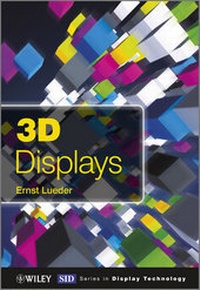
3D Displays
Description

Reviews / Votes
"Ernst Lueder's latest book in the SID-Wileyseries, 3D Displays, does an excellent job of taking the incrediblediversity of 3D display development and distilling it into keysub-areas ... In summary, 3D Displays is encyclopedic in scope,a great reference, and a recommended purchase." (Information Display, 1 May 2012)More details
Other editions
Additional editions
Person
Ernst Lueder, (retired), Department of Electrical Communications, University of Stuttgart, Germany
Ernst Lueder is Professor Emeritus at the University of Stuttgart, Germany. He was Director of the Institute of Network and Systems Theory at Stuttgart University until 1999, and also headed up a DM 80 million research laboratory for the fabrication of flat panel displays. He is an IEEE Fellow, as well as a Fellow of SID and in 2009, received SID's Slottow-Owaki award. Prof. Lueder has also been awarded the order of merit 1st Class of the Federal Republic of Germany. From 2000 until very recently in 2010, Prof. Lueder was President of the Electro Optical Consultancy. He has previously authored 2 editions of Liquid Crystal Displays: Addressing Schemes and Electro-Optical Effects published by Wiley.
Content
Series Preface xiii
Introduction xv
1 The Physiology of 3D Perception 1
1.1 Binocular Viewing or Human Stereopsis 1
1.2 The Mismatch of Accommodation and Disparity and the Depths of Focus and of Field 3
1.3 Distance Scaling of Disparity 6
1.4 Interocular Crosstalk 7
1.5 Psychological Effects for Depth Perception 10
1.6 High-Level Cognitive Factor 10
Acknowledgments 11
References 11
2 Stereoscopic Displays 13
2.1 Stereoscopic Displays with Area Multiplexing 13
2.1.1 Retarders for the generation of polarizations 13
2.1.2 Wire grid polarizers for processing of the second view 20
2.1.3 Stereoscopic display with two LCDs 22
2.2 Combined Area and Time Division Multiplex for 3D Displays 26
2.3 Stereoscopic Time Sequential Displays 31
2.3.1 Time sequential viewing with an active retarder 31
2.3.2 Fast time sequential 3D displays by the use of OCB LCDs 33
2.3.3 Time sequential 3D displays with black insertions 33
2.4 Special Solutions for Stereoscopic Displays 41
2.5 Stereoscopic Projectors 48
2.6 Interleaved, Simultaneous, and Progressive Addressing of AMOLEDs and AMLCDs 60
2.7 Photo-Induced Alignment for Retarders and Beam Splitters 68
Acknowledgments 68
References 69
3 Autostereoscopic Displays 73
3.1 Spatially Multiplexed Multiview Autostereoscopic Displays with Lenticular Lenses 73
3.2 Spatially Multiplexed Multiview Autostereoscopic Displays with Switchable Lenticular Lenses 85
3.3 Autostereoscopic Displays with Fixed and Switchable Parallax Barriers 95
3.4 Time Sequential Autostereoscopic Displays and Directional Backlights 104
3.4.1 Time sequential displays with special mirrors or 3D films 105
3.4.2 Time sequential displays with directionally switched backlights 109
3.5 Depth-Fused 3D Displays 115
3.6 Single and Multiview 3D Displays with a Light Guide 125
3.7 Test of 3D Displays and Medical Applications 129
Acknowledgments 129
References 130
4 Assessment of Quality of 3D Displays 133
4.1 Introduction and Overview 133
4.2 Retrieving Quality Data from Given Images 135
4.3 Algorithms Based on Objective Measures Providing Disparity or Depth Maps 136
4.3.1 The algorithm based on the sum of absolute differences 136
4.3.2 Smoothness and edge detection in images 140
4.4 An Algorithm Based on Subjective Measures 146
4.5 The Kanade-Lucas-Toman (KLT) Feature Tracking Algorithm 153
4.6 Special Approaches for 2D to 3D Conversion 158
4.6.1 Conversion of 2D to 3D images based on motion parallax 159
4.6.2 Conversion from 2D to 3D based on depth cues in still pictures 161
4.6.3 Conversion from 2D to 3D based on gray shade and luminance setting 162
4.7 Reconstruction of 3D Images from Disparity Maps Pertaining to Monoscopic 2D or 3D Originals 165
4.7.1 Preprocessing of the depth map 165
4.7.2 Warping of the image creating the left and the right eye views 167
4.7.3 Disocclusions and hole-filling 172
4.7.4 Special systems for depth image-based rendering (DIBR) 176
Acknowledgments 182
References 183
5 Integral Imaging 185
5.1 The Basis of Integral Imaging 186
5.2 Enhancement of Depth, Viewing Angle, and Resolution of 3D Integral Images 188
5.2.1 Enhancement of depth 189
5.2.2 Enlargement of viewing angle 193
5.2.3 Enhancing resolution 195
5.3 Integral Videography 196
5.4 Convertible 2D/3D Integral Imaging 207
Acknowledgments 214
References 214
6 Holography for 3D Displays 217
6.1 Introduction and Overview 217
6.2 Recording a Hologram and Reconstruction of the Original 3D Image 218
6.3 A Holographic Screen 227
6.4 Digital Holography Based on the Fourier Transform 229
6.5 A Holographic Laser Projector 232
Acknowledgments 235
References 235
7 Volumetric 3D Displays 237
7.1 The Nature of Volumetric Displays 237
7.2 Accessing and Activating Voxels in Static Volumetric Displays 238
7.3 Swept Volume or Mechanical 3D Displays 245
Acknowledgments 252
References 252
8 A Shot at the Assessment of 3D Technologies 253
Index 257
