

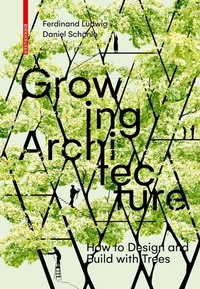
Growing Architecture
Description

Ein wachsendes, lebendes Haus, ein Gebäude aus einer Pflanze scheint ein Widerspruch in sich zu sein. Dennoch wussten schon die Khasi in Ostindien die Luftwurzeln von Gummibäumen zu Fußgängerbrücken zu verbinden und in Süddeutschland bildeten über Jahrhunderte hinweg Tanzlinden den Dorfmittelpunkt. Daran anknüpfend widmet sich die Baubotanik dem Entwerfen mit Bäumen. Realisierte Bauten, Versuchsreihen, Entwurfsstudien und visionäre Konzepte weisen den Weg zu einer neuen grünen Architektur. Diese Einführung geht auf die botanischen Wachstumsgesetze ein, die die Bauten leiten und legt die Grundlagen des Konstruierens mit lebenden Bäumen dar. Das Buch regt zu einem ganz neuen Blick auf Architektur an, die gleichsam zu einem Teil der Stadtnatur wird.
Reviews / Votes
"Ferdinand Ludwig's groundbreaking work is reshaping our understanding of architecture and encouraging us to design with nature, time, and the unknown in mind." (Podcast episode of The New Movement )
More details
Other editions
Additional editions
Persons
Ferdinand Ludwig, Professor für Green Technologies in Landscape Architecture an der Technischen Universität München
Daniel Schönle, Freier Architekt und Stadtplaner, Stuttgart
Content
- Intro
- Contents
- Preface: Buildings and Trees
- 1 Introduction
- 2 Botanical Foundations
- 3 Techniques and Tree Species
- 4 Fusion of Trees and Buildings
- 5 How Living Structures Interact with Their Environment
- 6 Designing with Trees and Time
- 7 Utopias and Visions: Living Architecture between Science and Fiction
- 8 Vers une Arbotecture: Towards a Future Tree Architecture
- Appendix
