

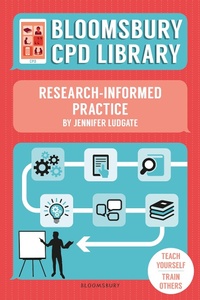
Bloomsbury CPD Library: Research-Informed Practice
1st Edition
Published on 19. September 2019
240 pages
978-1-4729-6152-5 (ISBN)
Description

Research-informed practice has an ever-growing impact on teaching. It involves reading widely, and discussing and debating evidence from sources outside a teacher's own educational setting. When done well, it can greatly improve practice, although it can often be complex and time-consuming. Bloomsbury CPD Library: Research-Informed Practice provides simple, manageable strategies for busy classroom teachers to access and engage with research and use it to transform teaching.
Experienced teacher and research lead Jennifer Ludgate presents an invaluable guide to using research to inform teaching practice within a busy school term. Full of top tips, it's split into two sections - teach yourself and train others - to develop a research-informed culture across the whole school. This easy-to-follow title in the Bloomsbury CPD Library series features self-evaluation tasks for reviewing your own progress and includes ready-to-use training plans for 20 hours of CPD.
With all handouts and presentation slides available as a free download from the companion website, this is an essential resource for any classroom teacher or school leader who would like to improve teaching practice using research and evidence.
Experienced teacher and research lead Jennifer Ludgate presents an invaluable guide to using research to inform teaching practice within a busy school term. Full of top tips, it's split into two sections - teach yourself and train others - to develop a research-informed culture across the whole school. This easy-to-follow title in the Bloomsbury CPD Library series features self-evaluation tasks for reviewing your own progress and includes ready-to-use training plans for 20 hours of CPD.
With all handouts and presentation slides available as a free download from the companion website, this is an essential resource for any classroom teacher or school leader who would like to improve teaching practice using research and evidence.
Reviews / Votes
Like the other titles in this brilliant Bloomsbury CPD Library series, Jennifer Ludgate's Research-Informed Practice is immensely practical in nature and bursting with advice if your intention is to become more research-informed but you are not sure where to start. Using the helpful structure of Part 1: Train yourself and Part 2: Train others, Jennifer's infectious enthusiasm guides you through this exciting professional learning, identifying a key shift needed towards thinking more proactively about our decision-making processes. The book comes with an array of questionnaire, templates and PowerPoint presentations, whilst at the heart of it, Jennifer provides us with a great Research Starter Toolkit in which she summarises for us the key learning points from some seminal research papers and reports. This does not lessen the impact of her advice on developing the ability to critically evaluate research evidence. The absolute joy of the book is in the way it empowers professionals to bridge the gap between theory and practice. This will be a genuinely great addition to schools' CPD bookshelves and I strongly recommend engaging with it. * Helene Galdin O-Shea, ResearchED organiser and Research Advocate at Park High School * In the last few years, references to research evidence have become commonplace in many schools. But what is good research? How and when should we be critical? Jennifer Ludgate offers some great starting points for busy teachers looking to engage with research evidence and to become critical consumers of research evidence. This book is useful for keen teachers and conscientious school leaders seeking research evidence that can helpfully inform their practice in the classroom. * Alex Quigley, National Content Manager at the Education Endowment Foundation and former English teacher, @HuntingEnglish * This book would be of value to members of staff who are responsible for managing CPD as it provides a clear structure for developing confidence in understanding and engaging with your own knowledge and skills as a precursor to training others. * SEN Magazine *More details
Series
Edition
1. Auflage
Language
English
Place of publication
London
United Kingdom
Publishing group
Bloomsbury Publishing PLC (Digital)
Target group
Professional and scholarly
ISBN-13
978-1-4729-6152-5 (9781472961525)
Copyright in bibliographic data and cover images is held by Nielsen Book Services Limited or by the publishers or by their respective licensors: all rights reserved.
Schweitzer Classification
Other editions
Additional editions
Jennifer Ludgate
Bloomsbury CPD Library: Research-Informed Practice
Book
09/2019
Bloomsbury Education
€50.94
Article exhausted; check different version
Person
Jennifer Ludgate is in her sixth year of teaching at a large comprehensive school in Hampshire. She has been Pedagogy Leader in the Teaching and Learning team, a tutor, Head of Key Stage 3 English and Head of Research, and is currently Head of English. In her role as Head of Research, Jennifer redesigned the training programme for second-year teachers to include a year-long evidence-based project. Since 2013, she has run the annual Teaching and Learning Takeover (TLT) conference, which has provided CPD for vast numbers of teachers from across the country. Follow Jennifer on Twitter at @MissJLud.
Content
- Cover
- Title
- Copyright
- Contents
- Acknowledgements
- How to use this book
- Part 1: Teach yourself
- Stage 1: Assess
- Chapter 1 - What's it all about?
- Chapter 2 - Self-assessment
- Stage 2: Improve
- Chapter 3 - Engaging with research
- Chapter 4 - Research starter toolkit
- Chapter 5 - Getting to grips with the key research
- Chapter 6 - Putting research into practice
- Stage 3: Evaluate
- Chapter 7 - Evaluating progress
- Stage 4: Excel
- Chapter 8 - Embedding and developing research-informed practice
- Part 2: Train others
- Chapter 1 - Preparing and planning your CPD
- Chapter 2 - Training plans
- Chapter 3 - Evaluating your CPD
- Bibliography
- Index
