

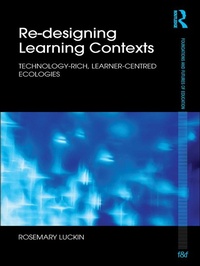
Re-Designing Learning Contexts
Technology-Rich, Learner-Centred Ecologies
Published on 12. April 2010
208 pages
978-1-136-99278-0 (ISBN)
Description

What do we mean by the word 'context' in education and how does our context influence the way that we learn?
What role can technology play in enhancing learning and what is the future of technology within learning?
Re-Designing Learning Contexts seeks to re-dress the lack of attention that has traditionally been paid to a learner's wider context and proposes a model to help educators and technologists develop more productive learning contexts. It defines context as the interactions between the learner and a set of inter-related resource elements that are not tied to a physical or virtual location. Context is something that belongs to an individual and that is created through their interactions in the world.
Based on original, empirical research, the book considers the intersection between learning, context and technology, and explores:
the meaning of the concept of context and it's relationship to learning
the ways in which different types of technology can scaffold learning in context
the Learner-Centric 'Ecology of Resources' model of context as a framework for designing technology-rich learning environments
the importance of matching available resources to each learner's particular needs
the ways in which the learner's environment and the technologies available might change over the coming years
the potential impact of recent technological developments within computer science and artificial intelligence.
This interdisciplinary study draws on a range of disciplines, including geography, anthropology, psychology, education and computing, to investigate the dynamics and potential of teacher-learner interaction within a learning continuum, and across a variety of locations. It will be of interest to those teaching, researching and thinking about the use of technology in learning and pedagogy, as well as those involved in developing technology for education and those who use it in their own teaching.
For practical examples of the way the Ecology of Resources framework has been used visit: http://eorframework.pbworks.com.
What role can technology play in enhancing learning and what is the future of technology within learning?
Re-Designing Learning Contexts seeks to re-dress the lack of attention that has traditionally been paid to a learner's wider context and proposes a model to help educators and technologists develop more productive learning contexts. It defines context as the interactions between the learner and a set of inter-related resource elements that are not tied to a physical or virtual location. Context is something that belongs to an individual and that is created through their interactions in the world.
Based on original, empirical research, the book considers the intersection between learning, context and technology, and explores:
the meaning of the concept of context and it's relationship to learning
the ways in which different types of technology can scaffold learning in context
the Learner-Centric 'Ecology of Resources' model of context as a framework for designing technology-rich learning environments
the importance of matching available resources to each learner's particular needs
the ways in which the learner's environment and the technologies available might change over the coming years
the potential impact of recent technological developments within computer science and artificial intelligence.
This interdisciplinary study draws on a range of disciplines, including geography, anthropology, psychology, education and computing, to investigate the dynamics and potential of teacher-learner interaction within a learning continuum, and across a variety of locations. It will be of interest to those teaching, researching and thinking about the use of technology in learning and pedagogy, as well as those involved in developing technology for education and those who use it in their own teaching.
For practical examples of the way the Ecology of Resources framework has been used visit: http://eorframework.pbworks.com.
Reviews / Votes
'One of the most important contributions on the whole TEL field.' - Richard Noss, Director of ESRC/EPSRC TEL Research Program'As new technologies, tools and online resources continue to proliferate, teachers, children and parents are increasingly confronted with 'learning support' overload. From smartphones to multitouch, apps to augmented reality, and interactive books to YouTube - how do they decide which to use and also how best to integrate with existing learning practices? Luckin's seminal and timely text covers the wider 'context of learning' spanning across time, space, home and school, while also crossing local and global and virtual and physical. A must read for those who want to learn more about how best to systematically choose, combine and constrain in an increasingly unwieldy world of instant knowledge and pervasive technology.' - Prof. Yvonne Rogers, Professor of Human-Computer Interaction, Oxford University
More details
Series
Language
English
Place of publication
London
United Kingdom
Publishing group
Taylor & Francis Ltd
Target group
College/higher education
Illustrations
8 s/w Abbildungen, 10 s/w Tabellen, 4 s/w Photographien bzw. Rasterbilder, 17 s/w Zeichnungen
10 Tables, black and white; 17 Line drawings, black and white; 4 Halftones, black and white; 8 Illustrations, black and white
File size
3,84 MB
ISBN-13
978-1-136-99278-0 (9781136992780)
Copyright in bibliographic data and cover images is held by Nielsen Book Services Limited or by the publishers or by their respective licensors: all rights reserved.
Schweitzer Classification
Other editions
Additional editions
Book
06/2011
1st Edition
Routledge
€206.20
Shipment within 15-20 days
Book
04/2010
1st Edition
Routledge
€65.10
Shipment within 15-20 days
Person
Rosemary Luckin is Professor of Learner-Centred Design at the London Knowledge Lab, Institute of Education, University of London, UK. She has graduate and postgraduate qualifications in Artificial Intelligence and Cognitive Science and has taught learners in schools, colleges and universities.
Content
Part One: Background 1. Contexts for Learning 2. Learners and Learning 3. The Role of Technology Part Two: The Ecology of Resources Model and Design Framework 4. Software Design and the Zone of Proximal Adjustment 5. Modelling a Learner's Context 6. The Ecology of Resources Method: Models and Participatory Design 7. The Ecology of Resources Design Framework Part Three: The Future of Technology Rich Learning 8. New Technologies, New Interactions? 9. New Interactions, New Opportunities for Learning
