

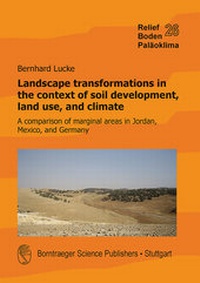
Landscape transformations in the context of soil development, land use, and climate
A comparison of marginal areas in Jordan, Mexico, and Germany
1st Edition
Published on 26. May 2020
199 pages
978-3-443-01148-2 (ISBN)
Description

The author compares soil development and sediments (soilscapes) in marginally productive areas of Jordan, Syria, Mexico, and Germany with the aim to conduct systematic comparisons of patterns at different scales. The idea of comparing research areas on three continents partly followed earlier investigations considering long-range teleconnections of past environmental changes in Jordan and Mexico. Soils in these countries were often considered degraded, but land use histories in the Americas differ significantly from the Fertile Crescent. In this context, climate variations can have identical detrimental impacts as intense land use. Volcanic eruptions, earthquakes, or cosmic impacts could play a role in climatic extremes and thus the deposition or erosion of sediments, and might represent a link of environmental changes on a global scale. The systematic comparison of soil development and sediments suggests that the negative impact of historic land use on soils has been overestimated. In Jordan, soil development seems to be governed by climate and parent material, and largely to represent a steady-state equilibrium with current climatic conditions. Not the soils of Jordan, but the shallow limestone soils of Mexico seem to match proposals of man-made historic land degradation, although the periods and techniques of land use were shorter and less intense than in the 'Old World'. The shallow soil covers on limestones in Mexico contrast with the model of more intense weathering and deeper soil formation in the humid tropics, and add support to indications that aeolian sediments represent the main parent material of soils in Jordan. Alternating severe droughts and heavy rainfall events were the most important drivers of landscape changes, and probably triggered by volcanic eruptions or cosmic impacts. Although intense agriculture could have been exacerbated their negative impacts, land use alone would not have caused major erosion-deposition processes. In this context, the concept that nature can be controlled by technology - as the newly proposed ?Anthropocene? implies - appears to be more hubris than backed by solid evidence. The belief that nature can be controlled and mastered by man and technology is to be substantiated on a major catastrophe, for example widespread volcanism or a sizeable cosmic impact. The publication addresses researchers in geoarchaeology, soil science, soil geography, geomorphology, and environmental history. As it discusses the potential impact of climate change, it is also relevant to geologists, farmers and their research institutes, students and scholarly libraries.
More details
Other editions
Additional editions
Bernhard Lucke
Landscape transformations in the context of soil development, land use, and climate
A comparison of marginal areas in Jordan, Mexico, and Germany
Book
06/2017
Borntraeger
€49.90
Shipment within 5-7 days
Content
- Cover
- Title
- Copyright
- Contents
- 1. Introduction
- 1.1 Summary of research aims and approach
- 1.2 Methods
- 2. Comparing in-situ soil development in marginal areas
- 2.1 Soil development in Jordan
- 2.1.1 Landscape change in the Decapolis region in the context of soil distribution
- 2.1.2 Soil distribution in Jordan: the role of climate
- 2.1.3 Soil distribution in Jordan: the role of land degradation
- 2.1.4 Soil substrate classification
- 2.1.5 Parent materials and degree of soil development
- 2.1.6 Quartz grain microsurfaces as archives of deposition histories
- 2.1.7 Soil redness and weathering along a climate gradient
- 2.1.8 Comparing bedrock residue, soils, and Ti/Zr-ratios: methodical considerations
- 2.1.9 Metasomatic neoformation of clay
- 2.1.10 Loess in north-east Jordan
- 2.1.11 Summary: soil development in Jordan
- 2.2 Soil development on limestone in central Germany
- 2.2.1 Terra rossa soils and red clay fills in limestone cracks in Franconia
- 2.2.2 Results: bulk soil analysis
- 2.2.3 Results: thin sections
- 2.2.4 Discussion: genesis of Terrae calcis in Franconia
- 2.2.5 Summary: soil development in central Germany
- 2.3 Soil development on limestone in Mexico
- 2.3.1 Comparing soil development in semi-humid and humid areas
- 2.3.2 Results and discussion of soil analysis in Mexico
- 2.3.3 Interpreting soil development on limestone in Mexico
- 2.3.4 Summary: soil development in Mexico
- 2.4 Summary: comparison of soil development
- 2.5 Key findings of the comparison of soil development
- 3. Historic landscape changes in the context of sediments
- 3.1 Valley fills in Jordan
- 3.1.1 Alluvial deposits and valley fills
- 3.1.2 Wadi Ziqlab: the role of slope collapses
- 3.1.3 'Ain Ghazal: floodplain transformations during the early Holocene?
- 3.1.4 Fell 'Ain Ghazal victim to increasing aridity?
- 3.1.5 Is there soil development in the debris covering 'Ain Ghazal?
- 3.1.6 Summary interpretation of sediments and soil development at 'Ain Ghazal
- 3.1.7 Early Holocene environmental changes in the context of a buried paleosol?
- 3.1.8 Remains of old valley fills near Ba'ja?
- 3.1.9 Possible environmental interpretation of the paleosol
- 3.1.10 Summary: possible Early Holocene environmental changes at Ba'ja
- 3.1.11 A valley fill in Wadi Queilbeh near Abila in northern Jordan
- 3.1.12 Analysis of the valley fill in Wadi Queilbeh
- 3.1.13 Environment changes documented by the sediments in Wadi Queilbeh
- 3.1.14 Landslides, sheet flows, and slope collapses
- 3.1.15 Land use and sedimentation in Wadi Queilbeh
- 3.1.16 Terra rossa soil creep
- 3.1.17 Environmental changes at Abila in the context of global climate events
- 3.1.18 The Dead Cities in northern Syria
- 3.1.19 Results of soil and sediment analysis in the Dead Cities region
- 3.2 Discussion of valley sediments in Jordan
- 3.2.1 Valley fills in geoarchaeological context: prehistoric landscape changes
- 3.2.2 Valley fills in geoarchaeological context: historic landscape changes
- 3.2.3 Drivers of valley fill aggradation and incision
- 3.2.4 Historic land use in the vicinity of Wadi Queilbeh
- 3.2.5 Extreme events and periods of rapid climate change
- 3.2.6 Summary of valley fills in Jordan
- 3.3 Past erosion-sedimentation phases in Mexico
- 3.3.1 The role of the Spanish conquest
- 3.3.2 Reconstructions of erosion and sedimentation in Mexico
- 3.3.3 The San Pablo sediment profile near Teotihuacan
- 3.3.4 Remains of the black soil on Cerro Gordo
- 3.3.5 Discussion: erosion and sedimentation in Mexico
- 3.4 Historic erosion-sedimentation processes in central Germany
- 3.4.1 Soils, sediments, and field systems of Fatschenbrunn, Steigerwald
- 3.4.2 Interpreting soil distribution near Fatschenbrunn in the context of past land use
- 3.5 Discussion of historic landscape changes in the context of sediments
- 3.5.1 Challenges of theoretical models
- 3.5.2 Understanding past land use
- 3.5.3 Modern analogies of erosion caused by current land use
- 3.5.4 The role of extreme events
- 3.6 Summary of landscape changes reflected by sediments
- 4. Final discussion
- 4.1 Comparing soils and sediments in Jordan, Mexico, and Germany
- 4.2 Past erosion and modern society
- 4.3 Future soil development
- 4.4 The Anthropocene
- 4.5 Outlook
- 5. Summary and conclusion
- 6. References
