

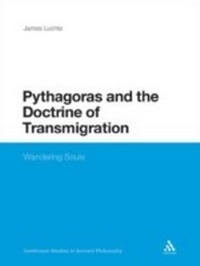
Pythagoras and the Doctrine of Transmigration
Wandering Souls
1st Edition
Published on 15. August 2009
224 pages
978-1-4411-0401-4 (ISBN)
Description

The mythical narrative of transmigration tells the story of myriad wandering souls, each migrating from body to body along a path of recurrence amid the becoming of the All.
In this highly original study, James Luchte explores the ways in which the concept of transmigration is a central motif in Pythagoras' philosophy, representing its fundamental meaning. Luchte argues that the many strands of the tale of transmigration come together in the Pythagorean philosophical movement, revealing a unity in which, for Pythagoreans, existence and eschatology are separated only by forgetfulness. Such an interpretation that seeks to retrieve the unity of Pythagorean thought goes against the grain of a long-standing tradition of interpretation that projects upon Pythagoras the segregation of 'mysticism' and 'science'. Luchte lays out an alternative interpretation of Pythagorean philosophy as magical in the sense that it orchestrates a holistic harmonization of theoria and praxis and through this reading discloses the radical character of Pythagorean philosophy.
In this highly original study, James Luchte explores the ways in which the concept of transmigration is a central motif in Pythagoras' philosophy, representing its fundamental meaning. Luchte argues that the many strands of the tale of transmigration come together in the Pythagorean philosophical movement, revealing a unity in which, for Pythagoreans, existence and eschatology are separated only by forgetfulness. Such an interpretation that seeks to retrieve the unity of Pythagorean thought goes against the grain of a long-standing tradition of interpretation that projects upon Pythagoras the segregation of 'mysticism' and 'science'. Luchte lays out an alternative interpretation of Pythagorean philosophy as magical in the sense that it orchestrates a holistic harmonization of theoria and praxis and through this reading discloses the radical character of Pythagorean philosophy.
Reviews / Votes
"The importance of [Luchte's] new book is based on his synthetic approach to the fragmentary traces of the Pythagorean movement. The symbol of transmigration is used as a hermeneutic key which gives access to the 'family similarity' (in the sense of Wittgenstein) of Pythagoras' seemingly heterogeneous teaching on mathematics, music, cosmology, ethics, theology, and the soul. He seeks to reconstruct Pythagoras' philosophy against the background of a 'magical' concept of thinking-practice which does not simply depict a 'given' reality, but considers philosophical concepts as part of a 'way of life' (Pierre Hadot) or as tools to be used in 'spiritual exercises' (Michel Foucault)." - Johannes Hoff, University of Wales, Lampeter, UK "Resisting mightily the lure of logical, mathematical, or scientific philosophy, Luchte offers a poetico-phenomenological exploration of the doctrine that souls migrate to another body when the old one dies, as an intimate philosophical interpretation or hermeneutics of tragic existence. His emphasis on the body and praxis in the Pythagorean bios precludes the link with Plato that so many philosophers long for. Among his topics are the emergence of mystic cults and the immortal soul, the alleged critique of Pythagoras by Parmenides, the Pythagorean divine between earth and sky, the Platonic rupture, and Plotinus and the ascent of the soul toward the one." -Eithne O'Leyne, BOOK NEWS, Inc. James Luchte writes about Pythagorus and the theory of transmigration with a wide range of cultural reference and a Socratic sense of the important of philosophy as an activity: this is a stimulating essay on the history of ideas.More details
Series
Edition
1. Auflage
Language
English
Place of publication
New York
United States
Target group
Professional and scholarly
ISBN-13
978-1-4411-0401-4 (9781441104014)
Copyright in bibliographic data and cover images is held by Nielsen Book Services Limited or by the publishers or by their respective licensors: all rights reserved.
Schweitzer Classification
Other editions
Additional editions
Book
01/2012
Continuum Publishing Corporation
€56.00
Shipment within 15-20 days
Person
James Luchte is a philosopher, author, writer and poet living in Wales. His scholarly publications, all published by Bloomsbury, include Mortal Thought: Hoelderlin and Philosophy, Early Greek Thought: Before the Dawn (2011), The Peacock and the Buffalo: The Poetry of Nietzsche (translator, 2010), Pythagoras and the Doctrine of Transmigration: Wandering Souls (2009), Heidegger's Early Philosophy: The Phenomenology of Ecstatic Temporality (2008), Nietzsche's Thus Spoke Zarathustra: Before Sunrise (Editor, 2008) and Kant's Critique of Pure Reason (2007). He has also published dozens of articles on various topics in Philosophy and Contemporary Politics.
Content
Introduction: The Poetic Topos of the Doctrine of Transmigration
1. Genealogy of the Doctrine of Transmigration
2. Beyond Mysticism and Science: Symbolism and Philosophical Magic
3. The Emergence of Mystic Cults and the Immortal Soul
4. Philolaus and the Question of Pythagorean Harmony
5. The Alleged Critique of Pythagoras by Parmenides
6. Between the Earth and the Sky: On the Pythagorean Divine
7. The Pythagorean Bios and the Doctrine of Transmigration
8. The Platonic Rupture: Writing and Difference
9. Plotinus: The Ascent of the Soul toward the One
10. Plotinus as Neoplatonic Mystic: Letter to Flaccus
Epilogue: The Fate of the Doctrine of Transmigration
Bibliography
Index
1. Genealogy of the Doctrine of Transmigration
2. Beyond Mysticism and Science: Symbolism and Philosophical Magic
3. The Emergence of Mystic Cults and the Immortal Soul
4. Philolaus and the Question of Pythagorean Harmony
5. The Alleged Critique of Pythagoras by Parmenides
6. Between the Earth and the Sky: On the Pythagorean Divine
7. The Pythagorean Bios and the Doctrine of Transmigration
8. The Platonic Rupture: Writing and Difference
9. Plotinus: The Ascent of the Soul toward the One
10. Plotinus as Neoplatonic Mystic: Letter to Flaccus
Epilogue: The Fate of the Doctrine of Transmigration
Bibliography
Index
