

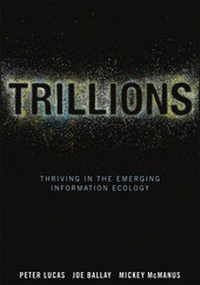
Trillions
Thriving in the Emerging Information Ecology
Published on 27. August 2012
272 pages
978-1-118-22715-2 (ISBN)
Description

We are facing a future of unbounded complexity. Whetherthat complexity is harnessed to build a world that is safe,pleasant, humane and profitable, or whether it causes us to careenoff a cliff into an abyss of mind-numbing junk is an open question.The challenges and opportunities--technical, business, andhuman--that this technological sea change will bring are withoutprecedent. Entire industries will be born and others will be laidto ruin as our society navigates this journey.
There are already many more computing devices in the world thanthere are people. In a few more years, their number willclimb into the trillions. We put microprocessors into nearly everysignificant thing that we manufacture, and the cost of routinecomputing and storage is rapidly becoming negligible. We haveliterally permeated our world with computation. But moresignificant than mere numbers is the fact we are quickly figuringout how to make those processors communicate with each other, andwith us. We are about to be faced, not with a trillion isolateddevices, but with a trillion-node network: a network whosescale and complexity will dwarf that of today's Internet.And, unlike the Internet, this will be a network not of computationthat we use, but of computation that we livein.
Written by the leaders of one of America's leadingpervasive computing design firms, this book gives a no-holds-barredinsiders' account of both the promise and the risks of theage of Trillions. It is also a cautionary tale of thehead-in-the-sand attitude with which many of today'sthought-leaders are at present approaching these issues.Trillions is a field guide to the future--designed to helpbusinesses and their customers prepare to prosper, in theinformation.
There are already many more computing devices in the world thanthere are people. In a few more years, their number willclimb into the trillions. We put microprocessors into nearly everysignificant thing that we manufacture, and the cost of routinecomputing and storage is rapidly becoming negligible. We haveliterally permeated our world with computation. But moresignificant than mere numbers is the fact we are quickly figuringout how to make those processors communicate with each other, andwith us. We are about to be faced, not with a trillion isolateddevices, but with a trillion-node network: a network whosescale and complexity will dwarf that of today's Internet.And, unlike the Internet, this will be a network not of computationthat we use, but of computation that we livein.
Written by the leaders of one of America's leadingpervasive computing design firms, this book gives a no-holds-barredinsiders' account of both the promise and the risks of theage of Trillions. It is also a cautionary tale of thehead-in-the-sand attitude with which many of today'sthought-leaders are at present approaching these issues.Trillions is a field guide to the future--designed to helpbusinesses and their customers prepare to prosper, in theinformation.
More details
Other editions
Additional editions
Book
10/2012
Wiley
€33.00
Shipment within 15-20 days
Persons
PETER LUCAS is founding principal at MAYA Design, whichhe cofounded in 1989. He is also adjunct associate professor ofHuman Computer Interaction at Carnegie Mellon University. He holdsa PhD from Cornell University, where he studied educational andcognitive psychology and psycholinguistics. He served on theCommittee on Networked Systems of Embedded Computers of theNational Research Council.
JOE BALLAY is former head of the School of Design atCarnegie Mellon University and a founding principal of MAYA Design.An interdisciplinarian, he holds an MFA in design from CarnegieMellon University, a BFA in industrial design from the Universityof Illinois, and a BS in industrial management from CarnegieInstitute of Technology. He has taught design at universitiesthroughout the world.
MICKEY McMANUS is president and CEO of MAYA Design. Heholds a BFA in industrial design from the University of Illinois,with extended studies in communication design and mathematics. Hiswork has been published in Bloomberg Businessweek, Fortune, FastCompany, the Wall Street Journal, and HarvardBusiness Review. He is a frequent speaker on the topic ofdesign, pervasive computing, and business innovation.
JOE BALLAY is former head of the School of Design atCarnegie Mellon University and a founding principal of MAYA Design.An interdisciplinarian, he holds an MFA in design from CarnegieMellon University, a BFA in industrial design from the Universityof Illinois, and a BS in industrial management from CarnegieInstitute of Technology. He has taught design at universitiesthroughout the world.
MICKEY McMANUS is president and CEO of MAYA Design. Heholds a BFA in industrial design from the University of Illinois,with extended studies in communication design and mathematics. Hiswork has been published in Bloomberg Businessweek, Fortune, FastCompany, the Wall Street Journal, and HarvardBusiness Review. He is a frequent speaker on the topic ofdesign, pervasive computing, and business innovation.
Content
Preface xi
Acknowledgments xvii
Chapter 1 The Future, So Far 01
Trillions Is a Done Deal 02
Connectivity Will Be the Seed of Change 05
Computing Turned Inside Out 07
The Power of Digital Literacy 11
Chapter 2 The Next Mountain 15
Fungible Devices 16
Liquid Information 25
Cyberspace for Real 30
Interlude Yesterday, Today, Tomorrow: Platforms and UserInterfaces 39
Yesterday 40
Today 41
Tomorrow 44
Chapter 3 The Tyranny of the Orthodoxy 51
Information Interruptus 52
The King and the Mathematician 60
Links to Nowhere 63
The Wrong Cloud 65
The Dream of One Big Computer 67
The Grand Repository in the Sky 68
FUD and the Birth of the Impostor Cloud 69
The Children's Crusade 71
The Peer-to-Peer Bogey 80
Chapter 4 How Nature Does It 83
The Internet of Plants 84
Nature Has Been There Before 85
The Qualities of Beautiful Complexity 93
At the Intersection of People and Information 102
Chapter 5 How Design Does It 105
Birth of Industrial Design 107
Novelty, Beauty, Ritual, and Comfort 113
Hearing History Rhyme 114
Instability as the Status Quo 117
Post-Industrial Design 119
Interlude Yesterday, Today, Tomorrow: Data Storage 133
Yesterday 133
Today 136
Tomorrow 136
Chapter 6 Design Science on Trillions Mountain 139
Beyond Design Thinking to Design Science 140
Make the Right Thing 143
Chapter 7 Architecture with a Capital "A"167
Architecture as Organic Principles 169
Architecture as Model 170
Architecture as "Style" 171
Information Architecture 173
Architecture and Design Science 178
Chapter 8 Life in an Information Ecology 181
Components 183
Challenges in the Information Ecology 188
Chapter 9 Aspects of Tomorrow 205
Beyond the Internet 206
Simplification 208
Devices 210
The Information Commons 212
The World Wide Dataflow 213
Publishing 216
Safety, Security, and Privacy 218
Epilogue Thriving in the Spacious Foothills 221
Seize the Low Ground 224
Microtransactions and the Rise of T-Commerce 225
Strange Bedfellows 226
Big Data and Information Visualization 226
The Trillions Bubble 227
Notes 231
About the Authors 245
Index 247
Acknowledgments xvii
Chapter 1 The Future, So Far 01
Trillions Is a Done Deal 02
Connectivity Will Be the Seed of Change 05
Computing Turned Inside Out 07
The Power of Digital Literacy 11
Chapter 2 The Next Mountain 15
Fungible Devices 16
Liquid Information 25
Cyberspace for Real 30
Interlude Yesterday, Today, Tomorrow: Platforms and UserInterfaces 39
Yesterday 40
Today 41
Tomorrow 44
Chapter 3 The Tyranny of the Orthodoxy 51
Information Interruptus 52
The King and the Mathematician 60
Links to Nowhere 63
The Wrong Cloud 65
The Dream of One Big Computer 67
The Grand Repository in the Sky 68
FUD and the Birth of the Impostor Cloud 69
The Children's Crusade 71
The Peer-to-Peer Bogey 80
Chapter 4 How Nature Does It 83
The Internet of Plants 84
Nature Has Been There Before 85
The Qualities of Beautiful Complexity 93
At the Intersection of People and Information 102
Chapter 5 How Design Does It 105
Birth of Industrial Design 107
Novelty, Beauty, Ritual, and Comfort 113
Hearing History Rhyme 114
Instability as the Status Quo 117
Post-Industrial Design 119
Interlude Yesterday, Today, Tomorrow: Data Storage 133
Yesterday 133
Today 136
Tomorrow 136
Chapter 6 Design Science on Trillions Mountain 139
Beyond Design Thinking to Design Science 140
Make the Right Thing 143
Chapter 7 Architecture with a Capital "A"167
Architecture as Organic Principles 169
Architecture as Model 170
Architecture as "Style" 171
Information Architecture 173
Architecture and Design Science 178
Chapter 8 Life in an Information Ecology 181
Components 183
Challenges in the Information Ecology 188
Chapter 9 Aspects of Tomorrow 205
Beyond the Internet 206
Simplification 208
Devices 210
The Information Commons 212
The World Wide Dataflow 213
Publishing 216
Safety, Security, and Privacy 218
Epilogue Thriving in the Spacious Foothills 221
Seize the Low Ground 224
Microtransactions and the Rise of T-Commerce 225
Strange Bedfellows 226
Big Data and Information Visualization 226
The Trillions Bubble 227
Notes 231
About the Authors 245
Index 247
