

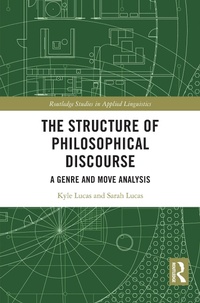
The Structure of Philosophical Discourse
A Genre and Move Analysis
1st Edition
Published on 29. March 2024
290 pages
978-1-003-85455-5 (ISBN)
Description

This book builds on existing work in genre analysis and move analysis in English for Specific Purposes (ESP) and applies this new framework to academic philosophical discourse, offering new insights into how ESP traditions can elucidate shifts in language conventions across disciplinary contexts.
The volume begins by surveying the state of the art in English for Specific Purposes and genre theory, as well as other genre theory paradigms before turning the focus on move analysis. Lucas and Lucas seek to maximize the potential of move analysis to precisely operationalize functional units of discourse by implementing a cognitive theory of genre grounded in frame semantics. Using the case of academic research articles in philosophy, the authors demonstrate how this framework can reveal distinctive dimensions unique to philosophical discourse and, in turn, how such an approach might be applied more broadly to examine nuances in language across disciplines and inform ESP research in the future.
This book will appeal to students and researchers in English for Specific Purposes, discourse analysis, academic writing, applied linguistics, and rhetoric and composition.
The volume begins by surveying the state of the art in English for Specific Purposes and genre theory, as well as other genre theory paradigms before turning the focus on move analysis. Lucas and Lucas seek to maximize the potential of move analysis to precisely operationalize functional units of discourse by implementing a cognitive theory of genre grounded in frame semantics. Using the case of academic research articles in philosophy, the authors demonstrate how this framework can reveal distinctive dimensions unique to philosophical discourse and, in turn, how such an approach might be applied more broadly to examine nuances in language across disciplines and inform ESP research in the future.
This book will appeal to students and researchers in English for Specific Purposes, discourse analysis, academic writing, applied linguistics, and rhetoric and composition.
Reviews / Votes
"Philosophers do not have very developed vocabularies for talking about the structure of philosophical writing, which does philosophy students at both the graduate and undergraduate levels a disservice. This work is part of the solution. Philosophers tend to lean on argument forms to describe writing, which rarely capture the global structure of a philosophy paper. By clearly distinguishing between the macro- and micro-structure within philosophical writing, the work goes a long way towards making visible the structure of papers in the central journals of analytic philosophy and will make an excellent resource for students and teachers of philosophy."Christopher Yeomans, Professor of Philosophy, Purdue University
"In this comprehensive, groundbreaking, lucid, and very readable book, the authors employ both theoretical and empirical means to develop a clear and detailed description of philosophical discourse, working from and adding to the ESP research tradition, and, in the process, contributing new and productive insights into genre and move analysis."
Tony Silva, Professor Emeritus of English, Purdue University
More details
Series
Edition
1. Auflage
Language
English
Place of publication
London
United Kingdom
Publishing group
Taylor & Francis Ebooks
Target group
College/higher education
Illustrations
46 Tables, black and white; 13 Line drawings, black and white; 1 Halftones, black and white; 14 Illustrations, black and white
ISBN-13
978-1-003-85455-5 (9781003854555)
Copyright in bibliographic data and cover images is held by Nielsen Book Services Limited or by the publishers or by their respective licensors: all rights reserved.
Schweitzer Classification
Other editions
Additional editions
Book
07/2025
1st Edition
Routledge
€67.70
Shipment within 10-20 days
Book
03/2024
1st Edition
Routledge
€206.70
Shipment within 10-20 days
Persons
Kyle Lucas is a Instructor of Writing at Ferris State University, Michigan, USA. He received his PhD in English from Purdue University in 2022.
Sarah Lucas is a PhD candidate in the Philosophy Department at Purdue University, Indiana, USA, and a Full-Time Lecturer in Philosophy at Ferris State University, Michigan, USA.
Sarah Lucas is a PhD candidate in the Philosophy Department at Purdue University, Indiana, USA, and a Full-Time Lecturer in Philosophy at Ferris State University, Michigan, USA.
Content
Contents
Acknowledgements
Chapter 1: Introduction
1.1 English for Specific Purposes, genre, and move analysis
1.2 Research space and motivation
1.3 Innovating genre and move analysis
1.4 Outline of remaining chapters
Chapter 2: Genre across research traditions
2.1 ESP genre theory and Swales' framework
2.2 Situating ESP genre theory: A comparative analysis
2.3 Criticisms and recent changes in the ESP tradition
2.4 The need for further theorizing
Chapter 3: A cognitive theory of genre
3.1 A definition of genre
3.2 Genre frames
3.3 Illocutionary and perlocutionary frame elements
3.4 Prototypicality effects in text classification
3.5 The basic level
3.6 Conclusion
Chapter 4: Introduction to move analysis
4.1 Move analysis overview
4.2 Building a corpus for move analysis
4.3 Analyzing the corpus
4.4 Refining move analysis
4.5 Conclusion
Chapter 5: What move analysis has revealed about academic writing
5.1 What move analysis has revealed about research article sections
5.2 What move analysis has revealed about writing across the disciplines
5.3 New horizons for move analysis and linguistic analysis
5.4 Conclusion
Chapter 6: Writing in philosophy
6.1 Move analysis studies of philosophical writing
6.2 Other forms of research on philosophical writing
6.3 Conclusion
Chapter 7: The corpus of philosophical research articles
7.1 The discipline of philosophy
7.2 Overview of the philosophical research article corpus
7.3 Situational analysis of corpus
7.4 Representativeness of the corpus
7.5 Methodological framework: Move analysis and communicative functions
7.6 Conclusion
Chapter 8: The macro-structure of philosophical discourse
8.1 The purpose and macro-structure of philosophy research articles
8.2 Macro-structures: Sequences and cycles
8.3 Discussion
8.4 Conclusion
Chapter 9: The micro-structure of philosophical discourse
9.1 Moves and steps in the introduction
9.2 Moves and steps in the body of the work
9.3 Argumentative strategies
9.4 Moves and steps in the conclusion
9.5 Conclusion
Chapter 10: Additional aspects of philosophical discourse
10.1 Overview of systemic functions
10.2 Footnotes
10.3 Key systemic functions
10.4 Conclusion
Chapter 11: Conclusion
11.1 Notable findings
11.2 Broader significance
11.3 Limitations and future research
Appendix: Corpus of research articles
Index
Acknowledgements
Chapter 1: Introduction
1.1 English for Specific Purposes, genre, and move analysis
1.2 Research space and motivation
1.3 Innovating genre and move analysis
1.4 Outline of remaining chapters
Chapter 2: Genre across research traditions
2.1 ESP genre theory and Swales' framework
2.2 Situating ESP genre theory: A comparative analysis
2.3 Criticisms and recent changes in the ESP tradition
2.4 The need for further theorizing
Chapter 3: A cognitive theory of genre
3.1 A definition of genre
3.2 Genre frames
3.3 Illocutionary and perlocutionary frame elements
3.4 Prototypicality effects in text classification
3.5 The basic level
3.6 Conclusion
Chapter 4: Introduction to move analysis
4.1 Move analysis overview
4.2 Building a corpus for move analysis
4.3 Analyzing the corpus
4.4 Refining move analysis
4.5 Conclusion
Chapter 5: What move analysis has revealed about academic writing
5.1 What move analysis has revealed about research article sections
5.2 What move analysis has revealed about writing across the disciplines
5.3 New horizons for move analysis and linguistic analysis
5.4 Conclusion
Chapter 6: Writing in philosophy
6.1 Move analysis studies of philosophical writing
6.2 Other forms of research on philosophical writing
6.3 Conclusion
Chapter 7: The corpus of philosophical research articles
7.1 The discipline of philosophy
7.2 Overview of the philosophical research article corpus
7.3 Situational analysis of corpus
7.4 Representativeness of the corpus
7.5 Methodological framework: Move analysis and communicative functions
7.6 Conclusion
Chapter 8: The macro-structure of philosophical discourse
8.1 The purpose and macro-structure of philosophy research articles
8.2 Macro-structures: Sequences and cycles
8.3 Discussion
8.4 Conclusion
Chapter 9: The micro-structure of philosophical discourse
9.1 Moves and steps in the introduction
9.2 Moves and steps in the body of the work
9.3 Argumentative strategies
9.4 Moves and steps in the conclusion
9.5 Conclusion
Chapter 10: Additional aspects of philosophical discourse
10.1 Overview of systemic functions
10.2 Footnotes
10.3 Key systemic functions
10.4 Conclusion
Chapter 11: Conclusion
11.1 Notable findings
11.2 Broader significance
11.3 Limitations and future research
Appendix: Corpus of research articles
Index
