

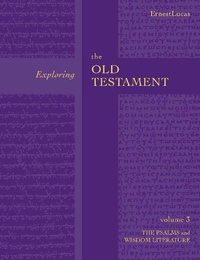
Exploring the Old Testament Vol 3
Description

The Psalms and Wisdom Literature is one of six textbooks covering the Old and New Testaments, all written by authors who have extensive experience of teaching students in their first two years of university-level study. This book offers an exploratory approach that enables students to engage with the text for themselves, and not simply to be passive learners. It provides activities and challenges at introductory and intermediate levels, the key background information needed to work at the required level, and ideas for further theological thought and reading. Students will discover: the kind of literature they are dealing with; the major questions in the scholarly study of these books; the structure and purpose of the books; the major themes and theology of each book; issues for today arising from each area of study. 'A study of the prophets that will serve admirably as a textbook for a class or a resource for individual study. I recommend this book highly to all who want to learn more about this important part of Hebrew Scriptures'. Tremper Longman III, Robert H. Gundry Professor of Biblical Studies, Westmont College 'I have found the range of topics treated by Lucas enormously impressive. From all the usual introductory topics through to detailed guidelines for interpretation, students will find here admirable summaries of the main scholarly views together with sensible comments to help evaluate them. I know of no other textbook on the Psalms and Writings that will service its intended readership so helpfully'. Professor H.G.M. Williamson, Regius Professor of Hebrew, University of Oxford Comments on Exploring the Old Testament: The Prophets: 'It fulfils superbly its aim of making the prophets accessible to the student reader' Professor Robert P. Gordon, University of Cambridge.
More details
Other editions
Additional editions
Person
Content
- Intro
- Title
- Copyright
- Contents
- Key to Panels
- Preface
- Introduction
- Abbreviations
- Map of the Ancient Near East
- 1 Psalms
- Different Types of Psalms
- Hymns
- Laments
- Songs of thanksgiving
- Royal psalms
- Psalms of confidence
- Wisdom psalms
- Other minor types
- The Psalms and Israel's Worship
- The autumn festival: Yahweh's enthronement?
- The autumn festival: covenant renewal?
- The autumn festival: a royal Zion festival?
- The autumn festival: conclusion
- The Psalm Headings
- Indication of authorship or collection
- Indication of the type of psalm
- Indication of liturgical use
- Technical musical terms
- The Structure and Growth of the Book of Psalms
- Structure
- A collection of collections
- The growth of the Psalter
- The Nature of the Book of Psalms
- Kingship and wisdom
- Eschatological interpretations
- Psalms as instruction
- Bounded by obedience and praise
- Macrostructure and microstructure
- A critical response
- A Sampler of Psalms
- Psalm 1
- Psalm 2
- Psalm 13
- Psalm 19
- Psalm 23
- Psalm 33
- Psalm 49
- Psalm 60
- Psalm 73
- Psalm 84
- Psalm 96
- Psalm 101
- Psalm 124
- Psalm 138
- Psalm 150
- Theology in the Psalms
- The understanding of God
- The understanding of humanity
- Life after death
- Sacrifice
- Imprecations in the psalms
- The understanding of kingship
- Further Reading
- 2 Hebrew Poetry
- Parallelism
- Linguistic Approaches
- Metre
- Recognizing Hebrew Poetry
- Verse, Strophe and Stanza
- Further Reading
- 3 Wisdom and Wisdom Literature
- The Wisdom Literature
- The Nature of Wisdom
- Wisdom in Israel - a Foreign Import?
- Wisdom schools
- Solomon's bureaucracy
- Professional 'wise men'
- Secular wisdom
- Conclusions
- Wisdom in Israel - Home Grown?
- Folk wisdom
- Family wisdom
- Conclusions
- Contexts of learning in Ancient Israel
- Wisdom 'Influence' in the Hebrew Bible
- Further Reading
- 4 Proverbs
- Overall Structure of the Book of Proverbs
- Literary Forms
- The 'instruction'
- The 'wisdom sentence'
- Other forms
- Other stylistic features
- What Is a Proverb?
- A Thematic Study: Words
- The liar
- The whisperer
- The gossip
- The flatterer
- The scoffer
- The righteous and the wicked
- The wise and the fool
- The wise use of words
- The helpful use of words
- The Compilation of the Book of Proverbs
- The Arrangement of the Sentences
- Amenemope and Proverbs 22:17-24:22
- Woman Wisdom in the Book of Proverbs
- Proverbs and Theology
- The fear of Yahweh
- Wisdom and creation
- Reward and retribution
- Wisdom after Proverbs
- Further Reading
- 5 Job
- The Structure of the Book of Job
- A Brief Overview
- The prologue
- The speeches of Job and his friends
- Elihu's speeches
- God's speeches and Job's responses
- The epilogue
- The Composition of the Book of Job
- The prose story
- The third round of speeches
- Job 28
- Elihu's speeches
- Yahweh's speeches
- The formation of the book
- The Text and Language of the Book of Job
- The Date and Authorship of the Book of Job
- Ancient Literature Comparable to Job
- The Book of Job as Literature
- The Epilogue
- The Message of the Book of Job
- Grounds for courage in the face of the mystery of suffering
- Suffering can deepen our knowledge of God
- Valuing God's presence for its own sake
- The 'redemption of God'
- A challenge to human self-understanding
- Reader-response
- Feminist readings of Job
- A liberation theology reading
- Further Reading
- 6 Ecclesiastes
- Who was Qoheleth?
- The Text and Language of Ecclesiastes
- When and Where did Qoheleth Live?
- The Man and the Book
- Literary Structure
- A Brief Overview
- Ecclesiastes 1:1-3
- Ecclesiastes 1:4-11
- Ecclesiastes 1:12-2:26
- Ecclesiastes 3:1-15
- Ecclesiastes 3:16-4:3
- Ecclesiastes 4:4-16
- Ecclesiastes 5:1-7
- Ecclesiastes 5:8-9
- Ecclesiastes 5:10-6:9
- Ecclesiastes 6:10-12
- Ecclesiastes 7:1-14
- Ecclesiastes 7:15-24
- Ecclesiastes 7:25-29
- Ecclesiastes 8:1-9
- Ecclesiastes 8:10-17
- Ecclesiastes 9:1-10
- Ecclesiastes 9:11-12
- Ecclesiastes 9:13-16
- Ecclesiastes 9:17-10:15
- Ecclesiastes 10:16-20
- Ecclesiastes 11:1-6
- Ecclesiastes 11:7-12:7
- Ecclesiastes 12:8
- Ecclesiastes 12:9-14
- Literary Forms
- Literary Genre
- Influences on Ecclesiastes
- Qoheleth: Pessimist, Sceptic or 'Preacher of Joy'?
- Theological Themes
- God
- God's relationship to humans
- Wisdom
- Death
- Ecclesiastes and the Canon of Scripture
- Further Reading
- 7 Song of Songs
- Authorship
- Was Solomon the author?
- Text and Language
- Text
- Vocabulary
- The language and the date of the Song of Songs
- Dating the Song of Songs
- The Song of Songs as Love Poetry
- Sumerian love poetry
- Akkadian love poetry
- Ugaritic love poetry
- Egyptian love poetry
- Tamil love poetry
- Literary Forms and Imagery
- The Structure of the Song of Songs
- A Brief Overview
- Song of Songs 1:1
- Song of Songs 1:2-4
- Song of Songs 1:5-6
- Song of Songs 1:7-8
- Song of Songs 1:9-11
- Song of Songs 1:12-14
- Song of Songs 1:15-2:3
- Song of Songs 2:4-7
- Song of Songs 2:8-17
- Song of Songs 3:1-5
- Song of Songs 3:6-11
- Song of Songs 4:1-7
- Song of Songs 4:8-15
- Song of Songs 4:16-5:1
- Song of Songs 5:2-6:3
- Song of Songs 6:4-10
- Song of Songs 6:11-12
- Song of Songs 6:13-7:10
- Song of Songs 7:11-13
- Song of Songs 8:1-4
- Song of Songs 8:5-7
- Song of Songs 8:8-10
- Song of Songs 8:11-12
- Song of Songs 8:13-14
- The Interpretation of the Song of Songs
- Allegorical interpretations
- Natural/literal interpretations
- Cultic interpretations
- Feminist interpretations
- The Message of the Song of Songs
- Further Reading
- Glossary
- Index
