

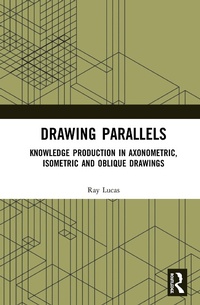
Drawing Parallels
Knowledge Production in Axonometric, Isometric and Oblique Drawings
1st Edition
Published on 29. April 2019
218 pages
978-1-317-14821-0 (ISBN)
Description

Drawing Parallels expands your understanding of the workings of architects by looking at their work from an alternative perspective. The book focuses on parallel projections such as axonometric, isometric, and oblique drawings. Ray Lucas argues that by retracing the marks made by architects, we can begin to engage more directly with their practice as it is only by redrawing the work that hidden aspects are revealed. The practice of drawing offers significantly different insights, not easily accessible through discourse analysis, critical theory, or observation.
Using James Stirling, JJP Oud, Peter Eisenman, John Hejduk, and Cedric Price as case studies, Lucas highlights each architect's creative practices which he anaylses with reference to Bergson's concepts of temporality and cretivity, discussing ther manner in which creative problems are explored and solved. The book also draws on a range of anthropological ideas including skilled practice and enchantment in order to explore why axonometrics are important to architecture and questions the degree to which the drawing convention influences the forms produced by architects.
With 60 black-and-white images to illustrate design development, this book would be an essential read for academics and students of architecture with a particular interest in further understanding the inner workings of the architectural creative process.
Using James Stirling, JJP Oud, Peter Eisenman, John Hejduk, and Cedric Price as case studies, Lucas highlights each architect's creative practices which he anaylses with reference to Bergson's concepts of temporality and cretivity, discussing ther manner in which creative problems are explored and solved. The book also draws on a range of anthropological ideas including skilled practice and enchantment in order to explore why axonometrics are important to architecture and questions the degree to which the drawing convention influences the forms produced by architects.
With 60 black-and-white images to illustrate design development, this book would be an essential read for academics and students of architecture with a particular interest in further understanding the inner workings of the architectural creative process.
More details
Edition
1. Auflage
Language
English
Place of publication
London
United Kingdom
Publishing group
Taylor & Francis Ltd
Target group
College/higher education
Illustrations
62 Line drawings, black and white; 3 Halftones, black and white; 70 Illustrations, black and white
ISBN-13
978-1-317-14821-0 (9781317148210)
Copyright in bibliographic data and cover images is held by Nielsen Book Services Limited or by the publishers or by their respective licensors: all rights reserved.
Schweitzer Classification
Other editions
Additional editions
Book
09/2020
1st Edition
Routledge
€55.70
Shipment within 15-20 days
Book
03/2019
1st Edition
Routledge
€206.20
Shipment within 10-20 days
Person
Ray Lucas is senior lecturer in architecture at the University of Manchester, where he served as head of department from 2014 to 2018.
Lucas has a PhD in social anthropology from the University of Aberdeen on A Theory of Notation as a Thinking Tool. From 2014 to 2018, Lucas was an associate researcher and external advisor for the ERC Advanced Grant Knowing From the Inside which worked between the disciplines of anthropology, fine art, design, architecture, and others in order to interrogate how we know our world.
Lucas is author of Research Methods for Architecture (Laurence King, 2016), Anthropology for Architects: Social Relations and the Built Environment (Bloomsbury 2019), and is coeditor of Architecture, Festival & the City (Roputledge 2018). Lucas' current research includes 'graphic anthropologies' on marketplaces in South Korea and urban festivals in Japan, as well as an interest in sensory design, film and architecture, anthropology and geometry, and further research into drawing.
Lucas has a PhD in social anthropology from the University of Aberdeen on A Theory of Notation as a Thinking Tool. From 2014 to 2018, Lucas was an associate researcher and external advisor for the ERC Advanced Grant Knowing From the Inside which worked between the disciplines of anthropology, fine art, design, architecture, and others in order to interrogate how we know our world.
Lucas is author of Research Methods for Architecture (Laurence King, 2016), Anthropology for Architects: Social Relations and the Built Environment (Bloomsbury 2019), and is coeditor of Architecture, Festival & the City (Roputledge 2018). Lucas' current research includes 'graphic anthropologies' on marketplaces in South Korea and urban festivals in Japan, as well as an interest in sensory design, film and architecture, anthropology and geometry, and further research into drawing.
Content
1. Introduction: Parallel Projections, Mimesis, and Intersections 2. James Stirling's Axonometric Traps 3. Modernism, scale, and Gesamkunstwerk in J. J. P. Oud 4. Occlusion and deliberately hidden lines: Hejduk's Wall House 5. Indeterminacy and Transfiguration: Hejduk's Multiple Projections 6. Axonometry as theoretical instrument: the case of Eisenman 7. Cedric Price's 'In Action' Drawings 8. Cognition, Image, and Embodiment 9. Conclusion: the Purpose of Drawing an Axonometric
